Meydan Racecourse: Inside Dubai's Temple of Horse Racing
Home to the Dubai World Cup, the world's richest horse race, Meydan Racecourse is a feat of engineering as much as a sporting venue. With a grandstand stretching around 1.6 kilometres and capacity for over 60,000 spectators, it operates on a scale that makes most European and American racecourses look modest. Here is what to expect when you visit.
Quick Facts
- Location
- Al Meydan Road, Nad Al Sheba, Dubai, UAE
- Getting There
- No direct metro. Taxi or ride-hailing (Careem/Uber) from Downtown Dubai takes around 10-15 minutes. On-site parking is available on race days.
- Time Needed
- 3-5 hours for a full race night; allow a full day for Dubai World Cup
- Cost
- General admission from around AED 5-40 on regular race nights; from AED 20 for Dubai World Cup general admission when bought in advance (verify before visiting)
- Best for
- Sports fans, first-time visitors wanting a uniquely Dubai spectacle, groups looking for a sociable evening out
- Official website
- dubairacingclub.com
What Meydan Racecourse Actually Is
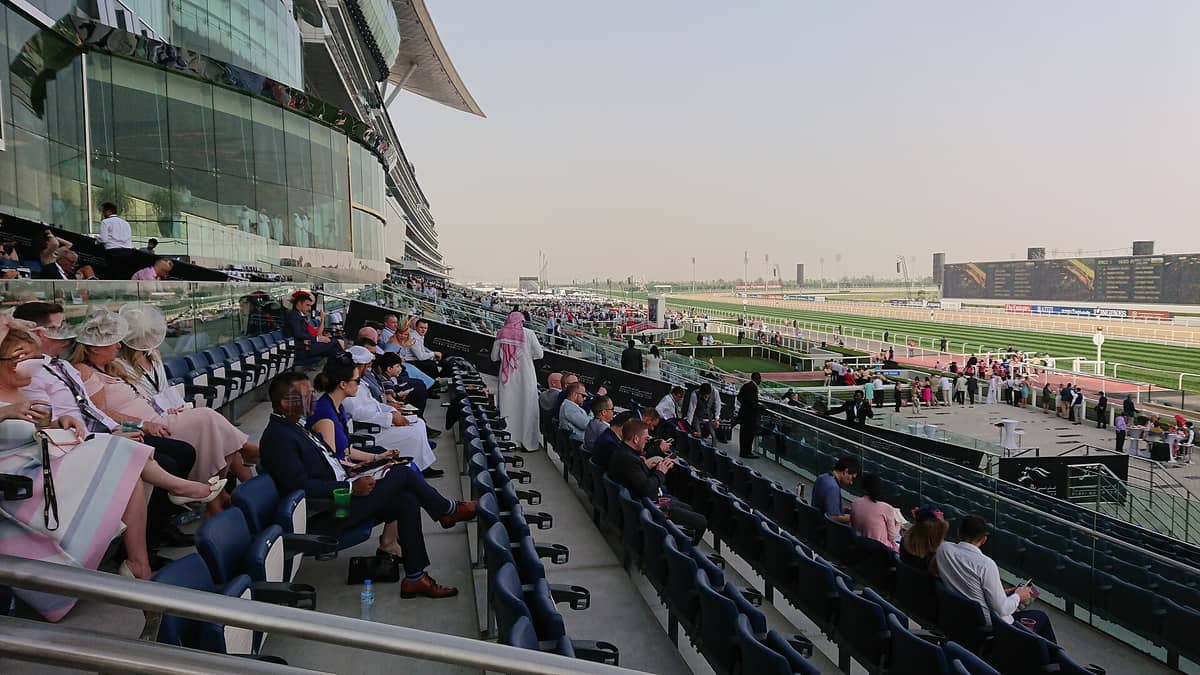
Meydan Racecourse opened in March 2010 on the site south of Downtown Dubai, replacing the former Nad Al Sheba Racecourse that had officially hosted race meetings since 1992. The scale of the replacement was extraordinary: where Nad Al Sheba was a functional provincial venue, Meydan was conceived as a statement. The main grandstand runs for approximately 1.6 kilometres, roughly the length of the entire straight at some circuits, and can accommodate over 60,000 spectators. It sits within the broader Meydan City development, a mixed-use district that includes hotels, retail, and residential towers, all anchored by the racecourse itself.
The track layout features two left-handed circuits: a 1,750-metre dirt track and a 2,400-metre turf track for flat racing. Most of the prestigious Dubai World Cup card is run on the dirt, which gives the meeting a different character from European equivalents, more reminiscent of American Grade 1 racing at Santa Anita or Churchill Downs than Ascot or Longchamp. Racing in Dubai is conducted under the authority of Dubai Racing Club, a name that appears on ticketing and official communications.
ℹ️ Good to know
Dubai Racing Club operates a seasonal race calendar, typically running from November through late March, aligned with Dubai's cooler months. Outside this season, the racecourse does not host live racing. Always check the official race calendar at dubairacingclub.com before planning your visit.
The Race Season and the Dubai World Cup
Regular race nights run from November through March, timed deliberately to avoid the extreme heat of the Gulf summer, when daytime temperatures regularly exceed 40 degrees Celsius. Evening meetings typically begin around 17:30, with gates usually opening about 90 minutes before the first race (often around 16:00), and the racing finishes well after dark. On a normal race night, the atmosphere is surprisingly relaxed: crowds are mixed, the grandstand rarely fills completely, and you can move freely between the apron, the parade ring, and the concourse areas.
The Dubai World Cup in late March is a different proposition entirely. First held in 1996, the meeting carries total prize money of roughly USD 30.5 million across the card, making it the world's richest race day. The World Cup itself, run over 2,000 metres on dirt, carries prize money of USD 12 million. Horses and connections travel from the United States, Japan, Europe, and Australia to compete. On World Cup day the grandstand fills properly, hospitality suites operate at full capacity, and the general admission areas become genuinely crowded by mid-afternoon.
If you are visiting Dubai specifically for racing, the World Cup represents the most complete spectacle, but it requires advance planning: tickets sell out in popular categories, and accommodation prices across the city rise for the occasion. A broader look at how to structure your time in the city is covered in our 3-day Dubai itinerary, which can help you work a race evening into a wider trip.
Tickets & tours
Hand-picked options from our booking partner. Prices are indicative; availability and final rates are confirmed when you complete your booking.
Three in one in Dubai: city tour, dhow cruise and desert safari
From 128 €Instant confirmationFree cancellationDubai day-tour with Burj Khalifa and Dubai Aquarium
From 146 €Instant confirmationFree cancellationMiracle Garden with transfers
From 81 €Instant confirmationFree cancellationHalf-day tour of Dubai and Burj Khalifa entrance ticket
From 113 €Instant confirmationFree cancellation
The Grandstand: Architecture and Atmosphere
The grandstand is the structural centrepiece, and seeing it for the first time is genuinely arresting. The building's curved glass-and-steel roof sweeps continuously along the full 1.5-kilometre length, lit at night from below so that it glows against the dark sky. From the apron directly in front of the track, the structure frames the far side of the course and the city skyline beyond it, creating a visual perspective that is specifically Dubai: controlled scale, high contrast, no rough edges.
Inside, the grandstand is divided into multiple levels with wide concourses, elevators, and escalators connecting them. The architecture supports flow well: even on busy nights, movement between areas does not feel congested until the biggest events. Restaurants and hospitality suites occupy the upper levels, while the ground-level apron gives the most immediate access to the track rail. The parade ring is positioned so that spectators can watch horses being walked and saddled before each race, which is one of the better unstructured viewing experiences available.
💡 Local tip
For photography, the best natural light is available in the 30 minutes around sunset, when the sky behind the grandstand turns warm and the track surface catches low-angle light. Bring a zoom lens: the track width means horses pass at distance during the early part of most races.
Tickets, Pricing, and What You Actually Get
Ticket categories span a wide range. On regular race nights, general admission is available from around AED 5 to AED 40 depending on the meeting and specific enclosure. For Dubai World Cup, published general admission prices have been set at AED 20 in advance for those aged 12 and over, and AED 10 for children aged 11 and under, though these figures should be verified directly with Dubai Racing Club before your visit as pricing is subject to annual change and race-day rates may be higher.
Family packages and premium hospitality options typically start from approximately AED 180-200 for family groupings and climb to AED 700 or more for premium positions during major events. General admission gives you access to the apron and main concourse areas, which is sufficient for a complete race-going experience. The premium tiers add table service, elevated viewing positions, and in some cases dedicated parking and entrance gates.
Children under five in pushchairs or strollers are admitted through Gate B during the race season without a paid ticket but with an access voucher collected from the Ticket Sales Office, and the wide concourse design accommodates families without significant difficulty. If you have specific mobility requirements, the venue has elevators and wheelchair-accessible areas, but it is worth contacting Dubai Racing Club directly in advance to confirm arrangements.
⚠️ What to skip
There is no direct Dubai Metro station within Meydan Racecourse. The nearest metro stations are on the Red Line in the Downtown/Business Bay area, still several kilometres away. Budget for a taxi or ride-hailing fare in both directions, and note that post-race departures can see queues. Booking a return ride in advance through Careem or Uber is advisable on busy nights.
What to Expect on a Race Night: Hour by Hour
Arriving around 16:00 to 16:30 gives you time to settle before the first race without feeling rushed. The apron in the first hour before racing is calm: you can examine the track surface, watch the groundstaff make final preparations, and find a good position at the rail. The parade ring begins filling with horses about 20 minutes before each race, and watching the pre-race routine up close is one of the things that separates a racecourse visit from watching sport on a screen.
Racing continues across six to eight races on a typical night, usually finishing between about 21:00 and 22:00. The crowd builds gradually through the evening as working hours end across the city. By the feature race, usually the fifth or sixth, the atmosphere has shifted: more people at the rail, louder reactions at the finish line, a sharper edge to the commentary. After the final race the crowd disperses quickly; the combination of direct car access and ride-hailing means the departure process moves faster than at many equivalent venues.
Dress code for standard race nights is smart casual. Dubai World Cup evening traditionally sees more formal attire, and premium hospitality areas often specify a smarter standard. The climate matters here: November through February evenings are genuinely pleasant, with temperatures in the low to mid-twenties Celsius, comfortable for outdoor standing. March evenings can push warmer, and by the time the World Cup arrives at the end of the month, temperatures can feel mild by global standards but warm if you are active. Light layers are rarely needed but a light jacket in January can be useful.
Meydan in Context: Dubai's Relationship with Horse Racing
Horse racing has an older connection to Gulf culture than many visitors realise, rooted in Arabian horse breeding traditions that stretch back centuries. Dubai's modern racing programme began in 1992 at Nad Al Sheba and grew rapidly under the patronage of Dubai's ruling family. The sport sits in an interesting position in the UAE: the racecourse is a public venue open to all visitors regardless of nationality, alcohol is served in designated hospitality and licensed areas (not freely across all public areas), and the crowd on any given night reflects the city's demographic breadth. You will find longtime racing enthusiasts from Europe and Australia, first-time visitors, local families, and groups using the evening as social entertainment rather than as a betting occasion. Visitors should note that betting facilities are not available at Meydan Racecourse and pari-mutuel wagering is not conducted on-site, so most attendees treat the evening as a social and sporting occasion rather than a betting-focused event. For a broader picture of how Dubai balances its social framework with tourism, the Dubai rules for tourists guide covers the relevant context.
The venue itself fits within a pattern of architectural ambition that defines Dubai's public landmarks. From the Burj Khalifa to the Museum of the Future, the city has a consistent habit of building at a scale designed to make an impression. Meydan does the same thing within the sporting category, and visiting it alongside other landmark sites gives a useful perspective on how Dubai has chosen to represent itself through built environment.
Honest Assessment: Is It Worth Your Time?
For visitors with any interest in horse racing, a Meydan race night during the season is straightforward value. Admission is inexpensive on regular nights, the venue is well-managed, the racing is competitive, and the setting is unlike any other racecourse in the world. The combination of the illuminated grandstand, the warm evening air, and the Dubai skyline visible beyond the far rail creates an atmosphere that is specific to this place.
For visitors with no interest in racing, the calculus is different. The Dubai World Cup has enough event energy to carry non-racing attendees through an afternoon, and the people-watching and spectacle are sufficient reasons to attend. A regular race night with no racing knowledge and no company can feel long, and the entertainment between races is limited compared to some high-profile meetings elsewhere. If your interest is primarily in an energetic Dubai night out, there are alternatives better suited to that goal.
Families with children generally find the venue more comfortable than expected. The space is generous, access is clear, and the pace of the evening is measured rather than relentless. Parents with young children who have limited patience for extended sitting should plan to explore the grandstand and apron areas rather than staying in one position. For other family-oriented activity options across the city, see our guide to Dubai with kids.
Insider Tips
- Check the Dubai Racing Club race calendar for "Super Saturday" meetings, which are held in the weeks leading up to the Dubai World Cup and feature Group 1 races with strong international fields, often with better crowd levels than the World Cup itself and significantly easier logistics.
- The apron area directly in front of the track rail is free to access with general admission and offers a closer racing experience than the grandstand seating. Position yourself 100-150 metres before the finish line for the best view of close finishes.
- On Dubai World Cup day, arrival by 13:00-14:00 is recommended if you want a rail position for the feature races. The general admission areas are not ticketed by specific seat, so early arrival is the only way to secure good viewing spots.
- Ride-hailing apps such as Careem and Uber work well for arrival but can show surge pricing immediately after the final race. Either book your return journey in advance or wait 20-30 minutes after racing ends for demand to ease.
- The ticket office at Meydan Grandstand is typically open Monday to Friday from 10:00-18:00, but purchasing online through Dubai Racing Club's website in advance is generally faster and allows entry through dedicated lanes.
Who Is Meydan Racecourse For?
- Horse racing fans seeking one of the world's most spectacular venues
- Travellers visiting Dubai in the winter season (November to March) looking for an evening activity with genuine local character
- Groups wanting a structured social outing with a built-in schedule and atmosphere
- Families with older children interested in sport or spectacle
- Photography enthusiasts drawn to architecture, motion, and striking nighttime light
Nearby Attractions
Combine your visit with:
- Al Mamzar Beach Park
Al Mamzar Beach Park is a sprawling 106-hectare public park on Dubai's northeastern coastline, offering multiple beaches, swimming pools, shaded lawns, and BBQ facilities for just AED 5 entry. It draws a loyal crowd of residents but sees far fewer tourists than the city's headline beach destinations, making it one of the more relaxed shoreline options in the emirate.
- Al Qudra Lakes
Al Qudra Lakes is a chain of human-made lakes set within the Al Marmoom Desert Conservation Reserve, roughly 55 km from central Dubai. Entry is free, the site is accessible throughout the year, and it offers something genuinely rare in this city: silence, open sky, and wildlife. It draws birdwatchers, cyclists, picnicking families, and anyone who needs a break from the urban pace.
- Alserkal Avenue
Alserkal Avenue transformed a stretch of Al Quoz warehouses into the UAE's most concentrated hub for contemporary art, independent cinema, design, and cultural programming. Entry is free, the galleries are genuinely good, and the experience feels nothing like the rest of Dubai.
- Aya Universe
AYA Universe is a large-scale immersive art installation inside Wafi City Mall, where 12 interconnected zones of light, sound, and sensory environments create an experience unlike any conventional attraction in Dubai. Plan around 90 minutes and book tickets in advance.