La Fontaine Park: The Plateau's Green Heart
La Fontaine Park (Parc La Fontaine) is a 35-hectare urban park in the Plateau-Mont-Royal neighborhood, open daily from 6 a.m. to midnight at no cost. With two large ponds, shaded pathways, an outdoor theatre, and a cross-section of Montrealers using it at all hours, it rewards a longer stay than most visitors plan for.
Quick Facts
- Location
- 3819 Avenue Calixa-Lavallée, Plateau-Mont-Royal, Montréal, QC H2L 3A7
- Getting There
- Sherbrooke (Orange Line) or Mont-Royal (Orange Line); several STM bus routes stop on adjacent streets
- Time Needed
- 1–3 hours depending on season and activities
- Cost
- Free (park admission); individual facilities may charge separately
- Best for
- Picnics, jogging, families, people-watching, autumn walks
- Official website
- montreal.ca/en/places/parc-la-fontaine
What La Fontaine Park Actually Is
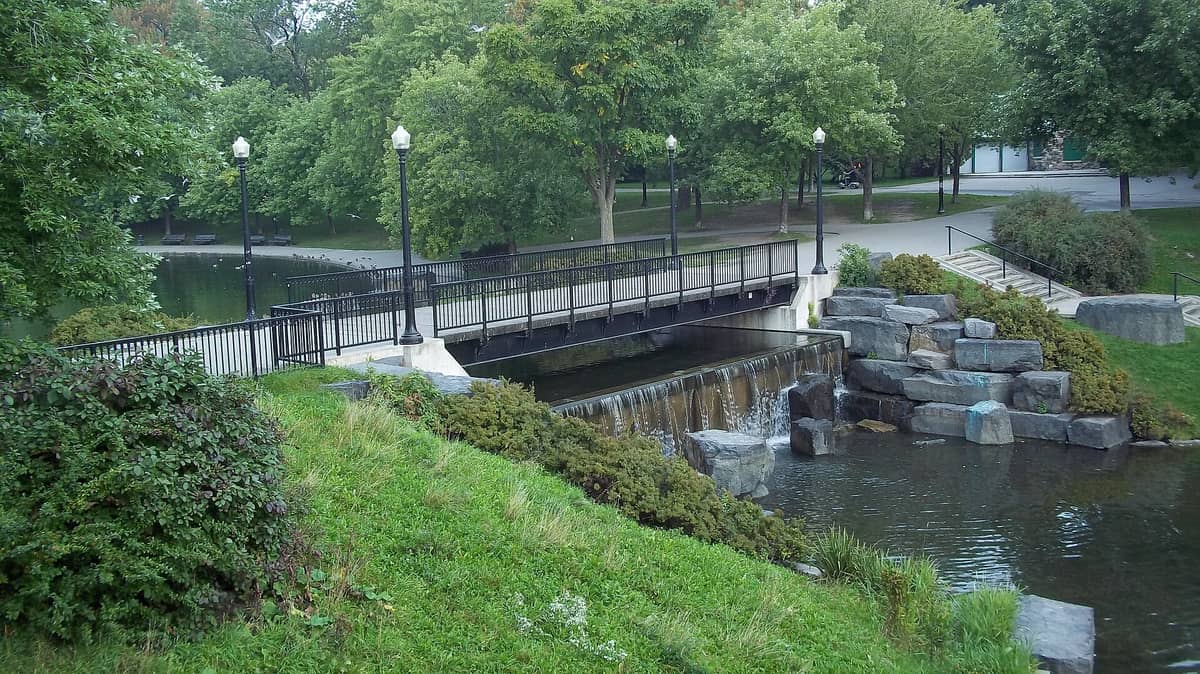
La Fontaine Park, known locally as Parc La Fontaine, sits at the eastern edge of the Plateau-Mont-Royal neighborhood and covers approximately 35 hectares of mixed green space. Two interconnected ponds anchor the central portion of the park, ringed by mature trees, gravel and asphalt paths, lawns, and a modest amount of infrastructure: public washrooms, a snack bar open in warm months, tennis courts, a wading pool, and the Théâtre de Verdure, an open-air stage that hosts free performances in summer.
The park’s origins date to 1874, when the city rented the Logan farm and began acquiring land around it, making it one of Montreal's older planned green spaces. The park’s two ponds were created in 1900, and its long history shows in the scale of the trees — the canopy along the main interior paths is dense enough that the park reads, in summer, almost like a woodland corridor running through the city grid.
ℹ️ Good to know
The park is open daily from 6:00 a.m. to midnight. There is no admission fee for general park access. Individual facilities such as sports courts or rental equipment may have separate fees or hours. Verify on-site or via the City of Montréal website before visiting.
How the Park Changes Through the Day
Early morning, from around 6 to 9 a.m., the park belongs almost entirely to people who live within walking distance. Joggers loop the outer paths in both directions; dog owners claim the grassy sections before leash rules are more strictly observed; and the air carries the clean, slightly vegetal smell of damp grass and pond water. It is genuinely quieter than the streets surrounding it, which makes the contrast with midday striking.
By late morning on weekdays, the park fills steadily with parents and young children, students from nearby schools, and anyone with a flexible schedule. The main east-west path running past the upper pond becomes a social corridor: people greet neighbors, dogs pull toward each other, and the ambient sound shifts from birdsong to conversation. On weekends, this builds to something closer to a full public gathering by midday, with blankets spread across the lawns and the snack bar drawing a line.
Late afternoon and evening are worth planning for separately. After 5 p.m. on warm evenings, the pond areas take on a noticeably softer quality as the light drops from the west and the tree canopy diffuses shadows across the water. The Théâtre de Verdure, situated at the north end of the park, draws audiences for its summer programming after dark. The surrounding paths are well-traveled but not crowded, and the park's midnight closing time means it remains accessible well into the evening.
Tickets & tours
Hand-picked options from our booking partner. Prices are indicative; availability and final rates are confirmed when you complete your booking.
Montreal evening cruise on the St. Lawrence River
From 54 €Instant confirmationFree cancellation3-hour e-bike guided tour in Montreal
From 68 €Instant confirmationFree cancellationWalking tour of Old Montreal
From 20 €Instant confirmationFree cancellationMontreal helicopter tour
From 156 €Instant confirmationFree cancellation
The Ponds and the Paths
The two ponds are the park's most recognizable feature. The upper pond is larger and hosts paddleboats seasonally; its surface on a still morning reflects the tree line and the old stone lampposts in a way that catches people mid-stride. In winter, when temperatures allow, both ponds are converted to free skating surfaces maintained by the city. The transformation is reliable enough that locals plan winter outings around it, though ice conditions vary year to year depending on temperature.
The path network is easy to navigate without a map. The main outer loop takes roughly 25 to 35 minutes at a casual pace. Interior paths connect to the pond viewing areas and to the various facilities scattered across the park. The surface is a mix of paved sections and compacted gravel; it is mostly flat, with gentle rises around the pond margins. Stroller access is generally good, and the park listing from the City of Montréal confirms stroller-friendly access along with a drop-off zone and reserved parking for permit holders.
💡 Local tip
For the best pond photography, arrive between 7 and 9 a.m. on weekdays. The light hits the water from the east, the paths are clear of crowds, and there is no competing noise. A clear morning in September or October, when the maples are turning, produces the most photogenic conditions.
Seasonal Shifts Worth Knowing
Summer is the park's peak season by visitor volume, but it is not necessarily the best time to visit unless you are specifically drawn to the Théâtre de Verdure programming or the pedal boat rental. July and August bring heat, and the exposed sections of the park around noon can feel considerably warmer than the shaded corridors. Humidity in Montreal's summer months averages temperatures around 18–22°C but spikes regularly into the high 20s; the tree cover along the main interior paths provides relief, but the open lawn areas do not.
September and early October represent the park at its most atmospheric. Montreal's autumn foliage peaks in this window, and La Fontaine Park's mix of maple and elm canopy produces a concentrated show of orange and yellow. The pond reflections in this period are particularly striking. Temperatures typically range from around 5°C to 17°C in autumn, making extended outdoor time comfortable with a layer.
Winter transforms the park into something quite different. When the ponds freeze, the city sets up the free outdoor skating rink with rental equipment available nearby. The park is significantly quieter in January and February — temperatures average around -9°C to -4°C — but Montrealers do use it year-round, and the snow-covered paths have a composed stillness that summer crowds cannot replicate. Dress in proper layers; the open sections of the park offer no wind protection.
Spring, particularly May, sees the park return to use rapidly. The combination of longer days, returning green, and mild temperatures (typically 4–13°C in spring) draws Plateau residents outdoors in force. If you are visiting Montreal in May, La Fontaine Park pairs well with the surrounding streets of the Plateau. For a broader picture of what the neighborhood offers, the Plateau-Mont-Royal neighborhood guide covers the area's character and key stops in detail.
Fitting La Fontaine Into Your Visit
The park's location in the Plateau makes it a natural add-on to several routes rather than a standalone destination requiring a dedicated trip. From the Sherbrooke metro station (Orange Line), the park is roughly a 10-minute walk north on Rue Amherst or Rue Papineau. The Mont-Royal metro station places you west of the park and gives you the option of walking through the Plateau's commercial streets — Rue Rachel, Avenue du Mont-Royal — before entering the park from the north or west.
Several STM bus routes also stop on the streets bordering the park; the 30 bus on Rue Sherbrooke is a useful east-west connection. For general transit orientation in Montreal, the guide to getting around Montreal covers metro lines, bus passes, and fare structure in full.
If you are spending more than a day in Montreal, the park integrates well into a Plateau-focused afternoon. The park sits close enough to the Plateau's café and restaurant strip that you can walk the ponds, cross Avenue Rachel, and settle into a meal within minutes. For a structured route that includes La Fontaine Park and nearby attractions, the 3-day Montreal itinerary offers a practical day-by-day framework.
The Théâtre de Verdure and Events
The Théâtre de Verdure is an outdoor amphitheatre set within the park's northern section. The city operates a summer performance program there, running typically from late June through August, with a mix of music, theatre, and dance. Performances are free and open to the public. The seating area fills on popular evenings, and it is worth arriving 20 to 30 minutes early for any advertised program. The programming schedule is published annually by the City of Montréal; check the city's cultural events calendar before your visit for current listings.
This kind of free outdoor programming fits into a broader pattern of accessible culture in Montreal. If you want to map out the city's free and low-cost options in advance, the free things to do in Montreal guide covers parks, events, and public spaces across the city.
Who Should Think Twice
La Fontaine Park does not have major architectural landmarks, world-class sports facilities, or ticketed attractions. If you are working through a short itinerary and prioritizing Montreal's most historically or culturally specific sites, the park may not justify the time. Visitors with only a day in the city will likely find more concentrated return at sites like the Plateau's commercial streets, or further afield in Old Montreal.
The park can also disappoint on a grey, rainy weekday outside of peak season when the facilities are closed and the paths are largely empty. It functions best as a social, atmospheric experience rather than a structured attraction, and the quality of that experience depends significantly on weather and the energy that other visitors bring to it.
Insider Tips
- The wading pool area is the most family-dense spot in summer; if you are visiting with young children, arrive before 11 a.m. to claim shaded ground nearby before it fills.
- The Théâtre de Verdure's programming is published on the City of Montréal's cultural events calendar, not always on the main park page — search for 'Théâtre de Verdure' directly on the city's website before your trip.
- The northwest corner of the park, near Avenue du Parc-La Fontaine, tends to be quieter than the main pond loop even at peak times. It's the best section for reading or a slow lunch.
- For winter skating, check the City of Montréal's park ice conditions page before heading out — the rink can be closed on short notice due to above-freezing temperatures or resurfacing.
- Rack your bike at the Bixi station on Rue Rachel at the park's north edge rather than locking to a tree or fence. The station is reliably stocked most of the day in warm months.
Who Is La Fontaine Park For?
- Plateau residents and travelers staying in the neighborhood who want an outdoor start or end to their day
- Families with young children looking for free, open green space with facilities
- Visitors in September or October wanting autumn foliage without the crowds of Mount Royal
- Runners and cyclists using the loop as part of a longer Plateau route
- Anyone wanting to experience local Montreal park culture rather than tourist infrastructure
Nearby Attractions
Other things to see while in Le Plateau-Mont-Royal:
- Écomusée du fier monde
Housed inside a former public bathhouse from the early 20th century, the Écomusée du fier monde tells the story of Centre-Sud's working-class communities through carefully curated exhibits. It's a small museum that delivers more than its size suggests in historical depth and architectural character.