Écomusée du fier monde: Montreal's Working-Class History in a Remarkable Bathhouse
Housed inside a former public bathhouse from the early 20th century, the Écomusée du fier monde tells the story of Centre-Sud's working-class communities through carefully curated exhibits. It's a small museum that delivers more than its size suggests in historical depth and architectural character.
Quick Facts
- Location
- 2050 Atateken Street, Montreal, QC H2L 3L8 (Centre-Sud / Plateau-adjacent)
- Getting There
- Berri-UQAM metro station (Green, Orange, Yellow lines), approx. 5-min walk via local streets
- Time Needed
- 1 to 2 hours
- Cost
- General admission $14; reduced and family rates available — verify current pricing at ecomusee.qc.ca
- Best for
- History lovers, architecture fans, French-Canadian culture seekers
- Official website
- ecomusee.qc.ca/en
What the Écomusée du fier monde Actually Is
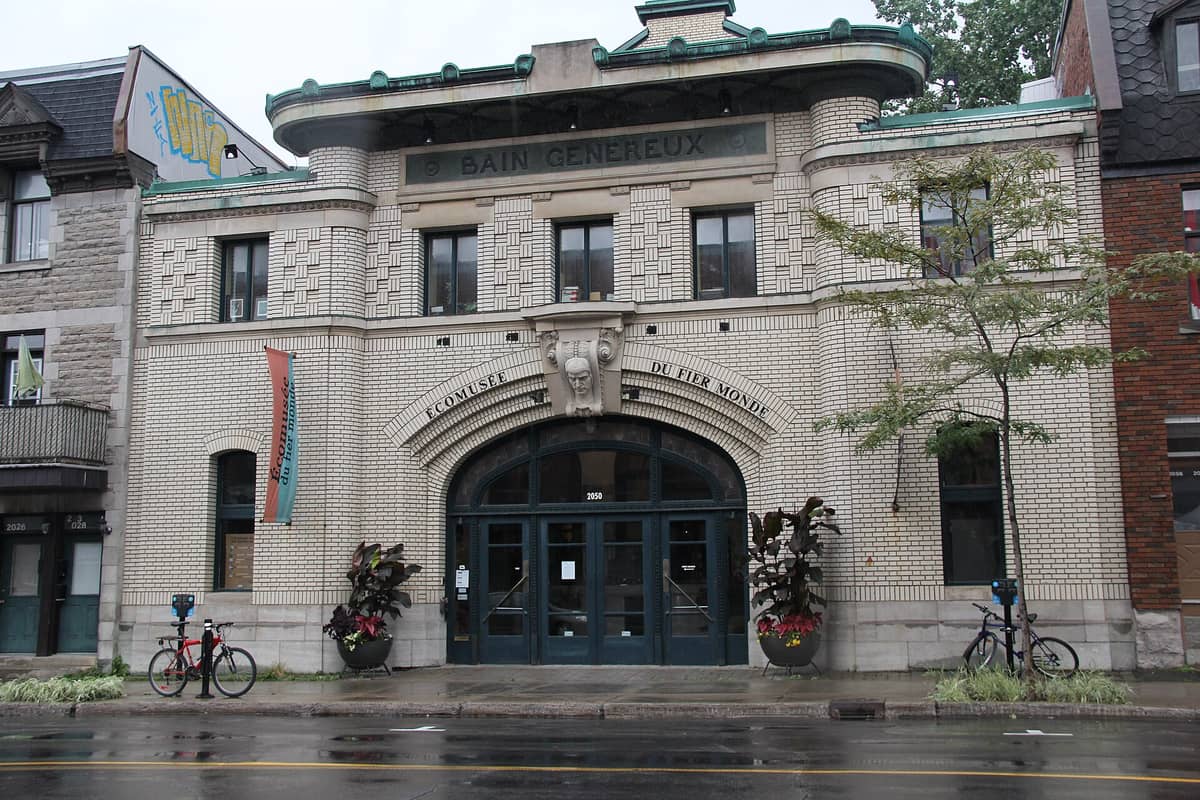
The Écomusée du fier monde is a community history museum that occupies the former Gohier public bath, a building constructed in the early 20th century to serve Montreal's working poor. At the time, access to hot water and proper bathing facilities was a class privilege, and municipal bathhouses like this one were civic infrastructure for people who had no such amenities at home. The building still carries that weight — and visiting it today, you can feel how the architecture was designed to give workers something dignified, even ceremonial.
The museum's focus is Centre-Sud, the neighbourhood that surrounds it: a historically dense, French-speaking, working-class district that sits just east of downtown Montreal. The exhibits trace the area's industrial past, its labour movements, its waves of immigration, and its community-driven transformation over the 20th century. 'Fier monde' is a Québécois expression meaning 'proud people' — and the museum wears that title earnestly, without sentimentality.
ℹ️ Good to know
The museum is open Wednesday to Sunday, 10:00 a.m. to 5:00 p.m., year-round, with the ticket office closing at 4:30 p.m. It is closed Monday and Tuesday. Always check ecomusee.qc.ca for holiday exceptions before visiting.
The Building: An Art Deco Bathhouse Worth Visiting on Its Own Terms
Before you read a single exhibit panel, stop and look at the space itself. The Gohier bath is an Art Deco structure with high ceilings, generous arched windows, and the kind of proportions that communicate civic seriousness. Light enters in long, controlled bands during the morning hours, falling across the interior at angles that make the original tile work and masonry look almost theatrical. By mid-afternoon, the quality of light shifts, and the space takes on a cooler, quieter tone.
The building's transition from functional public bath to museum has been handled with care. Structural features that recall its original use — the layout of the main hall, the rhythm of the changing rooms, the elevated gallery level — have been preserved and integrated into the exhibition design rather than erased. If you have any interest in Montreal's architectural history, this building earns attention alongside better-known landmarks.
For a broader look at how Montreal's built environment reflects its social history, the Montreal architecture guide offers useful context on the city's range of civic and industrial buildings from the same era.
Tickets & tours
Hand-picked options from our booking partner. Prices are indicative; availability and final rates are confirmed when you complete your booking.
Montreal evening cruise on the St. Lawrence River
From 54 €Instant confirmationFree cancellation3-hour e-bike guided tour in Montreal
From 68 €Instant confirmationFree cancellationWalking tour of Old Montreal
From 20 €Instant confirmationFree cancellationMontreal helicopter tour
From 156 €Instant confirmationFree cancellation
The Exhibitions: Labour, Community, and Neighbourhood Identity
The permanent collection focuses on the history of Centre-Sud from the late 19th century through the 20th. Exhibits cover the industrial workshops and factories that once defined the neighbourhood's economy, the labour unions and strikes that shaped its politics, the lives of working families in modest flats with shared courtyards, and the role of the Catholic Church in daily social life. Many of the objects on display — tools, photographs, domestic items, union documents — were gathered from the community itself, which gives the collection an intimate, non-institutional texture.
The museum also hosts temporary exhibitions, typically focused on Quebec social history, working-class culture, or community memory. These rotate and vary in scope. Some have addressed housing conditions, others the history of specific trades or cultural practices. The temporary gallery tends to be smaller than the permanent space, but the curatorial quality is generally consistent. Check the website before your visit to see what's currently on.
Most exhibit text is in French, which is entirely appropriate given the museum's subject matter and community focus. English summaries or bilingual panels are available in some areas, but this is not a museum designed primarily for English-speaking tourists. If your French is limited, you will still be able to appreciate the objects, photographs, and architectural space, but expect to miss some of the textual nuance.
💡 Local tip
If you read French even at an intermediate level, lean into it here. The exhibit writing is clear, direct, and rewards attention. It is not the kind of dense institutional French that defeats casual readers.
Visiting in Practice: What the Experience Feels Like Hour by Hour
The museum is compact. A focused visitor can move through the permanent collection in 45 to 60 minutes; someone who stops to read thoroughly, or who has a strong personal or academic interest in Quebec social history, will want closer to two hours. There is no café inside the museum, so plan accordingly if you are visiting midday.
Weekday mornings are the quietest time to visit. The museum rarely feels overcrowded, but on weekend afternoons it can attract school groups or guided tours that compress the space somewhat. The overall atmosphere is subdued and contemplative throughout the week. This is not a kinetic, interactive museum designed to hold children's attention for extended periods. Adults and older teenagers with genuine curiosity about urban social history will get the most from it.
The building is partially accessible to people with reduced mobility, and the museum states that assistance and service animals are permitted. Visitors with mobility considerations should contact the museum directly before visiting to confirm access details for specific areas. The address is 2050 Atateken Street, at the corner of Ontario Street, and the nearest metro stop — Berri-UQAM — is roughly a five-minute walk via the surrounding streets.
⚠️ What to skip
The museum is listed as partially accessible, not fully. Some areas of the historic building may present challenges for visitors using wheelchairs or mobility aids. Call ahead at 514-528-8444 if this affects your visit.
Who This Museum Is For — and Who Might Find It Underwhelming
The Écomusée du fier monde rewards visitors who come with a genuine interest in how ordinary people lived, worked, and organized in a 20th-century North American city. It is particularly well-suited to anyone trying to understand Montreal beyond its most photographed neighbourhoods and tourist corridors. Centre-Sud is not a district that appears prominently in most travel itineraries, and this museum is one of the most honest windows into the city's francophone, working-class majority that you will find.
Visitors who are primarily looking for large-scale collections, blockbuster temporary exhibitions, or the kind of polished international programming found at the Montreal Museum of Fine Arts will likely find this museum too small and too locally specific. That is not a criticism — it is simply a different kind of institution, built for different purposes.
Travellers on a budget will appreciate that C$14 is a reasonable price for what the museum offers, and it fits naturally into a broader day of low-cost cultural exploration. For more options in that direction, the free things to do in Montreal guide includes several nearby alternatives.
The Neighbourhood Around the Museum
The area around 2050 Atateken Street is part of Centre-Sud, a neighbourhood that sits just south and east of the Plateau-Mont-Royal. It is a genuinely residential part of the city, not a tourist precinct, which means the streets around the museum are lined with corner depanneurs, modest restaurants, and the kind of everyday urban texture that most visitors to Montreal never see.
The museum is also within easy reach of the Gay Village, which begins a few blocks to the east along Sainte-Catherine Street East. If you are spending a half-day in this part of the city, the museum pairs naturally with a walk through either the Village or the lower edges of the Plateau, where the density of coffee shops and local restaurants makes it easy to extend your time without planning much.
The Berri-UQAM metro station, your likely point of arrival, is one of Montreal's major interchange stations, connecting the Green, Orange, and Yellow lines. From there, the rest of the city is straightforwardly accessible. For a broader overview of how to move around Montreal by public transit, the getting around Montreal guide covers the STM metro and bus network in useful detail.
Insider Tips
- Visit on a Wednesday or Thursday morning if your schedule allows. The museum is at its quietest then, and the light through the original windows in the main hall is at its most striking before noon.
- Ask at the front desk about guided tours or interpretation sessions. When they are available, the museum staff tend to be unusually knowledgeable about Centre-Sud's social history and willing to go beyond what the panels say.
- The museum shop is small but thoughtful. It carries books and publications on Quebec labour history and Montreal's francophone working-class neighbourhoods that are not easy to find elsewhere.
- If you are researching a specific topic — family history, trade unions, the history of a particular street or building in Centre-Sud — contact the museum's archival resources in advance. The Écomusée has community documentation that goes beyond what is displayed.
- Combine your visit with a walk along Ontario Street East heading toward the Plateau. The street has a different character from the more photographed commercial strips of the Plateau, and it reflects the neighbourhood the museum describes.
Who Is Écomusée du fier monde For?
- Travellers who want to understand Montreal's francophone, working-class history beyond the tourist highlights
- Architecture enthusiasts interested in early 20th-century civic and Art Deco building traditions
- Visitors with a background in labour history, urban sociology, or Quebec studies
- Anyone spending a half-day in the Berri-UQAM and Centre-Sud area looking for a substantive cultural stop
- Culturally curious travellers who speak French, or who want to engage with exhibits in the language they were designed for
Nearby Attractions
Other things to see while in Le Plateau-Mont-Royal:
- La Fontaine Park
La Fontaine Park (Parc La Fontaine) is a 35-hectare urban park in the Plateau-Mont-Royal neighborhood, open daily from 6 a.m. to midnight at no cost. With two large ponds, shaded pathways, an outdoor theatre, and a cross-section of Montrealers using it at all hours, it rewards a longer stay than most visitors plan for.