Jean-Talon Market: Montreal's Greatest Public Market
Open since 1933, Marché Jean-Talon is the largest public market in Montreal and one of the most respected in North America. Sitting at the heart of Little Italy, it draws locals and visitors alike with exceptional produce, specialty food vendors, and a sensory experience that changes with every season.
Quick Facts
- Location
- 7070 Henri-Julien Ave, Little Italy, Montréal, QC H2S 3S3
- Getting There
- Jean-Talon Metro station (Orange and Blue lines), a short walk away. Paid parking on site.
- Time Needed
- 1 to 2 hours for a thorough visit; longer if you plan to eat on site
- Cost
- Free entry. Food and goods priced by individual vendors in CAD.
- Best for
- Food lovers, photographers, families, slow mornings, seasonal ingredient shopping
- Official website
- www.marchespublics-mtl.com/en/markets/jean-talon-market
What Jean-Talon Market Actually Is
Marché Jean-Talon, known in English as Jean-Talon Market, is a It was inaugurated in May 1933 and was originally created to supply the local population with fresh, local agri-food products. Today, it remains a working public market where professional chefs, home cooks, and neighbors come to buy from vendors.
The market occupies a distinct block in Little Italy, a neighborhood with deep Italian and more recent immigrant roots. That context matters: the vendors and the surrounding streets reinforce each other. After picking up tomatoes, basil, and fresh ricotta at the market, you can walk two blocks in any direction and find trattorias, espresso bars, and specialty grocery stores that complete the picture.
ℹ️ Good to know
Hours: Monday to Saturday, 8:00 a.m. to 6:00 p.m. Sunday, 8:00 a.m. to 5:00 p.m. The market is open year-round but closes December 25–26 and January 1–2. Hours may vary on other holidays; check the official site before visiting.
The Sensory Experience, Season by Season
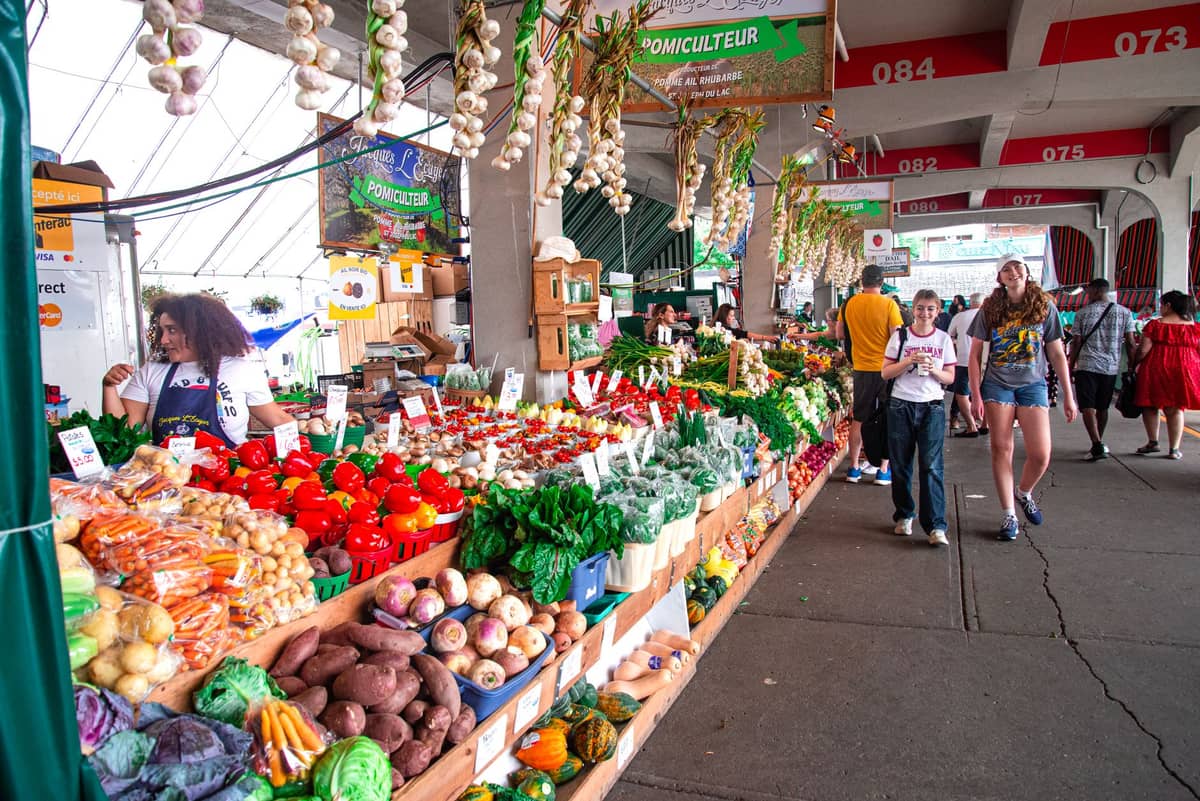
Summer is when Jean-Talon reaches its peak. From late June through October, the outdoor stalls overflow with produce: bright stacks of heirloom tomatoes, baskets of wild blueberries, sweet corn, squash, and peppers in every color imaginable. The smell on a warm Saturday morning is remarkable — ripe strawberries from Quebec farms mix with bundles of fresh herbs and the faint sweetness of stone fruit browning at the edges. The ground-level stalls are covered by a metal canopy structure, which keeps vendors protected but keeps the atmosphere open and airy rather than enclosed.
Autumn brings a different quality. The colors shift toward orange and deep red: enormous pumpkins, late-harvest apples, cider, dried flowers, and the last of the season's tomatoes. The crowd tends to be slightly smaller and noticeably more local. By November, the outdoor displays thin out, but the market does not close. Indoor and semi-covered vendors continue through winter with root vegetables, imported produce, local cheeses, cured meats, dried legumes, and specialty foods that keep regular shoppers coming back every week.
In winter, visiting Jean-Talon requires more intention, but it rewards it. The covered sections feel warm and close, with the sharp smell of aged cheese and smoked fish cutting through the cold air drifting in from outside. It is a reminder that this is a functional institution, not just a fair-weather amenity.
Tickets & tours
Hand-picked options from our booking partner. Prices are indicative; availability and final rates are confirmed when you complete your booking.
Montreal evening cruise on the St. Lawrence River
From 54 €Instant confirmationFree cancellation3-hour e-bike guided tour in Montreal
From 68 €Instant confirmationFree cancellationWalking tour of Old Montreal
From 20 €Instant confirmationFree cancellationMontreal helicopter tour
From 156 €Instant confirmationFree cancellation
How the Market Is Laid Out
The market divides into a central outdoor courtyard surrounded by a partially covered perimeter structure. The courtyard stalls, operated seasonally by farmers and small producers, are the most photogenic part of the market: long rows of wooden tables loaded with produce, flowers, and plants. The perimeter contains more permanent vendors, including butchers, fishmongers, fromageries, bakeries, and specialty retailers selling olive oils, spices, chocolates, local wines, and Quebec craft products.
A useful strategy for first-time visitors is to do a full loop of the perimeter first to see what is available and where, then move inward toward the outdoor stalls. Prices and quality vary noticeably between vendors for the same produce, so it is worth walking the full circuit before committing to your first purchase.
Several prepared food counters operate inside the market, selling ready-to-eat items including rotisserie chicken, takeaway sandwiches, pastries, and specialty items. For a broader picture of Montreal's food market landscape, see the guide to the best markets in Montreal, which covers Jean-Talon alongside Atwater Market and other options across the city.
Timing Your Visit
Weekday mornings between 8:00 a.m. and 10:00 a.m. are the calmest time to visit. The light is good for photography, vendors are restocking, and the crowd is mostly regulars who move efficiently and know what they want. If you want a slower, more observational experience, arriving early on a Tuesday or Wednesday gives you nearly the whole market to yourself.
Saturday mornings are the most alive but also the most congested. By 10:00 a.m., the outdoor courtyard can be genuinely crowded, with strollers, shopping carts, and shoulder-to-shoulder lines at popular vendors. The atmosphere is electric in summer but can feel overwhelming if you are not prepared for it. If crowds bother you, Sunday mornings offer a good compromise: busy enough to feel lively, but the shorter operating hours (closing at 5:00 p.m.) mean the mid-morning window is less compressed than Saturday.
💡 Local tip
Bring a reusable bag or basket. The market sells them, but prices are higher than bringing your own. If you plan to buy cheese or meat, a small cooler bag is worth having in summer, especially if you are traveling back by metro.
Getting There
The Jean-Talon Metro station on the Orange and Blue lines is the most straightforward option. From there, the market is a short walk. If you are coming from downtown, the Orange Line runs directly north and the trip takes roughly 15 to 20 minutes depending on your starting point. For a broader overview of navigating the city by transit, the covers metro lines, bus routes, and cycling infrastructure in detail. From there, the market is a short walk. If you are coming from downtown, the Orange Line runs directly north and the trip takes roughly 15 to 20 minutes depending on your starting point. For a broader overview of navigating the city by transit, the getting around Montreal guide covers metro lines, bus routes, and cycling infrastructure in detail.
Cycling is also a practical option. Jean-Talon Market is close to several cycling routes, and the surrounding streets are relatively bikeable. Montreal's BIXI bike-share stations are near the market. If you are spending a morning in Little Italy and the market, a bike makes it easy to extend the trip into Mile End afterward. Paid underground and outdoor parking is available for those arriving by car.
What to Buy: Practical Guidance
Quebec's growing season is short and intense, which means summer produce at Jean-Talon is exceptional but moves fast. The market is especially known for its strawberries in June and July, blueberries from Lac-Saint-Jean in late summer, sweet corn from regional farms in August, and apple varieties in September that do not appear in supermarkets. These are not specialty items at inflated tourist prices: they are competitively priced local produce sold by the people who grew them.
For non-produce purchases, the fromageries carry a solid selection of Quebec cheeses, some of which are genuinely difficult to find outside the province. Local cheesemakers produce washed-rind and soft varieties that do not travel well and are best bought close to the source. The specialty food shops along the perimeter carry Quebec maple products, ciders, and local hot sauces, all of which make practical gifts that are specific to the region rather than generic.
If you want to eat at the market rather than cook with your purchases, there are vendors selling prepared food and snacks throughout. The surrounding neighborhood also offers strong options. Montreal's food culture is well represented in Little Italy, and a late-morning meal at a nearby café or trattoria is a natural extension of a market visit.
Photography and Practical Notes
The outdoor stalls offer excellent conditions for food photography in natural light. The metal roof structure over the perimeter can create mixed lighting, with patches of direct sun and shade depending on time of day. Early mornings in summer produce the softest light in the courtyard. Midday light in summer is harsh but gives saturated colors on produce. Vendors are generally tolerant of photography, but it is courteous to ask before photographing people directly.
Accessibility: the market is listed as accessible, with paved surfaces through most areas. The outdoor courtyard can be uneven in sections, and heavy weekend crowds make maneuvering with mobility aids or strollers more challenging. The covered perimeter sections are the most consistently navigable.
⚠️ What to skip
In wet weather, the outdoor stalls remain open but the ground can become slippery. Wear shoes with grip, not sandals or dress shoes, if rain is forecast. In winter, the courtyard may be partially closed; the covered vendors continue to operate.
Who Might Not Enjoy This
If you are not interested in food shopping or cooking, Jean-Talon Market offers limited entertainment beyond the sensory atmosphere. It is not a spectacle in the way that some markets are: there is no live music, few artisanal crafts, and no particular performance to watch. Visitors who want a market experience oriented around gifts, clothing, or antiques will find more variety at other Montreal markets. In winter, the reduced outdoor stalls mean the experience is significantly quieter and more functional, which may disappoint visitors expecting the full summer abundance.
Insider Tips
- The courtyard producers and the perimeter retailers often sell the same ingredient at different price points. A wedge of aged cheddar from a perimeter cheese shop may cost more than the equivalent from a producer's stall in the courtyard. Walk the full market before buying.
- Quebec strawberries, available at the market from roughly late June, have a short season and are noticeably different from supermarket imports: smaller, darker, and intensely fragrant. If they are in season when you visit, buy them on the same day you plan to eat them.
- The market has a flower section with cut flowers and potted plants at competitive prices. If you are staying in an apartment or rented accommodation, a bunch of market flowers is a genuinely affordable way to make a space feel less generic.
- Several of the specialty food vendors accept credit card but some outdoor stall producers prefer cash. Having some Canadian dollars available saves friction, especially at busy periods when vendors may be less patient with declined terminals.
- If you want the full Little Italy experience, pair the market with a walk north along Saint-Laurent Boulevard or east along Jean-Talon Street after your visit. The concentration of Italian restaurants, cafés, and specialty grocers in the surrounding blocks gives context to what you have just seen inside the market.
Who Is Jean-Talon Market For?
- Food-focused travelers who want to cook or eat locally sourced Quebec ingredients
- Photographers looking for strong natural-light food and market scenes in summer
- Families with children who can handle crowds and benefit from the open outdoor layout
- Visitors interested in Quebec food culture and regional producers beyond restaurants
- Travelers combining a morning visit with a walk through Little Italy and the surrounding neighborhoods