Fulton Market Dining District: Chicago's Most Transformed Neighborhood
Once the beating heart of Chicago's meatpacking industry, the Fulton Market District has become the city's most talked-about stretch of restaurants, bars, and design hotels. The old cold-storage buildings and loading docks are still there — they just serve as backdrops for tasting menus and natural wine bars now.
Quick Facts
- Location
- West Loop, Chicago — centered on W. Fulton Market, W. Randolph St., and N. Green St.
- Getting There
- CTA Green/Pink Lines to Morgan station; CTA Blue Line to Grand or UIC–Halsted
- Time Needed
- 2–4 hours for dinner and drinks; a full afternoon-into-evening for serious exploration
- Cost
- Free to walk; dining ranges from $15 casual bites to $200+ per person at top tasting-menu restaurants
- Best for
- Serious food travelers, date nights, and anyone who wants to understand modern Chicago
- Official website
- www.fultonmarketdistrict.com
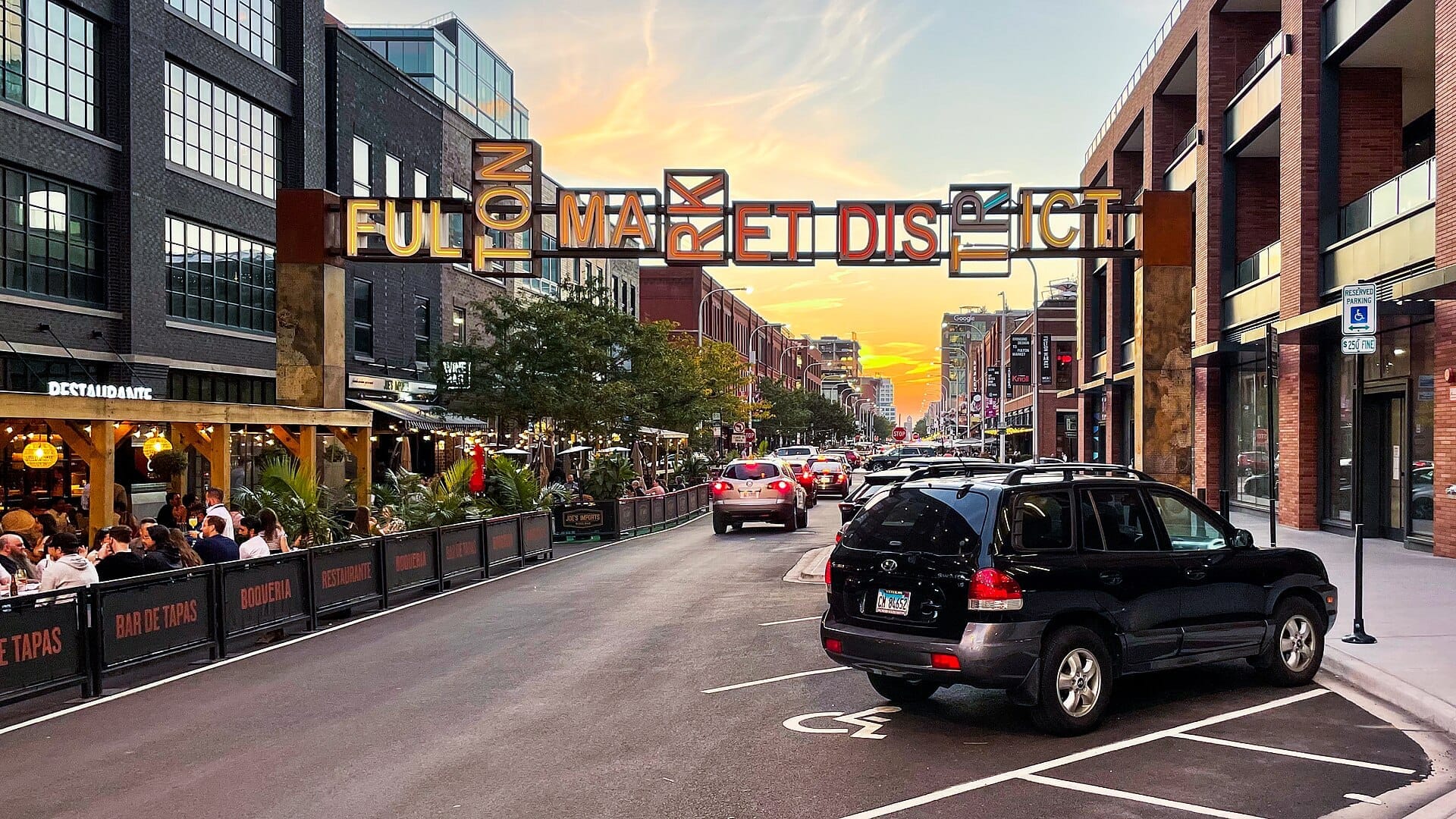
What Fulton Market Actually Is
The Fulton Market District is a roughly multi-block corridor in Chicago's West Loop that has spent the last decade becoming one of the most concentrated dining destinations in the United States. The area centers on W. Fulton Market street and bleeds into W. Randolph Street to the south, N. Green Street, and N. Sangamon Street. It is a public neighborhood — no gate, no ticket, no curated experience imposed from above. You walk in, and you figure out what you want.
What makes it worth understanding is the physical context. These are not purpose-built restaurant buildings. The facades are former meat processing plants, cold-storage warehouses, and distributor loading docks dating back to an industrial presence that goes at least to 1880. By the mid‑20th century, Fulton Market was a major hub for meatpacking and food distribution, with major packers such as Armour and Swift operating nearby in Chicago’s stockyards era. That industrial skeleton — the high ceilings, the exposed brick, the wide freight corridors — gives the restaurant interiors a texture that newer dining districts in other cities simply cannot replicate.
ℹ️ Good to know
Fulton Market is a neighborhood, not a venue. There is no single entrance, no wristband, and no operating hours. Restaurants open and close on their own schedules, so always check hours directly with individual spots before making the trip.
A Brief History: From Pigs to Prix Fixe
The story of Fulton Market is essentially a story about what happens to industrial land when food production moves out of cities. The area developed as a produce and market district along W. Randolph Street in the mid‑19th century, feeding a rapidly growing Chicago. The meatpacking operations that followed in the twentieth century gave the district its gritty infrastructure and, eventually, a lingering smell that kept real-estate prices low long after the last processing plant closed.
That low price per square foot attracted early restaurant risk-takers in the 2010s. Once a handful of ambitious chefs established footholds, the neighborhood's identity shifted quickly. Hotel development followed the restaurants. Tech offices moved into the converted warehouses. The district now markets itself as Chicago's intersection of food, design, commerce, arts, and culture — a characterization that is both accurate and slightly breathless. The bones are industrial. The ambitions are metropolitan.
For a deeper read on how Chicago's neighborhoods absorb and transform industrial infrastructure, the Chicago architecture guide provides useful context on the city's broader conversion of working-class building stock.
Tickets & tours
Hand-picked options from our booking partner. Prices are indicative; availability and final rates are confirmed when you complete your booking.
Go City | Chicago All-Inclusive Pass
From 127 €Instant confirmationFree cancellationiFLY Chicago Lincoln Park indoor skydiving experience
From 126 €Instant confirmationFree cancellationiFLY Chicago Rosemont indoor skydiving tickets
From 117 €Instant confirmationFree cancellationChicago lakefront neighbourhood bike tour
From 18 €Instant confirmationFree cancellation
The Dining Landscape: What You Actually Find Here
Fulton Market has attracted a genuinely wide range of operators, from the kind of tasting-menu restaurants that require reservations weeks in advance to casual lunch spots for the tech workers who now populate the neighborhood's offices during the day. The concentration is high enough that you can walk a single block and pass a Japanese izakaya, a wood-fired Italian osteria, a craft cocktail bar converted from a loading dock, and a specialty coffee roaster.
W. Randolph Street, the southern edge of the district, has the longest-established dining corridor and is where you find some of the city's most reliably reviewed restaurants. Fulton Market street itself skews newer, with more design-forward interiors and a higher concentration of destination-dining spots that have attracted national attention. The difference in atmosphere between the two streets is real: Randolph feels like a neighborhood that grew into its reputation, while Fulton Market feels like it is still performing.
For a broader view of where this neighborhood sits in Chicago's food landscape, the Chicago food guide maps out the major eating districts across the city.
💡 Local tip
If you want tasting-menu or highly rated spots, book at least two to three weeks ahead, particularly for weekend evenings. Walk-in seats at the bar are often your best same-day option at busier restaurants.
How the District Changes by Time of Day
Fulton Market has a distinct rhythm that is worth understanding before you decide when to visit. During weekday mornings and early afternoons, the streets feel almost residential — coffee shops doing steady trade, the occasional delivery truck still using the old loading bays, and office workers moving between buildings. This is a fine time to walk the area and get a sense of the architecture without contending with crowds.
By late afternoon, the shift begins. Restaurant staff start prep, lights come on in dining rooms, and the first early diners arrive around 5:30 p.m. The street noise changes: less truck traffic, more conversation spilling out of open doors. Between 7 and 9 p.m. on weekends, this is one of the louder and more kinetic stretches of Chicago — the combination of high ceilings, hard surfaces, and dense foot traffic creates a level of noise that some people find exciting and others find exhausting. If you are sensitive to noise, earlier seatings are meaningfully more comfortable.
On weekend nights after 10 p.m., the bar crowd takes over from the dining crowd. The sidewalks fill up, rideshare pickups create brief bottlenecks on narrower side streets, and the whole district takes on a more loosely organized late-night energy. It rarely feels unsafe, but it is distinctly different from the focused, culinary atmosphere of the earlier evening.
Getting Here and Getting Around
The CTA Green and Pink Lines both stop at Morgan station, which deposits you at the northeast edge of the district. From there, the main restaurant streets are a short walk south and west. The ride from downtown Loop stations typically takes about 5 to 10 minutes on the Green or Pink Line. Given the rideshare congestion on weekend evenings, the train is often the faster option even if a car seems more convenient on paper.
Street parking exists but is competitive, particularly after 6 p.m. Several parking garages operate in the immediate area. If you are driving from outside the city, arriving before 5:30 p.m. gives you a significantly easier time finding a space. The district is compact enough to walk entirely on foot once you arrive — there is no meaningful advantage to having a car once you are in the neighborhood.
If you are still sorting out how to move around Chicago more broadly, the getting around Chicago guide covers CTA fares, the L system, and rideshare logistics in detail.
💡 Local tip
Wear shoes you can walk in. The streets in the district mix newer pavement with original cobblestone and rough freight-bay surfaces. Heels are a common regret.
What the Experience Actually Feels Like
Walking Fulton Market during dinner service on a Friday evening involves a particular combination of stimuli that is hard to replicate elsewhere in Chicago. The smell shifts block by block: wood smoke from open-fire kitchens, garlic and butter from Italian spots, the faint industrial metallic undertone that still clings to some of the older building exteriors. The sound is layered — kitchen exhaust fans, bass from bar playlists, and the particular acoustic ring of a dining room full of voices bouncing off brick and concrete.
The architectural contrasts are constant. A century-old meat warehouse facade might have a floor-to-ceiling glass installation running along its ground floor. A converted cold-storage building might be serving a six-course tasting menu under original freight hooks. These juxtapositions are not accidental — the district's identity depends on that tension between the rough and the refined. It works, mostly, and it gives the neighborhood a visual character that is genuinely specific to Chicago's history rather than generic urban-renewal imagery.
What it does not feel like is quiet or intimate. If you are looking for a still, reflective dining experience, Fulton Market is probably not your destination. The baseline energy is high, the design is often theatrical, and the whole district has the self-consciousness of a neighborhood that knows it is being watched. That is a feature for some visitors and a reason to look elsewhere for others.
If a more relaxed evening meal is what you are after, neighborhoods like Lakeview or Wicker Park and Logan Square offer comparable quality with considerably less scene-consciousness.
Practical Notes for Visitors
There is no admission to enter the neighborhood itself. Every dollar you spend here goes directly to individual restaurants, bars, and shops. Prices across the district span a genuinely wide range: a casual lunch or a bar snack can cost the same as anywhere in the city, while high-end tasting menus with beverage pairings can reach $200 or more per person. Budget visitors can eat well here at lunch; dinner at flagship spots requires real planning and real spending.
Tipping follows standard American custom: 18 to 20 percent is expected at table-service restaurants, and bartenders typically receive $1 to $2 per drink or 20 percent on a tab. This is not optional in a social sense — service staff wages in Illinois, as across the U.S., are structured with the expectation of gratuity.
The district is walkable and the streets meet standard urban accessibility requirements with curb cuts and crosswalks. Individual restaurants vary in their interior accessibility, so if this is a concern, contacting venues directly before visiting is worthwhile. On weekend evenings the sidewalks are crowded enough that navigation can be slow, which is relevant for anyone with mobility considerations.
⚠️ What to skip
Reservations are not optional at the district's most popular restaurants. Same-day walk-ins at well-regarded spots are difficult on weekend evenings. If your itinerary depends on a specific restaurant, book before you arrive in Chicago.
Insider Tips
- Lunch on a weekday is the best-kept secret in Fulton Market. Many of the same high-quality kitchens offer abbreviated lunch menus at a fraction of the dinner price, and the streets are calm enough to actually appreciate the architecture.
- The Morgan CTA stop drops you at the edge of the district, but walking one block west to N. Morgan Street and then south gives you a better entry experience than emerging directly onto the busier Randolph Street corridor.
- If you want a bar seat at a restaurant that doesn't take reservations for the bar, arrive at opening time (typically 5 p.m.) and claim your spot. The same seat that's unavailable at 7:30 p.m. is often empty at 5:05.
- The district is loudest and most crowded between 7 and 9:30 p.m. on Friday and Saturday. If you want the same restaurants in a noticeably calmer setting, Sunday evenings and weekday evenings offer the same menus with lower noise floors and shorter waits.
- Several of the best cocktail bars are on side streets off Fulton Market and Randolph, not on the main strips. Walking one block north or south of the primary corridors often reveals less-trafficked spots with comparable quality.
Who Is Fulton Market Dining District For?
- Food-focused travelers who want to understand what is currently happening in American restaurant culture
- Couples looking for an energetic, design-forward evening that doubles as genuine sightseeing
- Chicago visitors on a second or third trip who have already done the traditional itinerary
- Anyone interested in adaptive reuse architecture and how industrial buildings get second lives
- Groups where everyone is genuinely interested in food and the logistics of coordinating dinner reservations
Nearby Attractions
Other things to see while in West Loop & Fulton Market:
- United Center
The United Center is one of the largest indoor arenas in North America and home to both the Chicago Bulls and Chicago Blackhawks. Whether you're attending an NBA playoff game, an NHL matchup, or a major concert, this West Side venue delivers a full-scale spectacle that rewards planning with a far better experience.