Fremantle Markets: What to Expect, When to Go, and How to Make the Most of It
Occupying a restored 1897 heritage hall in the heart of Fremantle, the Fremantle Markets run every Friday through Sunday with free entry. More than 170 stalls sell fresh produce, handmade crafts, street food, vintage clothing, and artisan goods under one ornate roof.
Quick Facts
- Location
- 74 South Terrace, Fremantle WA 6160 (corner of Henderson Street)
- Getting There
- Fremantle Train Station, approx. 10-minute walk; also accessible by bus, bicycle, or on foot
- Time Needed
- 1.5 to 3 hours
- Cost
- Free entry; individual vendor purchases extra
- Best for
- Foodies, craft shoppers, families, and anyone wanting to absorb Fremantle's character
- Official website
- fremantlemarkets.com.au
What the Fremantle Markets Actually Are
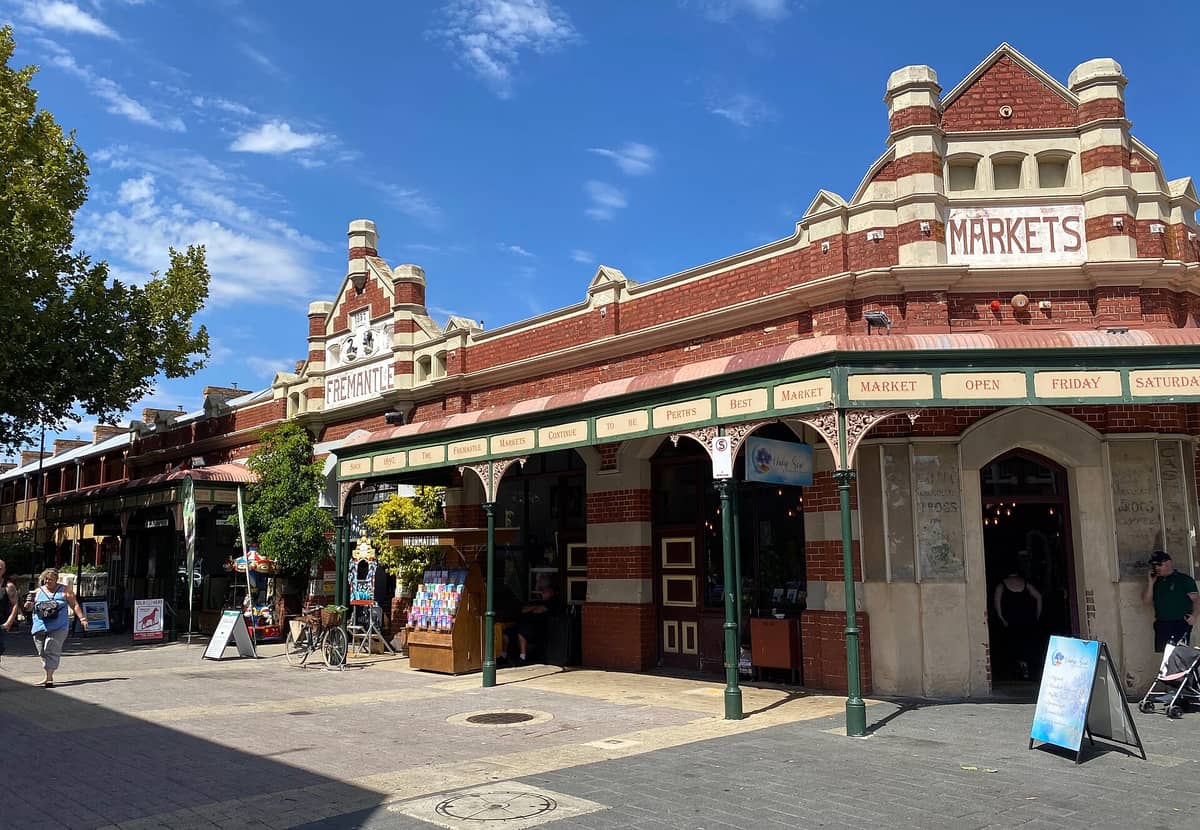
The Fremantle Markets are one of Western Australia's longest-running public markets, operating inside a heritage building dating from 1897, with the markets opening in June 1898. The structure itself is part of the experience: a Federation-era brick and iron hall whose high ceilings, original timber floors, and ornate facade give it a weight that no modern market pavilion can replicate. Entry is free every Friday, Saturday, Sunday, and on Monday public holidays.
The market divides into two distinct zones. The Hall, which opens at 9am, is the indoor section where the bulk of the more than 170 permanent stalls operate, selling handmade jewellery, vintage clothing, art prints, spices, fresh produce, homewares, crystals, leather goods, and street food from every corner of the globe. The Yard opens earlier at 8am and is the outdoor section, typically hosting additional food vendors and a rotating selection of pop-up stalls. Both sections close at 6pm.
ℹ️ Good to know
Hours: The Yard opens 8am; The Hall opens 9am. Both close at 6pm. Open Friday to Sunday and Monday public holidays. Free entry, no ticket required.
A Brief History of the Building and Its Role in Fremantle
The foundation stone was laid on 6 November 1897, and the markets opened in June 1898, making the building more than 120 years old. It was built to serve Fremantle's growing colonial population as a fresh food and produce exchange, a function that shaped the layout of its ground floor stalls and the width of its internal aisles, designed to accommodate crates and foot traffic simultaneously.
After a period of decline in the mid-twentieth century, the building was restored and reopened as a public market in 1975, part of a broader wave of heritage conservation that transformed Fremantle's inner city into what it is today. The markets sit on Noongar Country, the site also identified as Walyalup, and that deeper history extends well beyond the 1897 foundation stone.
The markets cannot be separated from the wider story of Fremantle itself. For context on the port city's character and layout, see theFremantle neighborhood guide.
Tickets & tours
Live prices and dates from our booking partner. If you book, we may earn a commission at no extra cost to you.
Perth and Fremantle Guided Tour and Swan River Cruise
From 110 €Instant confirmationFree cancellationPerth and Fremantle Tour in German with Hotel Pickup
From 84 €Instant confirmationFree cancellationPerth, Fremantle, Rottnest Island, and Swan River Guided Tour
From 166 €Instant confirmationFree cancellationPerth and Fremantle Guided Tour with Hotel Pickup
From 84 €Instant confirmationFree cancellation
What You'll Find Inside: Stalls, Food, and the Sensory Landscape
Walking into the Hall on a Saturday morning is a full sensory event before you have examined a single stall. The smell arrives first: a layered mix of roasting coffee, cardamom-heavy chai, frying garlic, incense from a crystal vendor, and the faintly woody smell of old timber floors warmed by the crowd. The acoustics, shaped by those high corrugated ceilings, produce a particular ambient hum that sits somewhere between a cathedral and a railway station.
Stalls are tightly packed but not chaotic if you visit at the right time. Fresh produce vendors occupy the central spine of the Hall, where the light is best and the foot traffic is highest. Around the edges and in the smaller corridors, you find handmade craft stalls, clothing sellers, artists, and food vendors representing Thai, Japanese, Middle Eastern, Indian, and other cuisines. The quality is genuinely mixed: some stalls are run by serious artisans who have been here for decades; others sell import-grade tourist items. A slow look distinguishes the two.
Street food is arguably the main draw for many visitors. The Yard adds additional outdoor food options and a slightly more relaxed atmosphere, with seating areas where you can eat without competing for floor space. Live music is a regular feature, typically folk, acoustic, or world music, and the quality varies week to week.
When to Visit: How the Markets Change by Time and Day
Friday is the quietest day and arguably the most pleasant for unhurried browsing. The crowd is thinner, stall holders have more time to talk, and you can actually examine items without someone reaching past you. If you have flexibility, Friday morning from 10am is close to ideal.
Saturday mid-morning to early afternoon is peak density. Aisles narrow effectively as the crowd builds, and the food queues at popular stalls can stretch to 10 or 15 minutes. If Saturday is your only option, arrive as close to 9am as possible to get through the Hall before the main crowd arrives around 11am.
Sunday is busier than Friday but typically less overwhelming than Saturday peak hours, and the late-afternoon window between 4pm and 6pm often sees the crowd thin as families with young children head home. Some produce vendors discount remaining stock toward closing time, which is a practical reason to arrive late if fresh food is your goal.
💡 Local tip
Photography tip: The Hall's corrugated iron roof and warm artificial lighting create atmospheric conditions for market photography, but midday on Saturday means you'll spend as much time navigating bodies as composing shots. Arrive at opening time for cleaner frames and more cooperative light from the upper windows.
Getting There and Getting Around
The most reliable approach is Transperth's Fremantle line from Perth City station, a direct rail connection that delivers you to Fremantle Train Station a walk from Fremantle Train Station to the markets. The walk itself passes through the heart of Fremantle's street grid, past cafes and the characteristic limestone facades of South Terrace, so it functions as part of the experience rather than a transit inconvenience.
Fremantle is also reachable by bus from several points in the southern suburbs, and the area is bicycle-friendly with paths connecting to the broader Perth cycling network. For a full overview of moving around the city, see theguide to getting around Perth.
Parking is available near the markets but can be tight on Saturday mornings. If you drive, allow extra time and consider the South Terrace or Henderson Street surrounds. The 74 South Terrace address sits at the corner of Henderson Street, and the building is immediately identifiable by its Victorian-era brick facade and market signage.
On accessibility: the official market information states that the markets are wheelchair- and mobility-aid accessible, with accessible routes through the main market areas and a wheelchair available to borrow on site. Some parts of the heritage building retain original surfaces and thresholds, so conditions are not uniformly flat, but the primary stall areas are navigable.
Honest Assessment: Strengths, Weaknesses, and Who Should Skip It
The Fremantle Markets are frequently cited in tourism material as a highlight of any Perth visit, and the setting genuinely earns that reputation. The building alone is worth the 10-minute walk from the station. The food selection is broad and the fresh produce quality is solid.
That said, the craft stalls occupy a wide spectrum. Visitors expecting an exclusively artisan market will find commercial imports mixed in among the genuine handmade work. The difference is visible if you look carefully, but it requires a slower, more discerning approach than many market visitors take on a busy Saturday.
Travelers who are sensitive to crowds, heat, or noise should reconsider a Saturday midday visit specifically. On a summer Saturday, the Hall becomes warm and close by noon, the acoustics amplify the crowd noise, and the aisles are genuinely difficult to navigate with a stroller or wheelchair despite the official accessibility provisions. Those conditions reverse sharply on a quiet Friday morning.
If your primary interest is Fremantle's food culture rather than the market specifically, the broader Fremantle precinct offers alternatives worth exploring. TheFishing Boat Harbour is a short walk away and operates daily.
Fitting the Markets Into a Wider Fremantle Visit
The markets pair naturally with a walk along South Terrace and a stop at one of the surrounding cafes before or after. Most visitors who come specifically for the markets spend between 90 minutes and three hours, depending on how seriously they approach the food and shopping.
For a structured approach to a full day in Fremantle, including the markets, the waterfront, the historic prison, and the arts centre, see the Fremantle day trip guide. The Perth food guide also covers the broader market food scene alongside the city's other eating neighborhoods.
If you are visiting from central Perth on a market day, the straightforward rail connection means the total round trip, including two or three hours at the markets, fits comfortably into a half-day. That makes it a practical addition to a longer Perth itinerary without requiring a dedicated full day.
Insider Tips
- The Yard section opens at 8am, a full hour before the Hall. If you arrive early on a Saturday, start outside where the crowd hasn't built yet and grab breakfast from one of the Yard food vendors before the Hall opens at 9am.
- Several of the fresh produce stalls reduce prices on remaining stock in the final hour before 6pm closing, particularly on Sundays. If you have a kitchen or accommodation with cooking facilities, this is when the value improves noticeably.
- The markets accept EFTPOS and card payments at many stalls, but some smaller vendors are cash-only. Having AUD cash on hand saves you from losing a purchase to a vendor who can't process your card.
- The wheelchair available to borrow on site must be requested from market staff. If you or someone in your group needs it, ask at the main entrance rather than hunting for a service desk inside.
- Live music quality and style varies significantly by week. If you care about the musical atmosphere, check the Fremantle Markets website or social channels before your visit to see who is scheduled.
Who Is Fremantle Markets For?
- Foodies who want to graze across multiple cuisines under one roof
- Shoppers looking for handmade jewellery, art, and craft with a discerning eye
- Families with children old enough to handle a busy indoor environment
- First-time Fremantle visitors who want to absorb the city's social character quickly
- Travelers on a budget: free entry, low minimum spend, and affordable street food
Nearby Attractions
Other things to see while in Fremantle:
- Bathers Beach
Tucked against Fremantle's heritage-listed West End, Bathers Beach is a 300-metre stretch of white sand where the Indian Ocean meets one of Australia's most storied port cities. Free to enter, easy to reach, and genuinely useful for a salt-aired half-day break — but it rewards those who understand its rhythms.
- Fremantle Arts Centre
Housed in one of Western Australia's most striking Gothic heritage buildings, Walyalup Fremantle Arts Centre is a working arts hub with free gallery admission, a courtyard café, craft studios, and a well-regarded live music program. It's a rare place where serious cultural programming meets an accessible, unhurried atmosphere.
- Fremantle Fishing Boat Harbour
Fremantle Fishing Boat Harbour is a working maritime precinct on Mews Road that doubles as one of Perth's most enjoyable spots to eat fish and chips by the water. Active trawlers, resident pelicans, and a string of seafood restaurants make it a practical and atmospheric stop when exploring Fremantle.
- Fremantle Prison
Fremantle Prison is one of Australia's most significant convict-era landmarks, a UNESCO World Heritage Site that operated as a place of incarceration for almost 140 years, closing in 1991. Whether you join the daytime cell-block tour or descend into the underground tunnels, the scale and weight of this place stays with you long after you leave.
Planning a trip? Discover personalized activities with the Nomado app.