Emirgan Park: Istanbul's Grand Bosphorus Parkland
Emirgan Park, officially Emirgân Korusu, is one of Istanbul's largest public parks, stretching across forested hillsides above the Bosphorus shore in the Sarıyer district. Entry is free year-round, and the park holds particular fame as the principal venue for Istanbul's annual Tulip Festival each April.
Quick Facts
- Location
- Reşitpaşa, Emirgan Sk., 34467 Sarıyer, Istanbul
- Getting There
- Buses 40T, 42T from Taksim; buses 22, 25E from Kabataş pier
- Time Needed
- 1.5 to 3 hours
- Cost
- Free entry
- Best for
- Spring walks, tulip season, families, Bosphorus views
- Official website
- tesislerimiz.ibb.istanbul
What Emirgan Park Actually Is
Emirgan Park, known in Turkish as Emirgân Korusu, sits on the European shore of the Bosphorus in Istanbul's Sarıyer district, roughly 8 kilometres north of Taksim Square. It is widely regarded as one of Istanbul's oldest and largest public parks, a sweeping landscape of forested slopes, formal flower beds, and Ottoman-era wooden pavilions that together form something closer to a historic estate than a city park.
The park is free to enter every day, usually open from 07:00 to 22:00, though hours can shift slightly with the seasons. There are no tickets, no queues at the gate, and no timed entry windows. That accessibility is a large part of why locals treat it as a genuine neighbourhood amenity rather than a tourist attraction to check off a list.
💡 Local tip
Verify current opening hours before visiting, particularly in winter months when parks managed by Istanbul Metropolitan Municipality occasionally adjust their schedules.
Emirgan Park is best understood alongside the broader string of Bosphorus-shore neighbourhoods that make up Istanbul's green northern corridor. If you are planning time along this stretch, the Bosphorus villages guide covers how to connect several of these areas in a single day.
The Landscape: Terraced Slopes and Three Pavilions
The park climbs from a narrow coastal road on the Bosphorus up through dense mixed woodland, opening at various levels onto lawns, rose gardens, and ornamental plantings. The terrain is hilly enough that flat-shoe visitors will want to know this in advance: some paths involve steady inclines, and the ground can be uneven on the upper forest trails after rain.
Three restored Ottoman pavilions anchor the park's identity. The Yellow Pavilion (Sarı Köşk), the White Pavilion (Beyaz Köşk), and the Pink Pavilion (Pembe Köşk) are 19th-century wooden structures that now operate as tea gardens and cafes. Sitting on the veranda of the Yellow Pavilion with a glass of çay, looking out over Bosphorus water framed by plane trees, is the park's signature experience. The café setting is casual and inexpensive by Istanbul standards.
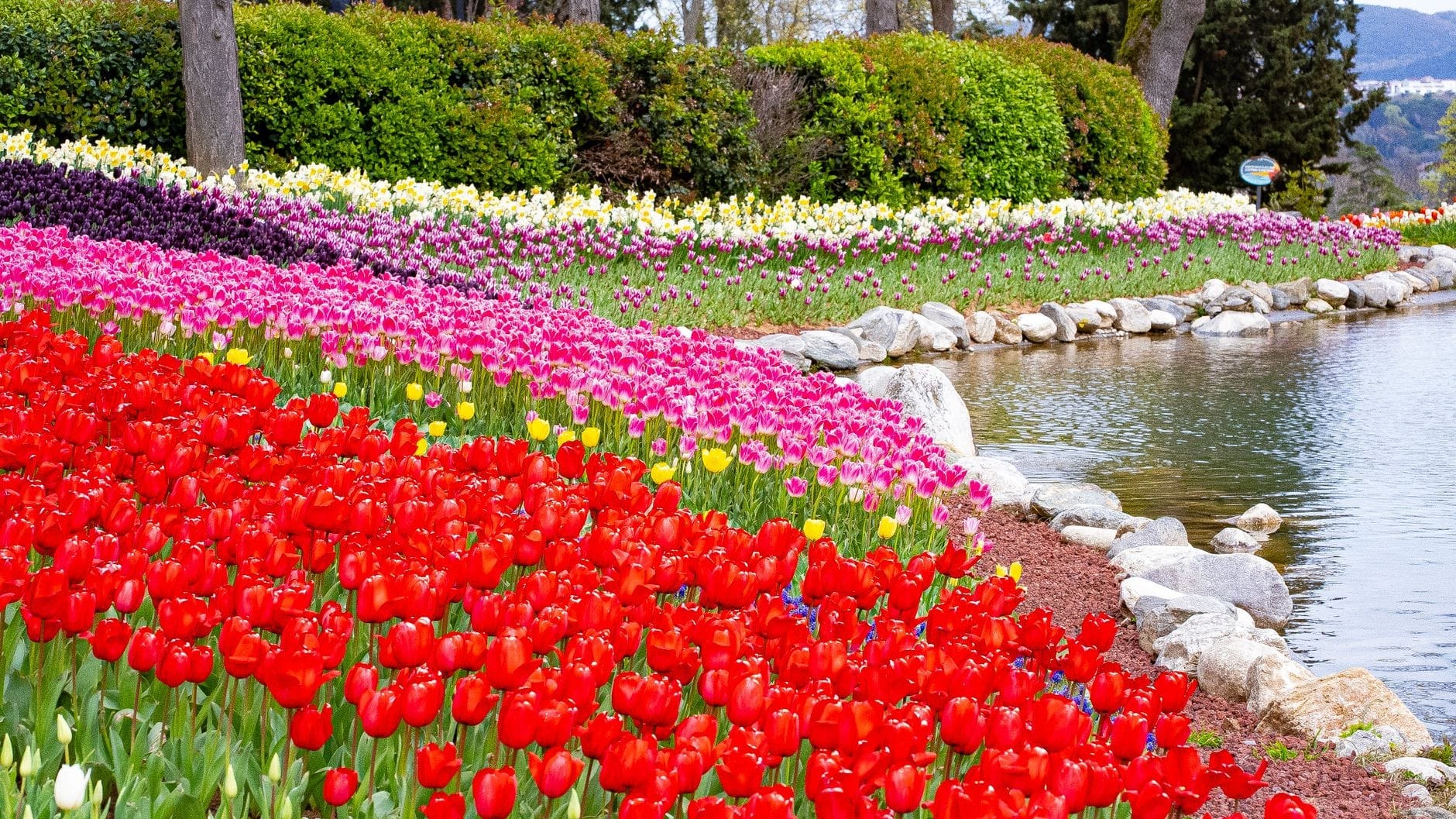
The formal flower garden at the lower section of the park is where most visitors spend time during the Tulip Festival. Outside of April, this area is planted with seasonal flowers and well-maintained lawn, but it lacks the drama of the tulip display. The upper wooded sections are quieter and feel forested, with mature plane trees, chestnuts, and pines providing dense shade.
Tickets & tours
Hand-picked options from our booking partner. Prices are indicative; availability and final rates are confirmed when you complete your booking.
Bosphorus sunset cruise on luxury yacht with guide
From 55 €Free cancellationIstanbul and Bosphorus cruise on private boat - half day afternoon tour
From 40 €Instant confirmationFree cancellationWhirling Dervishes live show and exhibition
From 29 €Instant confirmationBasilica Cistern fast-track entry ticket and optional audio guide
From 34 €Instant confirmation
Tulip Season: April and the Annual Festival
Every April, Emirgan Park becomes the main venue for Istanbul's Tulip Festival (Lale Festivali), when the lower terraces and formal beds are planted with millions of tulip bulbs in coordinated colour schemes. The display typically runs through most of April, peaking in the second and third weeks when the flowers are fully open.
ℹ️ Good to know
Tulip peak is highly weather-dependent. A warm early spring can advance bloom by a week; a cold snap can delay it. Check Istanbul Municipality announcements in late March for the expected peak dates each year.
The tulip has deep historical resonance in Ottoman culture, and Istanbul's festival revives a tradition that dates to the imperial period. For more context on what to expect during the event and how it fits into the city calendar, the Istanbul Tulip Festival guide gives a full breakdown of timings, logistics, and which areas of the city participate.
During peak tulip season, Emirgan Park sees its largest crowds of the year. Weekends in mid-April bring families, tour groups, and photographers arriving from opening time onward. If you want the flower beds without shoulder-to-shoulder crowds, a weekday morning before 09:30 is the practical solution. By late morning on a Saturday, the main garden paths become genuinely congested.
How the Park Changes Through the Day
Early morning is the park at its most local. From 07:00 onward, neighbourhood residents arrive for walks, joggers use the upper paths, and older men occupy the tea garden benches before the main crowds appear. The light at this hour, especially in spring and autumn, comes through the canopy at a low angle and catches the Bosphorus water between the trees on the lower paths. The park smells of damp soil and cut grass, with occasional drifts of wood smoke from the pavilion kitchens warming up.
Midday brings school groups on weekdays and family gatherings on weekends. The pavilion cafes fill up, and the main lawn areas become picnic territory. This is the park's social peak: the sound shifts from birdsong and distant ferry horns to children, conversation, and the clink of tea glasses. It is not unpleasant, just markedly different from the morning atmosphere.
Late afternoon light in autumn is arguably when Emirgan Park looks its best outside of tulip season. The canopy turns gold and amber, and the Bosphorus views from the upper paths take on a different quality in the lower sun. The park empties steadily from about 18:00, and by 20:00 on weekday evenings it is largely quiet, with just a few walkers and the pavilion cafes winding down.
Getting There and Navigating the Area
The most reliable public transport options from central Istanbul are bus routes 40T and 42T from Taksim Square, and buses 22 and 25E from Kabataş pier. The journey from Taksim takes roughly 30 to 40 minutes depending on traffic; the Bosphorus coastal road can slow significantly during morning and evening rush hours. Buses drop off close to the main park entrance on the Bosphorus-side road.
An Istanbulkart smart card covers the bus fare and makes transfers straightforward. Taxis and ride-hailing apps (BiTaksi, iTaksi, Uber operating through licensed taxis) are an option, but factor in the coastal road traffic, particularly on weekend afternoons when the Bosphorus shore road backs up considerably.
⚠️ What to skip
Parking near the park entrance is extremely limited, especially during the Tulip Festival and on summer weekends. Arriving by public bus or taxi is strongly advisable.
Emirgan Park sits within walking distance of the waterfront village of Bebek to the south, making it a natural pairing. For broader context on the Bosphorus shore and how to structure a day that covers multiple spots, see the Istanbul Historic Peninsula guide for background on the city's layout, or consider combining Emirgan with a Bosphorus cruise that passes the park's shoreline.
Photography and Practical Details
The park is excellent for photography at most times of year, but the reward-to-effort ratio is highest in April during the tulip display and in late October when the foliage peaks. For flower photography, a wide lens captures the scale of the formal beds, while a longer focal length picks out individual blooms against the Bosphorus backdrop visible from the upper terraces.
The pavilion structures are photogenic from several angles, particularly the Yellow Pavilion with its ornate wooden façade and the surrounding plane trees. Light from the east reaches the lower garden in the morning; the upper woodland is better lit in the afternoon.
On accessibility: the lower garden and main paths around the pavilions are manageable for pushchairs and for visitors with limited mobility, but the upper forest trails are unpaved and uneven. The park does not publish detailed accessibility information, so visitors with specific requirements should factor in the hilly terrain.
Restroom facilities are available near the pavilion areas. Dogs are commonly seen on leads in the park, which is officially permitted. There are water fountains at several points. The pavilion cafes accept cash; it is worth carrying some Turkish lira for tea and snacks, as card acceptance is not universal at smaller stands.
Who Should Reconsider
Visitors who are short on time and focused entirely on Ottoman monuments or Byzantine history may find Emirgan Park a lower priority than sites like Topkapı Palace or the Suleymaniye Mosque complex. The park's appeal is environmental and atmospheric rather than historical in the conventional sightseeing sense.
If your visit is in July or August and your main interest is Bosphorus scenery, there are stronger cases for a boat trip rather than a park walk in summer heat. The best time to visit Istanbul guide covers this seasonal trade-off in detail.
Visitors with significant mobility restrictions should be aware that the full park experience requires navigating slopes. The pavilion terrace areas are worth visiting regardless, but the advertised forest walks are not consistently accessible.
Insider Tips
- Arrive before 09:00 on any spring weekend to have the tulip garden largely to yourself. By 10:30, tour buses begin arriving from central Istanbul and the main paths become crowded.
- The Pink Pavilion (Pembe Köşk) tends to be the quietest of the three café options even at peak times, as most visitors gravitate toward the Yellow Pavilion for its Bosphorus views.
- In autumn, the upper forest paths offer foliage colour that rivals the tulip display for photographic interest, with almost none of the April crowds.
- Combine the park with the Emirgan village waterfront immediately below on the coastal road, where there are fish restaurants and tea gardens with Bosphorus water views.
- Buses back to Taksim can be packed on weekend afternoons. If you are caught in the afternoon rush, consider walking south along the coastal road toward Bebek (about 20 minutes) and catching a less congested bus or taxi from there.
Who Is Emirgan Park For?
- Spring travellers who want to experience the Tulip Festival without paying for ticketed attractions
- Families looking for a free, open space with café facilities and room for children to move around
- Photographers targeting seasonal colour, either April tulips or autumn foliage
- Anyone building a leisurely Bosphorus-shore day that combines a park visit with waterfront villages
- Early risers who want to see Istanbul in a local, unhurried setting before the tourist day begins
Nearby Attractions
Other things to see while in Bosphorus Villages:
- Anadolu Kavağı & Yoros Castle
At the far northern tip of the Bosphorus, where the strait meets the Black Sea, a medieval Byzantine fortress watches over a sleepy fishing village. Yoros Castle is free to enter, rarely crowded, and rewards the uphill walk with one of the most dramatic panoramas in all of Istanbul.
- Arnavutköy
Arnavutköy is a historic neighbourhood on Istanbul's European Bosphorus shore, sitting between Ortaköy and Bebek in the Beşiktaş district. Its wooden Ottoman yalıs, cobblestone backstreets, and working waterfront make it one of the city's most atmospheric places to walk, eat seafood, and slow down.
- Bebek Waterfront
Bebek Waterfront stretches along one of the Bosphorus's most photogenic bays on Istanbul's European shore. Free to enter, open around the clock, and flanked by waterside cafes and 19th-century architecture, it offers a side of Istanbul that belongs to the city's residents as much as its visitors.
- Borusan Contemporary
Borusan Contemporary transforms the historic Perili Köşk mansion in Rumelihisarı into one of Istanbul's most distinctive art spaces. Housed inside Borusan Holding's headquarters, the collection spans video art, digital installations, and works by major Turkish and international contemporary artists.