Daikanyama T-Site: Tokyo's Cultural Stronghold for Book Lovers
Daikanyama T-Site is a low-rise cultural complex in one of Tokyo's most refined neighborhoods, built around Daikanyama Tsutaya Books. Free to enter and open late, it draws readers, design enthusiasts, and anyone needing a slower pace in a fast city.
Quick Facts
- Location
- 16-15 Sarugakucho, Shibuya Ward, Tokyo 150-0033
- Getting There
- Daikan-yama Station (Tokyu Toyoko Line), approx. 5-minute walk from the West exit
- Time Needed
- 1.5 to 3 hours
- Cost
- Free entry; purchases priced individually in JPY
- Best for
- Book lovers, design and architecture fans, slow-paced solo exploration
- Official website
- store.tsite.jp/daikanyama/english
What Is Daikanyama T-Site?
Daikanyama T-Site is a multi-building cultural and commercial complex in Sarugakucho, Shibuya Ward, anchored by Daikanyama Tsutaya Books. It opened as a deliberate attempt to create what its developers called a 'cultural stronghold for adults,' and the phrase is not marketing fluff. The complex brings together a deeply curated bookshop, a Starbucks, a lounge space, a record shop, a camera and travel goods store, and a rotating mix of lifestyle tenants, all within walking distance of Daikanyama's low-key residential streets.
The architecture sets the tone immediately. Three low-rise buildings are connected by a facade motif of intersecting T-shapes, a reference to both the Tsutaya brand and the T-Site name. The structures are clad in perforated screens printed with the letter T in varying sizes and orientations. At night, with light filtering through those screens, the effect is striking without being loud. In a city that often favors spectacle, this is a place that rewards stillness.
The complex sits in Daikanyama and Nakameguro, a neighborhood that has long attracted architecture studios, independent fashion labels, and the kind of residents who value quiet streets over convenience. T-Site fits its surroundings without effort.
The Bookshop: What Makes It Different
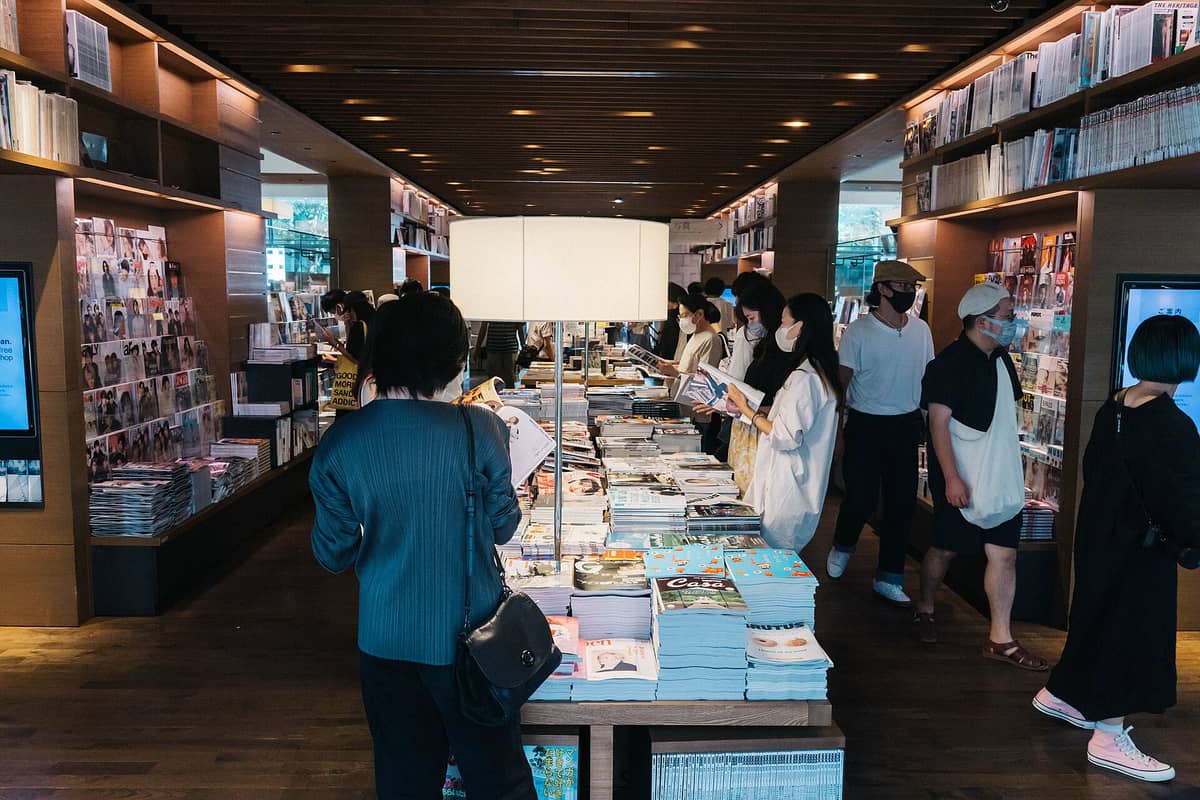
Daikanyama Tsutaya Books is organized by lifestyle rather than genre. The shelves are arranged around categories like travel, cooking, art, architecture, automobiles, and music, with physical products, magazines, DVDs, and CDs integrated alongside books in a way that reflects how a genuinely curious person actually navigates interests. A travel section might sit next to a selection of travel-themed novels, maps, and a few well-chosen guidebooks from international publishers.
The English-language section is more substantial than at most Tokyo bookshops, particularly for art books, architecture monographs, and design publications. Prices are standard retail. This is not a discount destination, but it is one of the few places in Tokyo where browsing feels like a pleasure rather than a task.
The magazine wall near the building connectors is worth extended attention. Titles from Japan, Europe, and North America are arranged by subject across hundreds of slots, including niche publications on typography, documentary photography, independent cinema, and food culture that simply do not appear on shelves elsewhere in the city.
💡 Local tip
The bookshop opens at 9:00 and is significantly quieter before 11:00, especially on weekdays. If browsing without interruption matters to you, the first two hours after opening are the best.
Tickets & tours
Hand-picked options from our booking partner. Prices are indicative; availability and final rates are confirmed when you complete your booking.
Tsukiji Fish Market Walking Food Tour
From 40 €Instant confirmationFree cancellationMt.Fuji,Owakudani, Hakone Cruise & Ropeway, Oshino Hakkai 1-Day Trip
From 54 €Instant confirmationFree cancellationTour to Mt. Fuji Area, Oshino Hakkai and Kawaguchi Lake from Tokyo
From 57 €Instant confirmationFree cancellationNikko UNESCO Shrine and Nature View 1-Day Tour from Tokyo
From 78 €Instant confirmationFree cancellation
How the Atmosphere Changes Through the Day
Early morning at T-Site is almost meditative. The Starbucks on the ground floor begins service at 7:00, and the handful of regulars with laptops and coffee cups barely register as noise. The outdoor terrace between buildings carries the smell of fresh coffee and, in autumn and spring, a faint green scent from the trees along the walkways. The light is soft and directional, and the perforated facade creates scattered patterns on the stone path.
By midday on weekends, the atmosphere shifts noticeably. The outdoor seating fills, the bookshop becomes genuinely crowded near the magazine wall and art section, and the Starbucks queue extends past the door. This is still far less hectic than Shibuya or Shinjuku, but the contemplative quality of morning is largely gone. Weekday lunchtimes are calmer, populated mainly by neighborhood residents and office workers from nearby streets.
Evening visits, especially between 19:00 and 21:00, offer a different kind of appeal. The complex is lit warmly, the crowd thins again, and the bookshop feels more intimate. The Share Lounge on the upper floor, which requires a separate fee, has a members-club quality at this hour. It is worth noting that the bookshop closes at 22:00 while the complex itself operates until 23:00, so late arrivals are not left without reason to stay.
Getting There and Getting Around the Complex
The most straightforward route is the Tokyu Toyoko Line to Daikan-yama Station. From the West exit, T-Site is a five-minute walk through a tree-lined residential street. The journey from Shibuya Station takes about 2–4 minutes by train, so combining the two neighborhoods in a single afternoon is easy.
If you are arriving from central Tokyo, the Tokyu Toyoko Line connects directly from Shibuya, which is also a short walk from Meguro River if you want to extend the day into Nakameguro. For route planning across the wider city, the guide to getting around Tokyo covers all major rail options.
Within the complex, the three buildings are connected at ground level by open-air covered passages. The layout is not immediately obvious on a first visit: Building 1 houses the main bookshop floors and the Starbucks; Building 2 contains the music and film sections as well as camera and travel merchandise; Building 3 holds the Share Lounge and additional tenants. Signage is in Japanese and English. Wheelchair users will find the outdoor paths between buildings flat and manageable, and accessible toilets are located in Buildings 1 and 3 on the ground floor.
Beyond Books: What Else the Complex Offers
Daikanyama Tsutaya Books is the reason most people visit, but the surrounding tenant mix adds texture to a longer stay. The music floor in Building 2 carries a selection of vinyl, CDs, and high-quality audio equipment oriented toward jazz, classical, and world music. It is a serious collection, not a gift-shop afterthought.
The camera and travel section stocks a range of film cameras, accessories, and travel goods with the same curatorial eye as the books. There is a modest selection of analog photography books and zines here that overlap with the photography section of the main bookshop. Visitors who shoot film will find it worth investigating.
The outdoor spaces between buildings are designed for lingering. Benches face inward toward the facade, and the landscaping uses mature trees rather than ornamental planters. In spring the area has blossom overhead from nearby trees; in autumn the light filters through changing leaves. These are small seasonal details, but they accumulate into an experience that feels considered rather than functional.
ℹ️ Good to know
The Share Lounge operates on a time-based fee and functions as a co-working and reading lounge. It is not required for visiting the bookshop but offers a quieter, more comfortable alternative to the Starbucks seating on busy days.
Honest Assessment: Who Will Love It and Who Might Not
Daikanyama T-Site is genuinely one of the most well-executed retail environments in Tokyo. The curation is real, the architecture holds up across multiple visits, and the neighborhood surrounding it adds to the experience rather than distracting from it. For anyone with an interest in books, design, photography, music, or simply well-made spaces, it justifies the detour from central Tokyo without question.
That said, it is not for everyone. Visitors focused on traditional Tokyo experiences, temples, street food, or historic neighborhoods will find little here that connects to those interests. The price point for books and goods is standard Japanese retail, which can feel high compared to equivalent purchases at home. Non-readers who have heard about T-Site as a 'famous place in Tokyo' sometimes arrive and find themselves unsure what to do after ten minutes. The experience rewards a curious, unhurried mindset.
If you are combining a literary or design-focused day in this part of the city, T-Site pairs well with a walk along the Meguro River and the independent shops in the lanes between Daikanyama and Nakameguro. The Tokyo architecture guide covers other notable examples of thoughtful design across the city, many of them in the same western neighborhoods.
⚠️ What to skip
The complex is closed on New Year's Day. Individual tenant hours vary, so if you are visiting specifically for the music floor or camera section, check current hours on the official site before making the trip.
Insider Tips
- The magazine wall near the building connectors is one of the most complete international magazine selections in Tokyo. Allow at least 20 minutes here separately from the book browsing if periodicals interest you.
- Weekday mornings between 9:00 and 11:00 offer the best combination of good light, full stock, and minimal crowds. The outdoor terrace is at its quietest before the local coffee crowd arrives.
- The bookshop's art and architecture monograph section on the upper floors of Building 1 stocks Japanese-language editions of titles that rarely appear in translation. Even without reading Japanese, the visual quality of these books makes them worthwhile.
- Daikanyama Station is only one stop and about 2–4 minutes from Shibuya on the Tokyu Toyoko Line, but the neighborhood feels worlds apart. Build in walking time to explore the surrounding streets before or after the complex.
- If you are interested in analog photography, the overlap between the camera section in Building 2 and the photography books in Building 1 is worth treating as a connected visit rather than two separate stops.
Who Is Daikanyama T-Site For?
- Book lovers, especially those interested in art, design, architecture, photography, and travel
- Design and architecture enthusiasts who appreciate spaces built with editorial intention
- Visitors wanting a calm, unhurried afternoon away from central Tokyo's pace
- Music collectors and anyone interested in a serious vinyl and CD selection
- Solo travelers who enjoy browsing at their own pace without a fixed agenda
Nearby Attractions
Other things to see while in Daikanyama & Nakameguro:
- Meguro River
The Meguro River is Tokyo's most celebrated urban waterway, winding through the fashionable Nakameguro neighborhood with tree-lined promenades, independent cafes, and some of the city's most photographed cherry blossoms. Free to visit at any hour, it rewards walkers across every season.