Casino de Montréal: What to Expect Before You Go
Housed in the former French Pavilion from Expo 67, Casino de Montréal is the largest casino in Canada by floor space. This guide covers the gaming floors, restaurants, the ARcade experience, getting there by metro, and who will enjoy it most.
Quick Facts
- Location
- 1 Avenue du Casino, Île Notre-Dame, Jean-Drapeau Park, Montréal, QC H3C 4W7
- Getting There
- Yellow Line to Jean-Drapeau station, then bus 777 to the casino
- Time Needed
- 2–5 hours, depending on whether you dine and play
- Cost
- Free entry; you must be 18+ with valid original photo ID. Gaming costs depend on what you wager.
- Best for
- Evening entertainment, architecture enthusiasts, night owls, and groups looking for a late-night destination
- Official website
- casinos.lotoquebec.com/en/montreal/home
First Impressions: Arriving at Île Notre-Dame
Most visitors arrive at Casino de Montréal the same way: a short metro ride on the Yellow Line to Jean-Drapeau station, then bus 777 that runs through the island and deposits you at the main entrance. That ten-minute crossing already sets the casino apart from anything in downtown. The Saint Lawrence River is wide here, the skyline visible to the north, and the surrounding grounds of Jean-Drapeau Park are quiet compared to what waits inside.
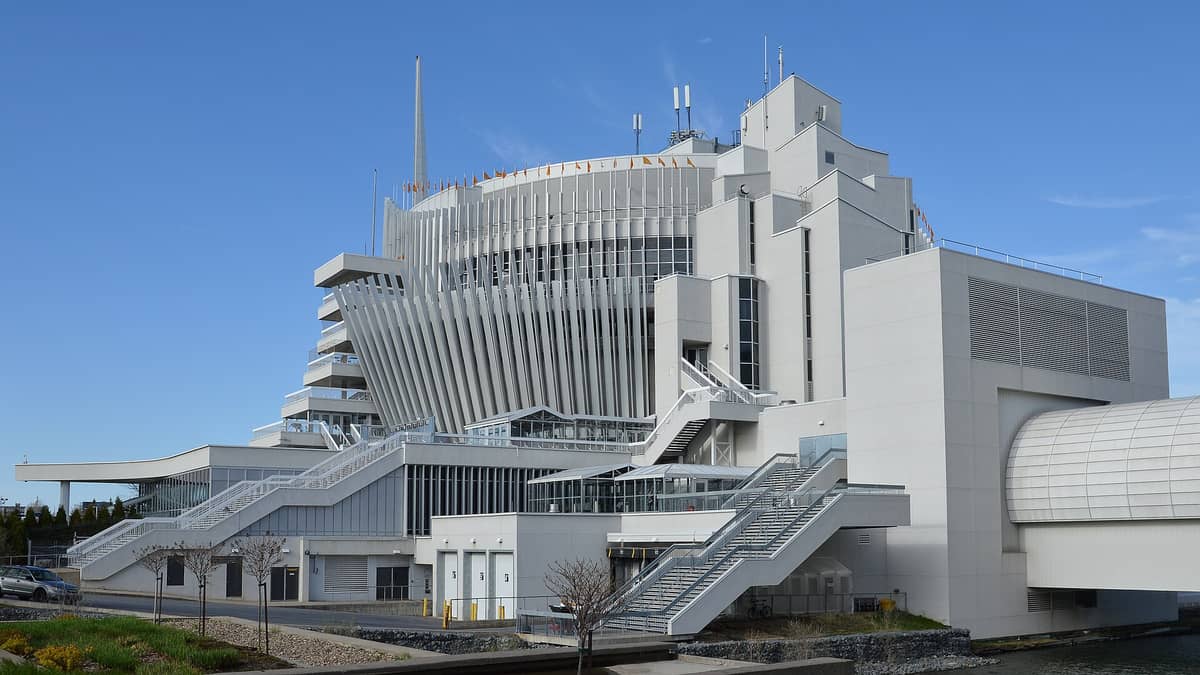
The building itself stops you before you reach the door. Casino de Montréal occupies the former French Pavilion constructed for Expo 67, the world's fair that reshaped both the island and the city's self-image. The pavilion's original modernist geometry — angular rooflines, interlocking volumes, large expanses of glass — remains legible even after decades of interior renovation and expansion. It does not look like a casino from the outside. That surprise is worth a moment before you walk in.
ℹ️ Good to know
Entry is free, but you must be at least 18 years old and may be asked to show government-issued photo identification at any point inside. The policy is applied consistently.
The Building: Expo 67 Architecture Repurposed
The casino opened in October 1993, making it one of the earliest large-scale casino operations in Quebec. It is operated by Loto-Québec, the provincial Crown corporation that manages gambling in the province. The choice of the Expo 67 French Pavilion as its home was deliberate: the structure was already a landmark, already iconic, and already part of the civic mythology of a city that treats that 1967 world's fair as a turning point in its modern identity.
The pavilion's original design features — particularly the layered terraces and the interplay between interior and exterior volumes — survive in parts of the building and reward anyone who slows down to look. If you approach the casino during daylight, the geometry of the rooflines reads clearly against the sky. For a broader understanding of how Expo 67 shaped Montreal's built environment, the Habitat 67 housing complex on the nearby Cité du Havre offers the most dramatic surviving example from the same era.
Interior renovations have layered a contemporary casino aesthetic over the original structure: mirrored ceilings, coloured light installations, and the low, directional lighting common to gaming floors. The original architecture is most readable near the upper levels and along the glass-fronted sections facing the water. It is not a preserved heritage interior, but traces of the original design are present for those who look.
Tickets & tours
Hand-picked options from our booking partner. Prices are indicative; availability and final rates are confirmed when you complete your booking.
Montreal evening cruise on the St. Lawrence River
From 54 €Instant confirmationFree cancellation3-hour e-bike guided tour in Montreal
From 68 €Instant confirmationFree cancellationWalking tour of Old Montreal
From 20 €Instant confirmationFree cancellationMontreal helicopter tour
From 156 €Instant confirmationFree cancellation
The Gaming Floors: Scale and Atmosphere
The casino spreads across multiple floors and is large enough that first-time visitors benefit from picking up a floor map at the entrance. Slot machines occupy a significant portion of the gaming area and produce the constant, layered sound that defines the ambient experience on the main floors: chimes, electronic tones, and the low murmur of a few hundred people all occupied in their own games simultaneously. In the early afternoon, the floors are relatively calm. By 9 or 10 p.m. on a Friday or Saturday, the atmosphere shifts considerably. The energy level rises, the dress skews smarter, and the table game sections fill with the kind of concentrated attention that makes a casino floor compelling to watch even if you are not playing.
Table games include blackjack, roulette, baccarat, and poker, with dedicated poker rooms operating on their own schedule. Minimum bets vary by table and time of day; higher-limit tables are clustered in quieter sections. If you are new to table games, the weekday afternoon sessions offer more space and less pressure than weekend evenings.
💡 Local tip
The casino operates a responsible gambling program. Visitors can set voluntary limits or request self-exclusion through Loto-Québec. Resources are available at the casino and on the official website.
ARcade by Moment Factory: The Non-Gambling Floor
Not everything at Casino de Montréal involves wagering. The ARcade, created in collaboration with Montreal-based multimedia studio Moment Factory, occupies a separate section of the building and operates as an interactive digital experience using augmented reality technology. It targets a different visitor than the traditional gaming floors — younger, more interested in entertainment than gambling, and likely drawn by the Moment Factory name, which carries weight in Montreal's creative technology scene.
One important limitation: the ARcade is not accessible to visitors with limited mobility, due to the nature of the technology involved. The casino acknowledges this directly on its FAQ page. People with reduced mobility can access all casino floors and games except the ARcade games; the ARcade technology does not permit them to play.
Dining, Hours, and Practical Logistics
The casino operates long hours designed around a gambling schedule. Monday through Thursday, it opens at 9:00 a.m. and closes at 5:00 a.m. the following day. From Friday at 9:00 a.m. through Monday at 5:00 a.m., it runs continuously, making it one of the few genuinely late-night destinations in Montreal outside of licensed bars and clubs. The casino is also open on statutory holidays.
Multiple dining options operate within the building, ranging from quick-service counters to full sit-down restaurants. Hours and menus vary by outlet and are subject to change, so check the official website before planning a dinner-and-gambling evening. For serious dining before or after a casino visit, the restaurants of Old Montréal are accessible by metro and worth considering as part of a broader evening itinerary.
Getting to the casino without a car is straightforward. Take the Yellow Line metro to Jean-Drapeau station — the same station used for La Ronde and the Biosphere — and board bus 777 toward the casino. Driving is also possible via the Cité du Havre and the De la Concorde bridge, and parking is available on site, though fees apply.
⚠️ What to skip
Late-night bus schedules should be confirmed directly with the STM before relying on them for a return trip after 2:00 a.m. Metro service ends around 1:00 a.m. on weekdays and 1:30 a.m. on Saturdays, so very late arrivals or departures require a taxi or rideshare.
The Setting: Jean-Drapeau Park After Dark
The casino's location on Île Notre-Dame, within Jean-Drapeau Park, gives it a separation from the city that feels more pronounced at night. Arriving after 9:00 p.m., the island is dark except for the casino's lit facade and the occasional passing car on the bridge roads. The Saint Lawrence is audible if you step outside. There is something genuinely strange about this contrast — a large, active, noisy casino in the middle of a park on a river island — and it is part of what makes the visit memorable beyond the games themselves.
During summer, the surrounding park hosts festivals, cycling paths, and the Circuit Gilles Villeneuve Formula 1 track. Combining a daytime park visit with an evening at the casino is a workable plan from late May through early September, when the park grounds are at their most active. In winter, the island is quiet outside the casino itself, and the walk between buildings or along the waterfront requires a warm coat.
Who This Attraction Suits — and Who Should Skip It
Casino de Montréal works well as an evening destination for adults who enjoy the atmosphere of a large casino, whether they are serious gamblers or casual visitors drawn by the architecture, the restaurants, or the late-night social environment. The scale and variety of the gaming floor give it a genuine edge over smaller venues, and the Expo 67 building adds a layer of cultural interest that a purpose-built casino would not have.
Visitors primarily motivated by Montreal's cultural highlights — its neighbourhoods, food, street life, or outdoor spaces — may find the casino a detour rather than a priority. The same evening could be spent at a concert at Place des Arts, at a restaurant in the Plateau, or simply walking the Old Port waterfront. The casino is not a substitute for those experiences; it is a different category of evening entirely. Anyone under 18 cannot enter the gaming areas or the ARcade.
People with gambling-related concerns should be aware that the casino is designed to extend stays and encourage play. The lack of natural light on the gaming floors and the absence of obvious clocks are standard industry design choices, not unique to this casino, but worth knowing in advance.
Insider Tips
- Bus 777 from Jean-Drapeau metro station is the official public-transit connection to the casino; check its schedule before returning late at night.
- The upper floors of the casino offer the clearest views of the original Expo 67 architectural geometry. If you are interested in the building's heritage, walk the full perimeter of the upper levels before settling into the gaming area.
- Weekday afternoons between 2:00 p.m. and 6:00 p.m. offer the casino at its least crowded — tables have more space, service is faster at dining counters, and the atmosphere is calmer. If you want to learn a table game, this is the window.
- Dress code is smart-casual in practice; you will see everything from jeans to cocktail dresses on a Friday night. Deliberately casual or sportswear-heavy outfits may draw a second look from staff, particularly in the higher-limit sections.
- The casino website offers event listings for concerts, poker tournaments, and special evenings. Checking the calendar before your visit can add a structured reason to go beyond general gaming.
Who Is Casino de Montréal For?
- Adults seeking a late-night destination after restaurants or shows close
- Architecture and design enthusiasts interested in the Expo 67 legacy
- Poker players looking for a serious room with consistent traffic
- Travellers wanting a full evening out that combines dining, entertainment, and gaming in one building
- Groups with mixed interests, since the ARcade, restaurants, and gaming floors serve different preferences simultaneously
Nearby Attractions
Other things to see while in Jean-Drapeau Park:
- Biosphère
Originally built as the United States Pavilion for Expo 67, the Biosphère is one of Montreal's most architecturally striking landmarks. Today it operates as an environmental museum within Parc Jean-Drapeau, combining a genuinely fascinating building with exhibits on climate, ecosystems, and water.
- Circuit Gilles-Villeneuve
Circuit Gilles-Villeneuve is Montreal's legendary Formula 1 track, threading 4.361 km around Île Notre-Dame in Parc Jean-Drapeau. Free to walk or cycle most of the year, it transforms into one of North America's great motorsport spectacles each June for the Canadian Grand Prix.
- La Ronde
Perched on Île Sainte-Hélène with sweeping views of the St. Lawrence River, La Ronde is Montreal's largest amusement park. Originally built for Expo 67, it packs over 50 years of thrill-ride history into 59 hectares of riverside terrain. Here's what to realistically expect before you go.
- Plage Jean-Doré
Plage Jean-Doré is Montreal's best-known supervised public beach, set within Parc Jean-Drapeau on Île Notre-Dame. A 600-metre stretch of sand, a 15,000 m² swimming area, and genuine skyline views make it a legitimate summer escape from the city grid, all for the price of a coffee.