The Essaouira Medina is a UNESCO World Heritage fortified city on Morocco's Atlantic coast, built in the mid-18th century to a rare grid layout that makes it one of the most walkable and least disorienting medinas in the country. Within its fortified walls you'll find artisan workshops, a storied Jewish quarter, seafront ramparts bristling with old cannons, and a port that still sends fishing boats out every morning.
The Essaouira Medina is unlike any other historic quarter in Morocco: planned, grid-like, and anchored to the Atlantic on three sides, it trades the labyrinthine chaos of Fez or Marrakech for something closer to a fortified coastal town that you can actually understand. Its UNESCO-listed walls, blue-and-white lanes, and salt-stung air make it the reason most people come to Essaouira in the first place.
Orientation: Where the Medina Sits and How It's Laid Out
The medina of Essaouira occupies a rocky Atlantic peninsula on Morocco's western coast, roughly 175 km southwest of Marrakech. Its boundaries are defined by 18th-century fortified walls, with the Atlantic Ocean pressing in from the north and west and the working port directly to the west and northwest. To the south, the medina's walls give way to the newer ville nouvelle and the long sweep of Essaouira's beach.
What distinguishes this medina from virtually every other in Morocco is its grid. When the Alaouite sultan Sidi Mohammed ben Abdallah commissioned the French military architect Théodore Cornut to redesign the city in the 1760s, the result was a planned town with straight, intersecting streets. You won't spend your first afternoon completely lost. The main commercial artery, Avenue de l'Istiqlal (also written Rue de l'Istiqlal), runs roughly north-south through the heart of the medina and serves as the spine from which most activity radiates.
The medina contains several distinct internal zones: the Kasbah quarter in the south, the market quarter at the center, and the Mellah, the former Jewish quarter, in the northeast corner near the ramparts. Place Moulay Hassan sits at the southwestern edge of the medina near the port entrance and acts as the de facto social center of the city, the point where the covered souks, seafront promenade, and port access all converge.
💡 Local tip
Orient yourself immediately by walking to Place Moulay Hassan when you arrive. From there, the Skala de la Ville ramparts are a short walk away, the port is nearby, and the main souk streets head east into the medina's interior.
Character and Atmosphere: What It Actually Feels Like
Mornings in the medina have a particular quality. By seven o'clock, the overnight stillness has already broken: bread sellers are stacking rounds of khobz outside communal ovens, cats are moving between fish stalls near the port, and the wind, which is the defining meteorological fact of Essaouira, comes off the Atlantic with enough force to make a light jacket feel sensible even in July. The light at this hour is flat and silver, the shadows still long, and the alleys quieter than they will be for the rest of the day.
By mid-morning the medina shifts register. Tour groups filter through from day-trip buses parked outside Bab Doukkala and Bab Marrakech (the main entry gates from the new town). Argan oil shops swing open their doors along the main commercial streets, wood-carvers set up outside their workshops in the covered artisan quarter near the Skala de la Ville, and the souks begin the particular visual density that makes them worth photographing. Avenue de l'Istiqlal and the parallel Rue Mohammed Ben Massoud fill with both locals on daily errands and visitors working through their to-do lists.
Afternoons, especially in summer, bring the famous alizé trade winds to full strength. Dust kicks up in the open squares, awnings strain, and conversation at outdoor cafes requires a slight lean toward the other person. This is not a hardship: the wind is why Essaouira never gets oppressively hot, and locals treat it as part of daily life rather than an inconvenience. The blue-washed walls and white-trimmed windows hold the afternoon light in a way that makes the medina feel almost Andalusian.
After dark, the medina contracts in the most pleasant way. The day-trip crowds have left on their buses back to Marrakech, restaurants around Place Moulay Hassan fill with guests who are actually staying in town, and the lanes going deeper into the medina become genuinely quiet, lit by occasional bulbs strung between buildings. There is no nightlife in the loud sense: Essaouira's medina after nine at night is for eating, slow walks, and early bed. That's part of the appeal.
ℹ️ Good to know
Essaouira's medina is consistently described by travelers as one of the most relaxed and low-pressure in Morocco. Persistent unofficial guides and aggressive touts, common in Marrakech's medina, are a minor issue here rather than a constant one.
What to See and Do
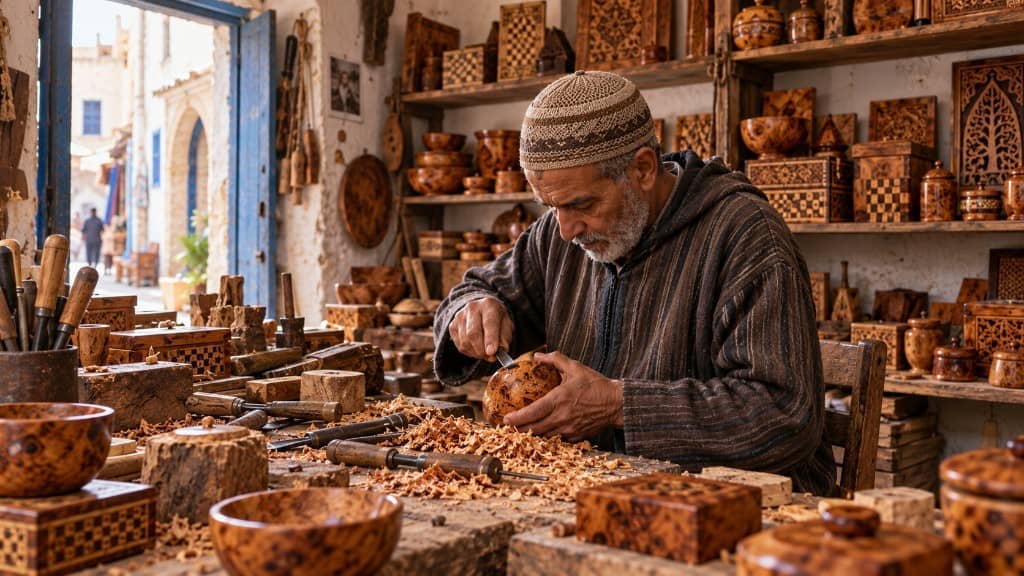
The Skala de la Ville is the medina's most striking physical feature: a long sea-facing rampart lined with bronze cannons pointing out over the Atlantic, with the old city walls rising behind. Walking its length, with the ocean below and the rooftops of the medina to your right, is one of those experiences that sticks in the memory. Below the rampart walls, artisan workshops carve thuya wood, a local specialty made from the root of the Moroccan cypress, into everything from jewelry boxes to chess sets.
From the southern end of the Skala de la Ville, Place Moulay Hassan opens up as the medina's main public square. It's flanked by café terraces on two sides and connects directly to the port entrance. In the evenings, it functions as an informal promenade, particularly for local families after the day's heat has passed.
The souks of Essaouira cover several distinct zones inside the medina walls. The spice and grain souk operates in a covered section of the market quarter; the jewelry souk concentrates silver and semi-precious stones; and the woodworking quarter, just inside the Skala, is where you'll find the most skilled craftsmen working in thuya. Unlike some Moroccan medinas, the souks here are compact enough to cover in a couple of hours without losing your bearings.
Skala de la Ville: Atlantic-facing ramparts with cannons, best in morning light
Place Moulay Hassan: the medina's main square, busy from mid-morning until late evening
Thuya wood workshops: artisan carvers working near the northern ramparts
Mellah quarter: the former Jewish quarter in the northeast of the medina, with distinct architecture
Musée Sidi Mohammed ben Abdallah: regional museum inside the medina with exhibits on local history and culture
Synagogue Bayt Dakira and Slat Lkahal: restored synagogues in the Mellah, significant to Essaouira's Sephardic heritage
Galerie Damgaard: the gallery that helped launch Essaouira's reputation as a center for naive art in the 1980s
The Mohammed Ben Abdallah Museum is housed in a 19th-century pasha's residence inside the medina and holds a collection of instruments, weapons, carpets, and jewelry documenting the region's history, including its multicultural trading-port past. It's small enough to absorb in an hour and provides useful context before exploring the streets.
The Synagogue Bayt Dakira and the Synagogue Slat Lkahal in the Mellah are among the most tangible reminders of Essaouira's once-large Jewish community, which at its peak in the 19th century made up a significant portion of the city's merchant class. Both have been restored in recent decades and are open to visitors.
For those interested in the city's artistic reputation, Galerie Damgaard near the main medina streets remains one of the best places to understand how Essaouira developed an internationally recognized school of self-taught artists from the 1960s onward. The gallery continues to exhibit work by local artists. You'll also find smaller commercial galleries scattered through the medina, particularly on streets running parallel to Avenue de l'Istiqlal.
Eating and Drinking in the Medina
The medina's food scene is anchored to the sea. Essaouira's working port means fresh fish and shellfish arrive daily, and the most direct way to eat it is at the fish market stalls near the port entrance, where vendors grill whole fish, calamari, and prawns on charcoal braziers and charge by weight. Point at what you want, agree a price, and sit at one of the plastic tables nearby. It's informal, inexpensive, and as close to the source as possible.
Moving away from the port, the medina has a solid range of sit-down restaurants catering to different budgets. The streets around Place Moulay Hassan have the highest concentration of tourist-facing restaurants, with terrace seating, printed menus in multiple languages, and prices that reflect the location. Quality varies: a few of these are genuinely good, others are coasting on foot traffic. Going one or two streets deeper into the medina tends to yield smaller, more locally frequented places with better value on Moroccan staples like harira, kefta tagine, and pastilla.
Cafes in the medina serve Moroccan mint tea, coffee, and simple breakfasts throughout the morning. The terraces on Place Moulay Hassan are the most social spots for this, and watching the square come to life over a glass of tea is a reasonable way to start any day in Essaouira. For a more local atmosphere, the smaller cafes tucked into the market quarter cater primarily to residents and vendors.
Alcohol is available in some restaurants inside and near the medina, generally without fanfare, but Essaouira is not a city with a bar culture. For a broader overview of where and what to eat, the complete guide to eating in Essaouira covers the full range of options across the city, including places outside the medina walls.
⚠️ What to skip
At the port-side grill stalls, always confirm the price per 100g before the vendor puts anything on the grill. Misunderstandings about pricing are the most common complaint from visitors at this otherwise excellent spot.
Getting There and Around
The medina is entirely pedestrianized inside its walls, which means once you're in, you're on foot. Vehicles can approach the main gates, Bab Doukkala to the north and Bab Marrakech slightly further along the wall, where taxis stop and drop off passengers. From either gate, the heart of the medina is no more than a ten-minute walk.
Intercity buses from Marrakech (roughly 2.5 to 3 hours), Agadir, and Casablanca arrive at bus stations in town, with CTM on Place 11 Janvier and Supratours near Bab Sbaa. From there, the medina gates are a short walk or taxi ride away. If you're arriving from Marrakech on a day trip, this is the standard entry point and it deposits you close to the medina walls.
Essaouira-Mogador Airport (IATA: ESU) sits approximately 16-17 km southeast of the medina. There is no scheduled public bus service connecting the airport directly to the city; taxis and pre-booked private transfers are the practical options. Taxi fares should be agreed before departure, and prices fluctuate, so confirm current rates locally on arrival.
Within Essaouira, getting to the medina from the beachfront hotels or ville nouvelle is a short walk or a quick petit taxi ride. For full logistics on moving around the city and arriving from Marrakech, the getting around Essaouira guide and the Essaouira day trip from Marrakech guide cover the details.
Where to Stay in the Medina
The medina is where most visitors to Essaouira choose to stay, and for good reason: being inside the walls means you walk out of your front door into the city's most atmospheric streets. The accommodation here is almost entirely riads and maisons d'hôtes, traditional townhouses converted into guesthouses, ranging from modest family-run places to polished boutique hotels with Atlantic-view roof terraces.
The most desirable rooms tend to be those in the northern section of the medina, closer to the Skala de la Ville, where upper floors and roof terraces have ocean views. Properties on or near Avenue de l'Istiqlal and the streets running toward the Skala offer the best balance of location, atmosphere, and access. The Mellah quarter in the northeast has quieter, less touristed streets, which some visitors prefer, though it's slightly further from the port and main square.
Be aware that staying inside the medina means no vehicle access to your door. Arriving with luggage requires either walking from the nearest gate or hiring a porter with a cart from the gate. It's a minor inconvenience that most guests find worth it. For a wider overview of accommodation zones across the city, see the full Essaouira accommodation guide.
💡 Local tip
If light sleep is important to you, ask for a room that doesn't face the main souk streets. The medina is quiet after 10pm in most areas, but rooms above active lanes can be noisy from early morning when merchants set up.
Practical Notes and Honest Drawbacks
The medina is generally considered one of the safest historic quarters in Morocco, with a lower incidence of the aggressive touts and unofficial guides that can make Marrakech's medina tiring. Petty theft in crowded souk areas is the main risk to be aware of, particularly around the busy market streets and during the Gnaoua and World Music Festival, when crowds peak significantly. Keep bags zipped and valuables out of back pockets in the densest market areas.
The wind is a genuine factor in daily life here, not a romantic detail. On high-wind days (which are common in spring and early summer), fine sand from the beach blows into the medina streets, grit gets into food and drinks at outdoor cafes, and walking into the wind on the open ramparts requires some effort. Layers and a scarf are practical packing choices year-round, not just for modesty.
The medina is at its most crowded during summer weekends (July-August) and during the annual Gnaoua festival in June, when accommodation prices spike and Place Moulay Hassan becomes genuinely packed. Visiting in shoulder season, particularly September-October or March-April, gives you the same streets and sights with noticeably fewer people. For timing advice, see the best time to visit Essaouira guide.
Essaouira's medina is also compact enough that it works well as a base for exploring beyond the walls. The beach and watersports area is a fifteen-minute walk south, the port is immediately accessible at the western edge, and day trips to the argan oil cooperatives in the surrounding region or the coastal village of Diabat are easy to arrange. The Essaouira medina walking tour is a good way to structure a first full day and covers the key landmarks in a logical sequence.
TL;DR
The Essaouira Medina is a UNESCO-listed walled city with a rare grid layout, making it one of the most navigable historic quarters in Morocco.
Best for travelers who want Atlantic coastal atmosphere, artisan culture, and a slower pace than Marrakech or Fez, without sacrificing a genuine historic medina experience.
Key attractions include the Skala de la Ville ramparts, Place Moulay Hassan, the thuya wood souks, the Mellah quarter, and the port-side fish grills.
Honest drawback: the wind is constant and can blow sand into everything; the area around Place Moulay Hassan gets genuinely crowded with day-trippers in summer.
Staying inside the medina in a riad is the recommended base for most visitors, with the northern section near the Skala offering the best ocean-view options.
Two days is the sweet spot for Essaouira. Long enough to walk every corner of the medina, eat grilled fish at the port, and watch the kites dot the Atlantic horizon. This itinerary gives you a realistic, hour-by-hour plan with prices, logistics, and the kind of detail that separates a good trip from a great one.
Essaouira's Atlantic climate makes it a year-round destination, but timing still matters. This guide breaks down every season by weather, crowds, wind, and cost so you can choose the visit that suits you best.
Essaouira is compact enough to explore in a day or two, but the surrounding coastline and countryside reward those who venture further. These are the best day trips you can make from the city, whether you have a rental car, a grand taxi, or just a bus ticket.
Essaouira sits at the edge of the Arganeraie Biosphere Reserve, making it one of Morocco's best places to buy authentic argan oil. This guide covers how cooperatives work, what fair prices look like in 2024-2026, how to spot fakes, and how to shop with confidence.
Essaouira's Atlantic beach is one of Morocco's most distinctive stretches of coastline: wide, public, perpetually windswept, and accessible year-round. This guide covers the beach's layout, water sports pricing, seasonal conditions, what to expect as a swimmer versus a surfer, and how to get the most out of the shore without falling for the tourist traps.
Essaouira's cooking classes range from family kitchen sessions in the medina to full-day Berber farm experiences in the countryside. This guide breaks down every format, price tier, and booking method so you can choose the right class for your trip.
Essaouira is one of Morocco's most underrated destinations for couples: a fortified Atlantic city with cool ocean breezes, candlelit medina alleys, and hammams that cost a fraction of what you'd pay in Europe. This guide covers the best seasons, where to stay, what to do, and how to avoid the pitfalls.
The journey from Marrakech to Essaouira takes around 3 hours each way, which makes a day trip tight but genuinely doable. This guide covers every transport option, realistic itineraries, what to prioritize in Essaouira, and the honest tradeoffs of doing it in a single day versus staying overnight.
The Essaouira fish market is one of the most rewarding and affordable eating experiences on Morocco's Atlantic coast. This guide covers everything: when to go, what to pay, how the grill stalls work, and how to avoid the common traps that catch first-time visitors.
The Gnaoua World Music Festival is one of Africa's most celebrated music festivals, drawing tens of thousands of visitors to Essaouira's medina each June. This guide covers tickets, free stages, what to expect on the ground, and how to plan your trip around the festival.
Essaouira is one of the Atlantic's most consistent wind destinations, drawing kiters and windsurfers from across Europe and beyond. This guide breaks down the wind calendar, lesson costs, top schools, and practical gear advice so you can make the most of every session.
Essaouira's UNESCO-listed medina is compact, walkable, and remarkably easy to explore on your own. This guide covers the full route from Bab Sbaa to the Atlantic beach — with stop-by-stop directions, entry costs, timing tips, and practical notes on what's worth your time.
Essaouira is one of Morocco's most affordable Atlantic-coast destinations, but smart budgeting requires knowing the real costs. This guide breaks down transport, accommodation, food, and free activities so you can plan a trip to Essaouira without financial surprises.
Essaouira is one of Morocco's safest cities, but that doesn't mean you should arrive unprepared. This guide covers the real risks, common scams, taxi pricing, and practical precautions so you can explore the medina, port, and beach with confidence.
Essaouira has earned its reputation as Morocco's windy city, but the reality is more nuanced than the nickname suggests. This guide breaks down exactly when the wind blows, how it affects different activities, and how to time your visit for the experience you actually want.
Essaouira punches well above its size as a family destination. This guide covers the best kid-friendly activities, seasonal timing, real costs, and practical logistics for families traveling to Morocco's Atlantic coast.
Essaouira is one of Morocco's most rewarding cities to explore on a tight budget. From cannon-lined sea ramparts to a working fishing port, most of what makes this UNESCO-listed medina special is completely free to experience.
Everything you need to know about reaching Essaouira and navigating the city once you arrive. Covers the Marrakech to Essaouira bus route, airport transfers, city taxis, walking the medina, and day trips by car.
Essaouira is one of Morocco's most distinctive coastal cities, but it is not the right destination for everyone. This guide cuts through the travel-blog hype to tell you exactly what to expect: the atmosphere, the drawbacks, the best seasons, and the practical details you need to decide.
Essaouira is one of Morocco's most rewarding stops, but most travelers underestimate how much time it deserves. This guide covers exactly how to fit Essaouira into a Morocco itinerary: transport logistics, timing, how long to stay, and what to prioritize once you're there.
Renting a car in Essaouira unlocks the Moroccan Atlantic coast in a way no bus or taxi can match. This guide covers where to pick up, how much to pay, what documents to bring, and which roads are worth driving.
Essaouira is one of Morocco's best-value shopping destinations, known for argan oil, thuya woodwork, hand-woven textiles, and spices. This guide covers what to buy, current price benchmarks, where to shop, and how to avoid common scams.
Essaouira delivers year-round Atlantic swells, world-class wind, and a relaxed surf culture that draws everyone from first-timers to experienced riders. This guide covers the best surf spots, when to go, what lessons cost, and the common mistakes that waste a surf trip.
Essaouira is far more than a beach stop on the Moroccan Atlantic coast. This guide covers the city's best experiences — fortified ramparts, a working fishing port, artisan souks, watersports, and day trips — with practical notes on what to skip, what to prioritize, and how to plan your time.
Essaouira's food scene runs from freshly grilled sardines at the harbour to carefully plated tasting menus in the medina. This guide breaks down where to eat in Essaouira by budget, neighbourhood, and meal type, with real prices and a clear take on what to skip.
Essaouira's compact size makes it deceptively easy to pick the wrong base. This guide breaks down every area, from the UNESCO-listed medina to the Atlantic beachfront, with real price ranges, seasonal timing advice, and honest takes on which accommodation type suits which traveler.