Thuya Wood Workshops of Essaouira: A Guide to the Medina's Living Craft Tradition
Essaouira's thuya wood workshops are among the most distinctive craft experiences in Morocco. Scattered through the medina's alleys and concentrated near the ramparts, they offer visitors a rare chance to watch multi-generational artisans carve, inlay, and polish one of the world's most aromatic woods — and to bring home something genuinely made here.
Quick Facts
- Location
- Essaouira Medina & Centre Artisanal d'Essaouira, 118 Avenue Sidi Mohamed Ben Abdellah, Essaouira, Morocco
- Getting There
- On foot from anywhere in the walled medina; taxi or car to Centre Artisanal on Ave. Sidi Mohamed Ben Abdellah
- Time Needed
- 30–90 minutes to browse; 2–3 hours for a hands-on workshop class
- Cost
- Free to watch artisans in the souks; paid hands-on workshop classes available through tour operators (prices in MAD, vary by provider)
- Best for
- Craft lovers, souvenir hunters, design enthusiasts, families with older children
- Official website
- www.thuya-wood.com
What Are the Thuya Wood Workshops?
The Thuya Wood Workshops of Essaouira are not a single building or ticketed museum. They are a living cluster of artisan ateliers spread across the medina's narrower lanes, with the heaviest concentration running along the covered alleys near Skala de la Ville and behind Place Moulay Hassan. A more formal presentation of the craft can be found at the Centre Artisanal d'Essaouira at 118 Avenue Sidi Mohamed Ben Abdellah, where multiple workshops and retail spaces operate under one roof.
The wood itself is what makes this craft extraordinary. Thuya (Tetraclinis articulata) is a slow-growing conifer native to North Africa whose root burls contain tight, swirling grain patterns and natural oils that give finished pieces a warm, resinous scent unlike any other wood. Artisans prize the burls specifically because no two pieces have the same pattern, which means no two finished objects are identical. The smell alone, a cross between cedar and incense, tends to stop visitors in their tracks.
💡 Local tip
Watching artisans work is completely free in the souk workshops. You are not obligated to buy anything, though some workshops will apply gentle pressure. A polite 'shukran' (thank you) is enough to disengage if you are not interested in purchasing.
The Craft and Its History
Thuya marquetry in Essaouira has been passed down through family lineages over multiple generations. The techniques involved include root-burl selection from the surrounding countryside, hand-carving, geometric inlay work using contrasting woods, and finishing with mother-of-pearl or metal wire. The city's position as a major Atlantic trade port for centuries meant that its craftspeople had exposure to both Andalusian woodworking traditions and sub-Saharan artistic forms, and that influence is visible in the intricate geometric patterns still favored today.
Essaouira, known historically as Mogador, developed strong artisan guilds under the reign of Sultan Mohammed III, who initiated the creation of the current city in 1765 and oversaw its foundation later in the 1760s, deliberately attracting craftsmen from across the region. Thuya carving became one of the defining trades of the medina, and the workshops near the ramparts were among the first artisan spaces established within the fortified walls. Today, UNESCO recognition of the medina as a World Heritage Site has helped preserve these workshops even as younger generations increasingly seek other employment.
The craft does not exist in isolation. It connects directly to the argan and thuya forests of the surrounding region, making it part of a broader ecological and economic story you can explore further through the argan oil cooperatives and craft traditions of Essaouira.
What You Will Actually See and Experience
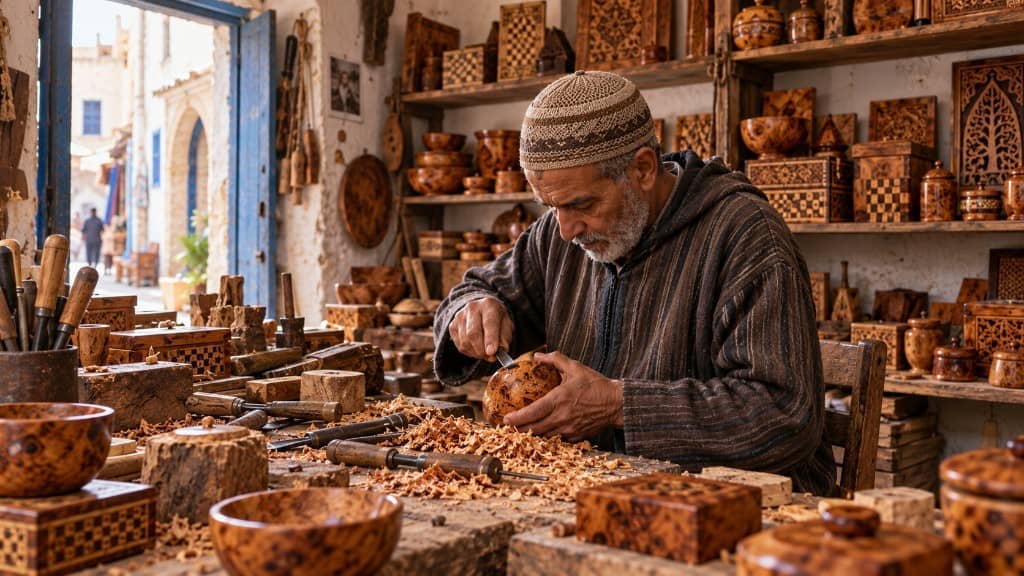
Walking into a thuya atelier is an immediate sensory shift. The sawdust on the floor is fine and pale, the walls are lined with finished pieces ranging from small jewelry boxes to full chess sets, mirror frames, and decorative panels. Most workshops keep their production visible: a carver will be bent over a vise, chiseling out a geometric rosette, while an apprentice sands a panel at a nearby bench. The sound is a soft, rhythmic scraping. The smell is persistent and deeply pleasant.
Smaller pieces like keyrings and coasters start at modest prices and are aimed squarely at casual visitors. The mid-range includes decorative boxes, trays, and frames with inlay work, where price depends heavily on the complexity of the pattern and the quality of the inlay material. At the upper end, full backgammon and chess boards with camel-bone or mother-of-pearl inlay represent dozens of hours of skilled work and are priced accordingly. Quality varies significantly across workshops, so it is worth visiting several before committing to a purchase.
Centre Artisanal vs. Medina Workshops
The Centre Artisanal d'Essaouira on Avenue Sidi Mohamed Ben Abdellah offers a more organized experience: multiple workshops in one space, reported opening hours of approximately 08:00 to 20:00 daily (with reduced hours on Wednesdays, approximately 12:00 to 18:00, though these should be verified locally), and better accessibility for visitors with mobility constraints. The complex is described as wheelchair accessible, unlike many of the tight medina alleys.
The medina workshops, by contrast, feel more organic and less curated. Prices can be lower, the production process is more visible, and the interaction with individual craftspeople is more direct. The tradeoff is that souk workshops on uneven cobbled surfaces are not accessible to wheelchair users, and the atmosphere can feel more pressured in the more tourist-facing alleys.
When to Visit and How the Experience Changes
Mornings before 10:00 are the best time to watch active production. Carvers tend to work during cooler hours, and workshops are less busy with other visitors. The light in the covered alleys near Skala de la Ville is softer in the morning, which also makes for better photographs of the wood grain. Midday brings tour groups through the more prominent workshops, which can make quiet observation difficult. Late afternoon, from around 16:00 onwards, is a reasonable second window: production picks up again after the midday lull and the alleys are not yet at peak evening foot traffic.
ℹ️ Good to know
Souk workshops operate on a broadly daily schedule, but individual ateliers may close for prayer times or personal schedules with no advance notice. If a specific workshop is your goal, arriving earlier in the day reduces the chance of finding it shuttered.
Essaouira's climate is mild year-round thanks to Atlantic trade winds, so there is no bad season to visit the workshops indoors. However, the city is known for persistent wind that can make outdoor medina exploration less comfortable in winter. For a fuller picture of how weather affects your visit, see the best time to visit Essaouira guide.
Hands-On Workshop Experiences
Several operators offer paid participatory workshops where visitors can try basic thuya carving or assemble and decorate a small box under artisan guidance. These are typically booked in advance through tour platforms and take two to three hours. The experience is oriented toward beginners and requires no prior woodworking skill. Participants leave with a small finished piece.
Prices for these structured sessions are listed in Moroccan dirham and vary by operator and group size. Because prices change and are set by individual providers rather than a central body, verify current rates directly with tour operators before booking. Reviews on travel platforms suggest these sessions are particularly well received by families with older children and by visitors who want something more immersive than a standard shopping stop.
Buying Thuya Wood: What to Know
Bargaining is standard practice in the souk workshops, though the Centre Artisanal tends toward fixed or semi-fixed pricing. As a general rule, the first price offered is rarely the final price in open-market stalls. That said, aggressive counter-offers on clearly labor-intensive pieces are neither effective nor fair. A reasonable approach is to ask for a 'best price' once and work from there. If the gap is large, walking away and returning often prompts a more flexible offer.
The main quality markers to look for are the density and uniformity of the grain pattern, the tightness of any inlay work (gaps or uneven lines indicate rushed finishing), and whether the piece has been sealed or left natural. Unsealed pieces retain more of the thuya scent but are more susceptible to moisture damage. For items that will travel internationally, a well-sealed piece is more practical.
If you plan to combine thuya shopping with broader medina exploration, a structured walk helps you cover the most relevant areas efficiently. The Essaouira medina walking tour covers the key workshop alleys along with the souks, ramparts, and surrounding historic structures.
Who Might Not Enjoy This
Visitors who are uncomfortable with sales interactions or feel anxious in environments where purchase is implicitly expected may find the more tourist-facing souk workshops stressful. The Centre Artisanal setting is lower-pressure and better for those who prefer to browse without engagement. Anyone with a strong aversion to wood dust or resinous smells should be aware that the workshops, particularly enclosed ones, can be quite intense in this regard. Travelers with limited mobility should head directly to the Centre Artisanal on Avenue Sidi Mohamed Ben Abdellah, as the medina alley workshops involve cobbled, uneven surfaces.
Insider Tips
- Ask to see the raw burl before it is carved. Most artisans are happy to show unfinished root sections, and seeing the natural wood helps you understand what you are paying for in the finished piece.
- The workshops closest to the main medina entrance gates tend to quote higher opening prices because foot traffic is highest there. Walking three or four alleys deeper gets you to workshops with the same quality but less tourist markup.
- If you are buying a large item like a chess board or mirror frame, ask whether the workshop can wrap it in the box it came in rather than plastic bags. Most will have a proper box, which makes airport transport significantly easier.
- Wednesday afternoons at the Centre Artisanal are reported as having reduced opening hours, typically around 12:00 to 18:00. Confirm before making it a dedicated stop on a Wednesday itinerary.
- The thuya scent fades slowly once sealed pieces are enclosed in luggage for a long flight. Unwrap them at home and leave them in open air for a day or two to reactivate the natural oils.
Who Is Thuya Wood Workshops For?
- Craft and design enthusiasts wanting to watch traditional woodworking techniques in real time
- Shoppers looking for a high-quality, genuinely local souvenir with clear artisan provenance
- Families with older children interested in a hands-on carving or box-making workshop
- Photographers focused on texture, grain detail, and workshop atmosphere
- Travelers who want to understand Essaouira's artisan economy beyond surface-level browsing
Nearby Attractions
Other things to see while in Essaouira Medina:
- Galerie d'Art Damgaard
Located on Avenue Oqba Ibn Nafiaa near the medina’s clock tower, Galerie d'Art Damgaard is one of the most established contemporary art venues in Essaouira. Free to enter and open every day in two shifts, it offers an unhurried window into the city's thriving community of local painters and sculptors.
- Mohammed Ben Abdallah Museum
Housed in a 19th-century riad off Rue Laalouj, the Sidi Mohammed Ben Abdallah Museum is Essaouira's main ethnographic and history museum. As of 2026 it is closed for rehabilitation under a partnership signed in April 2026 — confirm reopening before you go. When operating, its compact galleries cover traditional musical instruments, Amazigh jewelry, weapons, historic maps, and artifacts tied to the city's Jewish and Muslim communities.
- Place Moulay Hassan
Place Moulay Hassan is the broad, open square at the heart of Essaouira's medina, sitting at the junction between the old city, the port, and the seafront ramparts. Free to enter at any hour, it serves as the natural gathering point for both locals and visitors — a place to orient yourself, watch the city move, and settle into a café terrace with a mint tea.
- Souks of Essaouira Medina
The souks of Essaouira Medina run through the heart of a UNESCO World Heritage Site, where thuya woodcarvers, spice sellers, and silver jewellers work in the same streets they have occupied for centuries. Free to enter, compact enough to cover on foot, and far less overwhelming than Marrakech's markets, they reward slow, attentive walkers.
Planning a trip? Discover personalized activities with the Nomado app.