Yehliu Geopark: The Coastline That Looks Like Another Planet
Yehliu Geopark stretches along a narrow cape in New Taipei City, where decades of wave erosion and sea-salt weathering have carved sandstone into formations unlike anything else in Taiwan. It is one of the country's most distinctive natural sites, and for good reason: the rock garden is genuinely strange, visually arresting, and unlike most geological attractions, completely accessible without hiking boots.
Quick Facts
- Location
- No. 167-1, Gangdong Road, Yehliu Village, Wanli District, New Taipei City 207, Taiwan
- Getting There
- Kuo-Kuang Bus 1815 from Taipei Main Station (alight at Yehliu stop); also served by Crown Northern Coast Shuttle Bus 716 and Keelung Bus routes 953, 1068, 790, and 862
- Time Needed
- 1.5 to 2.5 hours for the full cape walk
- Cost
- Adults NT$120 / Concession (students, children 6–12, seniors 65+) NT$60 / Under 6 free
- Best for
- Geology enthusiasts, photographers, families, day-trippers from Taipei
- Official website
- http://www.ylgeopark.org.tw/ENG
What Is Yehliu Geopark?
Yehliu Geopark occupies a slender cape on the north coast of New Taipei City. The cape is a seaward extension of the Datun Mountain range, and its narrow width means you are never far from the sound of the Taiwan Strait on one side and the rocky shoreline on the other.
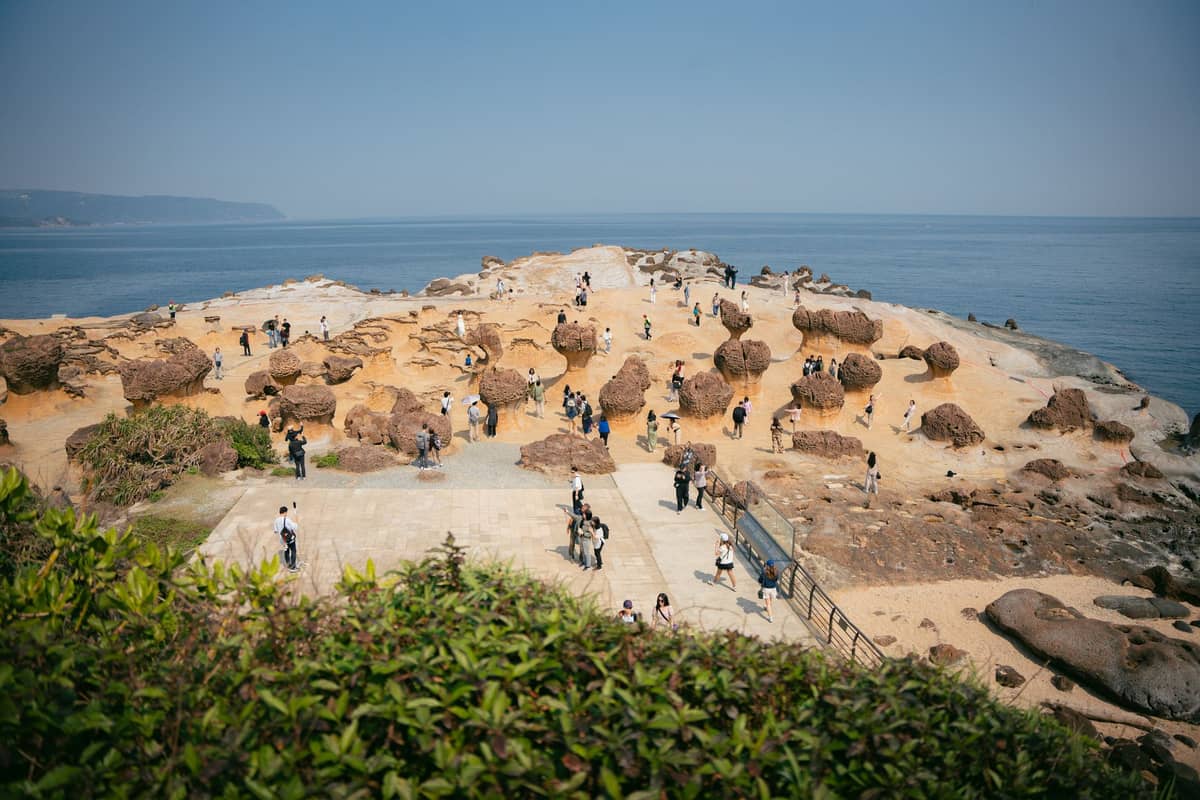
The park's reputation rests on its mushroom rocks, sea candles, ginger rocks, and the celebrated Queen's Head formation. These are not human-made sculptures. They are the result of millions of years of differential erosion: softer sandstone layers wear away faster than harder iron-rich nodules, leaving pedestals and caps that look carved. The Queen's Head has become one of Taiwan's most recognizable geological images, featuring in official tourism materials. The shape is the result of millions of years of differential erosion: softer sandstone layers wear away faster than harder iron-rich nodules, leaving pedestals and caps that look carved.
⚠️ What to skip
The Queen's Head neck is thinning each year due to natural erosion. Visit while the silhouette still looks as expected — it will not always.
The Walk Through the Cape: What You Actually See
The park is divided into three main zones. Zone 1, closest to the entrance, contains many of the best-known mushroom rocks and includes the Queen's Head. Zone 2 offers sea candles, ginger rocks, and potholes. Zone 3 extends to the cape tip and is less crowded, with rougher terrain and stronger wind exposure.
The path through the park is paved and mostly flat, making it walkable for most fitness levels. You follow raised boardwalk sections and concrete paths that keep visitors off the formations. Touching the rocks is prohibited. The formations are fragile in a way that is not immediately obvious.
Beyond the geological formations, the cape edge offers views of the open sea. The rocks at the shoreline are sharp, layered, and slick with sea spray, which gives the entire park a feeling of being at the edge of something. The smell of salt and exposed rock is constant. On windy days, which are common on the north coast, the cape becomes noticeably exposed, and any loose items, hats especially, will not survive unattended.
How the Experience Changes Through the Day
Yehliu opens at 08:00 and the first hour of the day is the best time to visit. Arriving before 09:00 means you can walk the central area in relative quiet, with softer morning light that works far better for photography than the harsh midday sun.
Midday is objectively the worst time to be here in summer. The cape is exposed with almost no shade, the sun bounces off pale sandstone, and the crowd density in Zone 1 makes the walk feel less like a geopark and more like an outdoor queuing system. If you are visiting between June and September, arriving at opening time is not optional advice — it is the difference between a good visit and an unpleasant one.
Late afternoon sees crowds thin as tour buses depart. The light in the final hour before closing has a warm, low-angle quality that makes the eroded surfaces read beautifully. Standard closing is 17:00, with summer hours extended to 18:00. Confirm current hours on the official website before planning a late visit.
💡 Local tip
October through April is the most comfortable season for the north coast. Autumn days are clear and cooler, winter brings occasional fog that creates an entirely different, more atmospheric mood over the rock formations.
Getting There from Taipei
Yehliu is not on the Taipei MRT network, so reaching it requires a bus or a hired vehicle. The most straightforward option is the Kuo-Kuang Bus 1815 from Taipei Main Station, which runs directly to Yehliu. The stop is signed for Yehliu.
Alternatively, the Crown Northern Coast Shuttle Bus 716 connects Tamsui to Keelung along the coast and stops at Yehliu, making it possible to combine Yehliu with a visit to Tamsui's waterfront in a single day trip along the north coast. Keelung Bus routes 953, 1068, 790, and 862 also serve Yehliu, with some routes running low-floor buses accessible to wheelchair users. A taxi or ride-share from Taipei takes around 45 to 60 minutes depending on traffic and is considerably more expensive but direct.
If you are planning a longer day out, Yehliu pairs naturally with the coastline to the east, including Jiufen Old Street and the Jinguashi Gold Museum, both roughly 30 to 40 minutes further along the coast by bus. This circuit is one of the most popular day trips from Taipei, covering geological, historical, and cultural ground in a single outing.
Practical Details: What to Wear and Bring
Footwear with grip matters. The paved paths are generally dry, but sections near the water's edge and around Zone 3 involve uneven rock surfaces that can be wet with sea spray. Sandals and smooth-soled shoes are uncomfortable at minimum and slippery in places. Closed shoes with rubber soles are the practical choice.
The cape offers almost no natural shade. A hat, sunscreen, and water are not optional accessories in any season. There are facilities including toilets and a small commercial area near the entrance, but no reliable food options along the cape itself. The area around the park entrance and nearby Yehliu Village has a few restaurants and seafood stalls if you want to eat before or after.
- Wear closed shoes with rubber soles
- Bring a hat and sunscreen regardless of season
- Carry water, especially in summer — no vendors on the cape itself
- Secure loose items against coastal wind
- Download an offline map or screenshot the park zone layout before entry — signal on the cape can be weak
Photography at Yehliu
The Queen's Head is the obvious focal point, but getting a clean image of it without other visitors in frame requires either an early arrival or patience during midday. The formation works best photographed from its western angle, where the profile reads most clearly. Morning light from the east catches the texture of the rock surface in a way that flattens in harsher conditions.
The mushroom rocks in Zone 1 photograph well with a wide-angle lens that exaggerates the alien landscape effect. Zone 3 near the cape tip offers compositions that include the sea, which adds context that Zone 1 images often lack. The tidal pools and layered rock surfaces at the shoreline edges reward close attention: the patterns of erosion are as interesting at macro scale as they are at landscape scale.
ℹ️ Good to know
Drone use at Yehliu Geopark is restricted. Check current regulations before bringing equipment.
Is Yehliu Worth It? An Honest Assessment
Yes, but with conditions. The formations are genuinely remarkable and unlike anything you will see elsewhere in Taiwan. The Queen's Head alone justifies the trip if you have any interest in natural landforms. The admission price of NT$120 is low relative to what you get, and the one to two hours required fits comfortably into a north coast day itinerary.
The honest caveat is that Yehliu can feel overwhelmed by visitors at peak times, particularly on summer weekends and public holidays when tour group volume is high. If your tolerance for crowds is low, come off-season and early. Those who prefer quiet, undisturbed natural spaces may want to pair this with something less trafficked, such as the Bitou Cape Trail further along the north coast, which offers similar coastal drama with a fraction of the foot traffic.
Yehliu also pairs well with a full north coast day trip from Taipei, which allows you to spread the day across multiple sites rather than spending too long at any single one. If you are working through a broader Taipei itinerary, the geopark is most efficiently visited on a day when you are also heading east toward Jiufen or Keelung.
Insider Tips
- The park is divided into three zones, but most visitors turn back after Zone 1. Walk all the way to Zone 3 at the cape tip: the crowd thins completely, the views open up, and the formations there are less famous but equally interesting.
- If you want a photograph of the Queen's Head with no other people in frame, arrive at opening time (08:00) on a weekday in the October-to-April window. By 09:30 most days, the queue for this shot is several dozen people deep.
- The seafood restaurants in Yehliu Village just outside the park entrance serve locally caught fish at prices well below what you would pay in Taipei. Lunch here before catching a bus onward is a better use of the location than rushing back.
- Winter fog on the north coast can roll in and transform the park completely. The formations take on a monochrome, almost cinematic quality in low visibility, and crowds drop significantly. If you see fog in the forecast, this is an opportunity rather than a deterrent.
- The bus back to Taipei can fill quickly in the afternoon, particularly on weekends. Note the departure schedule and position yourself at the stop a few minutes early to avoid being left for the next service.
Who Is Yehliu Geopark For?
- Geology and natural science enthusiasts who want to understand how the formations were created
- Photographers looking for genuinely unusual landscapes within a day trip of Taipei
- Families with children old enough to walk a flat 2km path — the visual impact lands well with kids
- Day-trippers combining Yehliu with Jiufen or Keelung along the north coast
- Visitors who want a memorable natural site without a strenuous hike
Nearby Attractions
Combine your visit with:
- Bitou Cape Trail
The Bitou Cape Trail (鼻頭角步道) traces a narrow coastal ridge above the Pacific Ocean in Ruifang District, New Taipei City. Free to enter and roughly 3.5 km long, it rewards hikers with some of the most dramatic ocean scenery within striking distance of Taipei. Note that sections have been under reconstruction since 2020, so checking current trail status before visiting is essential.
- Houtong Cat Village
Houtong Cat Village is a retired mining settlement in New Taipei City's Ruifang District where a large resident cat population transformed a fading industrial town into one of Taiwan's most photographed day trips. The village is free to enter, reached by a scenic Taiwan Railways train ride from Taipei, and pairs well with the adjacent Houtong Coal Mine Ecological Park.
- Jinguashi Gold Museum Area
Set high in the mountains of Ruifang District, the Gold Museum in Jinguashi preserves an entire Japanese-era gold and copper mining complex. Expect underground tunnel walks, colonial architecture, a POW camp memorial, and sweeping Pacific coastline views, all within a single open-air park.
- Jiufen Old Street
Jiufen Old Street (Jishan Street) is a narrow, lantern-lit lane winding through a former gold-mining town above Taiwan's northeast coast. Free to enter and accessible by train and bus from Taipei, it rewards visitors who arrive early or stay for dusk, when the red lanterns glow against the mountain fog.