University of Western Australia: Perth's Most Beautiful Campus
Established in 1911, the University of Western Australia sits on 51 hectares of Swan River foreshore in Crawley, about 10 minutes from the Perth CBD. With its sandstone colonnades, manicured gardens, public art installations, and free entry, the campus rewards visitors who want something beyond the standard tourist circuit.
Quick Facts
- Location
- 35 Stirling Highway, Crawley, Perth WA 6009
- Getting There
- Bus routes serve the campus directly from Perth CBD; the Purple CAT provides a free service to UWA. The campus is roughly 10 minutes by car from the city centre.
- Time Needed
- 1.5 to 3 hours for a relaxed walk; longer if visiting galleries or the foreshore
- Cost
- Free to enter and walk the campus grounds
- Best for
- Architecture lovers, photographers, solo walkers, families wanting green space, and anyone curious about Perth's academic heritage
- Official website
- www.uwa.edu.au
What the University of Western Australia Actually Is
The University of Western Australia, universally called UWA, is the state's oldest university, founded in 1911 and welcoming its first 184 students in 1913. For travellers, that institutional fact is almost beside the point. What matters is that UWA's Crawley campus is one of the most architecturally coherent and visually rewarding open spaces in Perth, and it costs nothing to walk through it.
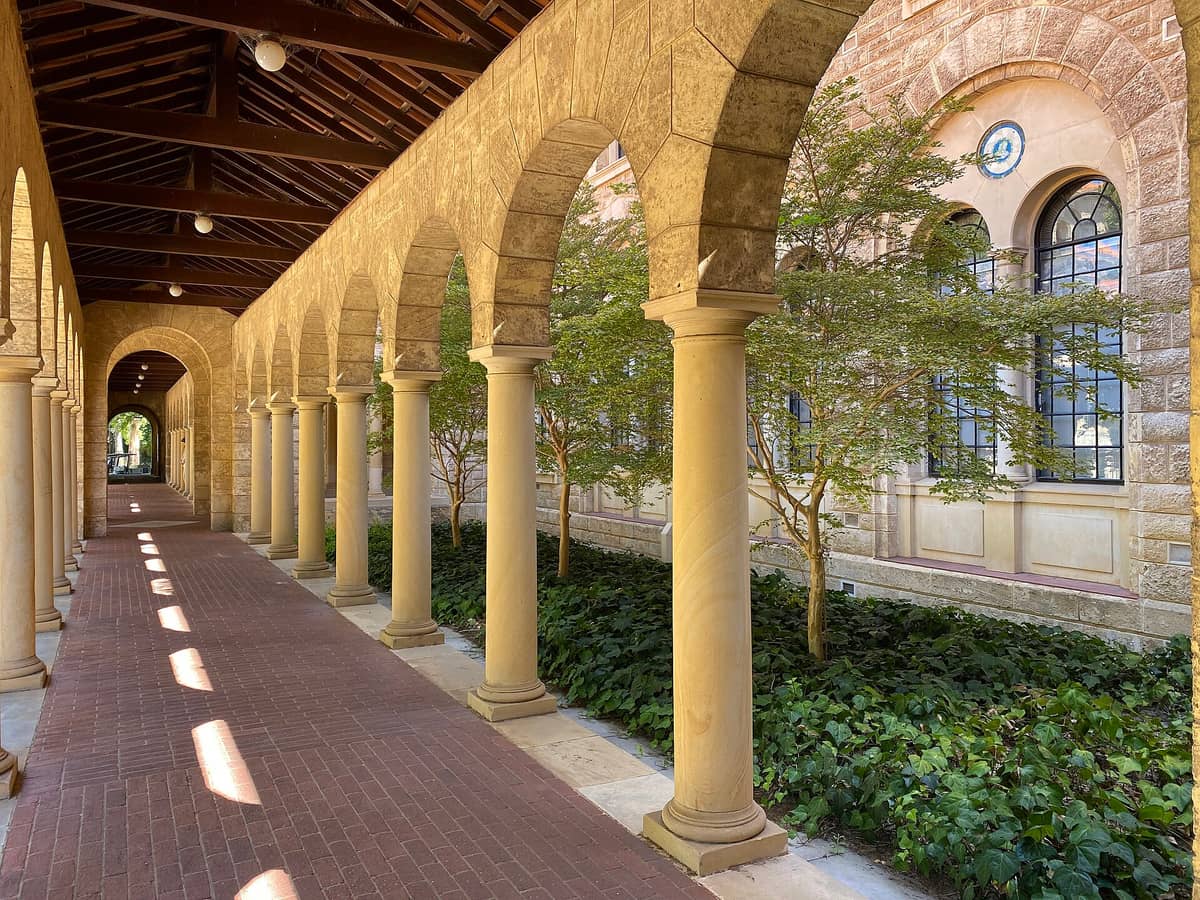
The campus covers 51 hectares along the southern bank of the Swan River, roughly midway between the Perth CBD and the suburb of Nedlands. Building development began in earnest in 1929, which gives the core precinct a unified interwar character: cream-coloured Donnybrook sandstone colonnades, terracotta rooflines, shaded cloisters, and a formal symmetry that feels more Mediterranean than colonial. This is architecture designed for a hot climate, built by people who understood that shade and airflow are not decorative choices.
💡 Local tip
The campus is open to the public and there is no charge to walk the grounds. You do not need to register or sign in to visit as a tourist.
The Architecture: Why the Campus Looks the Way It Does
The dominant building material is Donnybrook sandstone, quarried from the Perth Hills region and used widely in Western Australian civic architecture from the late nineteenth century onward. Under morning light it reads as warm honey-gold; by midday it bleaches toward cream; at dusk, depending on the angle, it can take on an almost amber quality. The stone is tactile, visibly worked, and ages in a way that concrete never does.
The colonnaded walkways that connect the older buildings are the campus's most photographed feature, and for practical reasons as much as aesthetic ones: they provide continuous shade between buildings during Perth's summer months, when daytime temperatures routinely exceed 35°C. The interplay between the covered walkways and the open quadrangles creates a rhythm of shade and light that is genuinely pleasant to walk through.
Winthrop Hall, the university's main ceremonial building, is the architectural centrepiece. Its tower is visible from much of the campus and serves as a useful orientation point. The building's interior is not always open to the public, but the exterior and the surrounding quadrangle are freely accessible and worth spending time around.
Tickets & tours
Live prices and dates from our booking partner. If you book, we may earn a commission at no extra cost to you.
The Bell Tower chiming experience
From 11 €Instant confirmationFree cancellationPinnacles and Swan Valley Full-day Guided Tour
From 201 €Instant confirmationFree cancellationPerth and Fremantle Guided Tour and Swan River Cruise
From 110 €Instant confirmationFree cancellationPerth and Fremantle Tour in German with Hotel Pickup
From 84 €Instant confirmationFree cancellation
The Swan River Foreshore and Matilda Bay
One of UWA's most underappreciated assets is its direct access to the Swan River. The northern edge of the campus meets the foreshore, where lawns slope down to the water and black swans drift in and out of view. The area adjacent to the campus,Matilda Bay, is a calm, shallow inlet popular with kayakers, stand-up paddleboarders, and people who simply want to sit near the water without the surf noise of a coastal beach.
Early mornings on the foreshore are particularly calm. The light off the river is soft, there are almost no other visitors at that hour, and the campus buildings make an unusual backdrop: sandstone and terracotta reflected, however faintly, in still water. Photographers who want something more considered than the standard skyline shot should factor this in.
By late afternoon, especially on weekends, the riverbank attracts a relaxed mix of students, families, and cyclists passing through on the trail that runs along the foreshore. The atmosphere is social but unhurried. There are grassy areas suitable for sitting, and the views across the river toward South Perth are unobstructed and wide.
Public Art, Gardens, and What to Look For
The campus has accumulated a significant collection of public sculptures and artworks placed across the grounds over several decades. Some are large-scale and immediately visible; others require a slower pace to notice. There is no single map that captures every piece, so the experience of finding them is partly serendipitous, which suits the tempo of a campus walk well.
The gardens and planted areas are substantial and well maintained. The combination of native Western Australian species and exotic plantings means that the campus has colour and texture across most of the year. In late winter and early spring, when much of Perth is in wildflower season, the grounds take on additional interest for anyone paying attention to what is growing at ground level.
If the gardens here spark interest in Perth's broader botanical landscape, the Kings Park Botanic Garden is the natural next stop: a much larger collection of Western Australian native flora, about 10 minutes by car to the east.
How the Campus Changes Through the Day
On weekday mornings during semester, the campus is genuinely alive with people. Covered walkways fill with students moving between lectures, cafe seating fills quickly, and the atmosphere is purposeful. For visitors who like to observe a working institution in motion, this is the right time to come. The contrast between the century-old architecture and the contemporary rhythm of university life is more interesting in person than it sounds in description.
Weekend mornings are quieter in the core academic areas but can be busy on the foreshore and in the open lawn spaces. The campus never feels crowded in the way that a central-city attraction does. There is space to move at your own pace, which is part of the point.
Outside of semester, typically in December and January, significant parts of the campus become substantially quieter. Some facilities and cafes reduce their hours or close. Visitors planning a trip during that window should not assume they will find cafes or university services operating on normal schedules.
⚠️ What to skip
Parking on and around campus is limited and metered in most areas. Public transport is the more practical choice: check Transperth's journey planner before visiting, as routes and services may have changed.
Practical Information for Visitors
UWA is located at 35 Stirling Highway, Crawley. Multiple Transperth bus routes serve the campus from the Perth CBD, making it straightforward to visit without a car. The Purple CAT provides a free service to UWA; check the UWA transport and parking page for current details before visiting, as schedules are subject to change.
There is no admission fee to walk the campus grounds. The campus is generally accessible during daylight hours, though individual buildings, galleries, and facilities have their own operating hours. The Future Students office accepts drop-in visitors Monday to Friday, 9am to 4pm, with December hours subject to change.
UWA publishes an accessibility map for the campus; individual accessible routes and facilities are best confirmed directly with the university before visiting if this is a specific requirement.
If you are planning a wider day around this part of Perth, the Elizabeth Quaywaterfront development and the Perth CBD are a short bus or car journey away. Alternatively, the campus pairs naturally with a walk along the Swan River foreshore toward South Perth or back toward the city.
Who This Attraction Is Not For
Visitors expecting a curated tourist experience with signage, audio guides, and clear visitor pathways will find UWA underdeveloped in that sense. It is a working university campus, not a heritage precinct managed for tourism. If you need structured guidance to feel comfortable in a space, this may feel underwhelming.
It is also worth being direct: UWA is architecturally significant by Perth's standards, but it would not be the standout campus in a city like Oxford, Edinburgh, or Bologna. Its appeal is proportional to how much you value quiet green space, good sandstone buildings, and proximity to a calm stretch of river. On those terms, it genuinely delivers. As a 'destination attraction' with singular wow-factor, it does not.
Travellers focused primarily on Perth's beach corridor, from Cottesloe Beachnorthward to Scarborough, may find UWA a detour that doesn't fit their itinerary. It works best when combined with the river foreshore, a visit to nearby Matilda Bay, or as part of a broader exploration of Perth's inner western suburbs.
Photography Notes
The sandstone colonnades photograph best in the hour after sunrise and the hour before sunset, when angled light picks out the texture of the stone and the shadows under the arcades deepen. Midday light flattens the architecture considerably. The foreshore views work at any time of day but are particularly good in the morning when the river surface is calm.
Wide-angle lenses suit the colonnaded walkways and the formal quadrangles. The Winthrop Hall tower frames well from the main quadrangle. For the foreshore, a longer focal length picks out the black swans and the South Perth skyline without requiring you to get close to the water's edge.
ℹ️ Good to know
Drone use on the UWA campus and adjacent river foreshore is subject to Civil Aviation Safety Authority (CASA) regulations and university policy. Check both before flying.
Insider Tips
- The covered colonnades on the western side of the main quad are the coolest part of the campus in summer heat. If you are visiting between December and February, plan your route to stay in shade and carry water.
- The Sunken Garden, tucked between several of the older sandstone buildings, is a quieter counterpoint to the main quad and easy to miss if you are following the obvious pedestrian paths. Worth seeking out.
- UWA's main library building is open to the public during operating hours and contains some interesting architectural details in its interior. It is not a formal tourist sight, but walking through it gives a better sense of the campus than the exterior alone.
- The Matilda Bay foreshore immediately north of the campus is better for sitting and watching the river than the campus lawn areas themselves. Bring something to sit on and plan to stay a while if the weather is good.
- Perth's free and reduced-fare public transport options make getting to UWA straightforward from the CBD. Check Transperth's journey planner for current routes rather than relying on cached directions, as services are periodically adjusted.
Who Is University of Western Australia (UWA) For?
- Architecture and design travellers interested in early twentieth-century Australian civic buildings
- Photographers looking for sandstone textures, river reflections, and framed walkways
- Families wanting a free, open, low-pressure green space away from commercial attractions
- Solo travellers who prefer unhurried exploration over guided tours
- Anyone visiting Perth in wildflower season who wants planted grounds alongside native bushland
Nearby Attractions
Combine your visit with:
- AQWA – The Aquarium of Western Australia
AQWA – The Aquarium of Western Australia at Hillarys Boat Harbour is the state's largest aquarium, built around a 98-metre underwater tunnel that replicates five distinct West Australian marine zones. It draws families, ocean enthusiasts, and travellers curious about the marine life that makes this coastline one of the most biodiverse in the Southern Hemisphere.
- Bold Park
Bold Park is a 437-hectare A-class nature reserve on Whadjuk Noongar Country, protecting some of the last intact coastal heath near central Perth. Free to enter and open daily, it offers walking trails, a panoramic hilltop lookout, and some of the richest concentrations of native wildflowers in the metropolitan area.
- City Beach
City Beach is a well-maintained stretch of Indian Ocean coastline about 12 kilometres from Perth's city centre. With patrolled swimming, solid amenities, and genuine surf, it draws a wide range of visitors without the commercial noise of some of Perth's busier coastal strips.
- Crown Perth
Crown Perth is Western Australia's largest integrated entertainment complex, sitting on the south bank of the Swan River in Burswood. From a 24-hour casino and three hotels to dozens of restaurants, bars and live event venues, it covers an enormous amount of ground — and rewards some planning before you arrive.
Planning a trip? Discover personalized activities with the Nomado app.