Jack Daniel's Distillery: The Complete Guide to America's Most Famous Whiskey Tour
Located in Lynchburg, Tennessee, about 90 minutes southeast of Nashville, Jack Daniel's Distillery is the oldest registered distillery in the United States, established in 1866 and listed on the National Register of Historic Places. Multiple guided tour options range from a straightforward production walk-through to intimate tasting experiences, making it one of the most rewarding day trips from Nashville for whiskey enthusiasts and history buffs alike.
Quick Facts
- Location
- 133 Lynchburg Highway, Lynchburg, TN 37352 — approx. 70 miles (90 min drive) southeast of Nashville
- Getting There
- Car or organized Nashville day-tour operator; no direct public transit from Nashville
- Time Needed
- Half day minimum; full day if you combine with exploring Lynchburg town square
- Cost
- Approx. USD $25–$75 per person depending on tour type; verify current pricing at jackdaniels.com
- Best for
- Whiskey lovers, American history fans, distillery tourism, Nashville day-trippers
- Official website
- www.jackdaniels.com
Why This Distillery Is Worth the Drive
Jack Daniel's Distillery is not just a brand experience. It is a working production facility with a legitimate claim to history: it is widely recognized as the oldest registered distillery in the United States, with roots tracing back to the 1860s and an often-cited establishment year of 1866 for its registration as a distillery. The site is listed on the National Register of Historic Places, and the physical setting reinforces that weight. The distillery sits in a hollow carved out of the Tennessee hills, fed by an iron-free limestone spring that Jack Daniel identified as essential to his process. That spring still feeds production today.
Lynchburg itself is a small town of roughly 6,000 residents in the wider Lynchburg-Moore County area, and the distillery is its dominant institution. The irony that Moore County, where Lynchburg sits, has historically been considered a dry county — with very limited alcohol sales and no liquor stores — has become part of the tour's standard talking points. Whiskey can be purchased at the distillery’s White Rabbit Bottle Shop under a special retail permit, but you are still unlikely to find mixed-whiskey cocktails widely available around the square. For visitors who appreciate this kind of historical contradiction, it adds texture to the experience.
ℹ️ Good to know
Advance booking is strongly recommended, especially for the premium tasting tours (such as the Flight of Jack and Angel's Share experiences). These have limited capacity and sell out on weekends. The base Dry County Tour is more walk-up friendly but can still see waits during peak season.
Getting There from Nashville
The distillery is approximately 70 miles southeast of Nashville, a drive that takes roughly 85 to 100 minutes depending on traffic and your starting point. The route via I-24 South toward Shelbyville, then down through the rolling farmland of middle Tennessee, is straightforward and pleasant, particularly in spring and fall when the landscape is at its most photogenic. There is no public transit option that makes this trip practical; a car or an organized tour is your realistic choice.
Several Nashville-based tour operators run guided day trips that handle the driving, which is worth considering if you plan to participate in tasting experiences. If you are already planning a broader exploration of middle Tennessee, this pairs well with other day trips from Nashville such as the Natchez Trace Parkway or the historic town of Franklin.
Parking at the distillery is free and generally adequate, though peak summer weekends and October visits can see the lots fill up by mid-morning. Plan to arrive before 10:00 am if you want a smooth start to your tour without a wait for your booking slot confirmation.
Tickets & tours
Live prices and dates from our booking partner. If you book, we may earn a commission at no extra cost to you.
General Jackson showboat lunch or dinner tour in Nashville
From 0 €Instant confirmationGeneral Jackson showboat lunch or dinner tour in Nashville
From 0 €Instant confirmationOld Town trolley tour of Nashville
From 54 €Instant confirmationFree cancellationHatch Show Print guided tour
From 21 €Instant confirmationFree cancellation
Choosing the Right Tour
The distillery offers several distinct guided experiences, and the difference between them is meaningful. A non-tasting production-focused tour (often referred to as the Dry County Tour) is the entry-level option: a walking tour through the production facilities covering the charcoal mellowing process (Jack Daniel's uses the Lincoln County Process, which filters new spirit through 10 feet of sugar maple charcoal before it enters the barrel), the barrel warehouses, and the historic cave spring. This tour does not include whiskey tasting, which is what the 'dry county' name nods at, and it is open to visitors of all ages.
The Flight of Jack tour adds structured tastings of multiple expressions at the White Rabbit Saloon on the property. The Angel's Share and Bonded Tour options go deeper into production details and barrel selection, with more focused tasting components. All tasting tours require participants to be 21 or older with valid ID. Recent reports place prices in the range of approximately USD $25 to $75 depending on the experience, though these figures shift seasonally and with new offerings. Always confirm current pricing directly with the distillery before booking.
💡 Local tip
If you are visiting with a mixed group where some members cannot or do not drink, the Dry County Tour is genuinely engaging for non-drinkers. The production process, cave spring, and historical context hold up without the tasting component.
What the Experience Actually Feels and Smells Like
Arriving at the property, the first thing most visitors notice before they even park is the smell. The sweet, slightly sharp scent of fermenting grain and charcoal hangs in the hollow, more pronounced on warm days and in the later morning hours as the temperature climbs. It is not unpleasant — it is distinctive, and it signals immediately that this is a real production site, not a museum replica.
The cave spring hollow is the visual centerpiece of the property. The spring emerges from the limestone at a constant 56°F year-round, and the stone walls and wooden structures surrounding it have been part of the operation for over a century. Early morning tours, particularly in cooler months, sometimes see a light mist rising from the spring and the hollow floor, which makes for striking photographs. The hollows in middle Tennessee hold cold air longer than open ground, so even in late spring, that area of the tour has a refreshing chill to it.
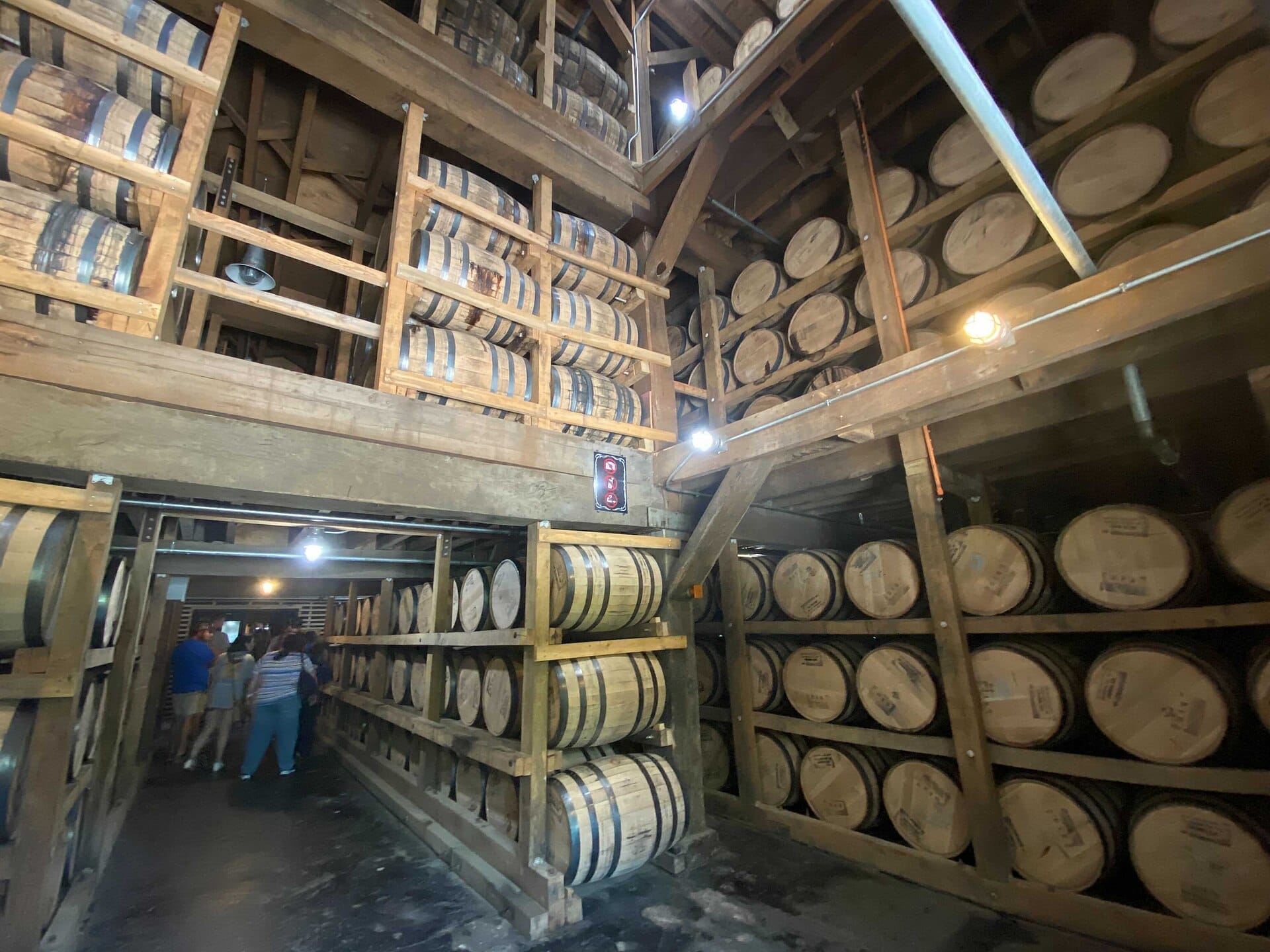
The barrel warehouses are imposing multi-story structures called rickhouses, and standing inside one is an experience in itself. The smell intensifies sharply — a concentrated blend of oak, caramel, and ethanol vapor called the 'angel's share,' the portion that evaporates through the barrel wood each year. The sound is silence cut through by the occasional creak of wood expanding in the heat. Rows of barrels recede into darkness in both directions. It is one of those sensory moments that photographs do not quite capture.
Historical Context: More Than a Marketing Story
Jack Daniel is believed to have learned distilling from a Lutheran minister and storekeeper named Dan Call in the early 1860s, making him one of the younger entrepreneurs in American distilling history — some accounts suggest he was producing whiskey as a teenager. The distillery’s establishment and registration date of 1866 is the figure used to support the 'oldest registered distillery in the United States' claim, though the broader history of American spirits is complex and contested in places. What is documented is that Daniel built a commercially significant operation before his death in 1911, with the brand passing through family and corporate ownership until Brown-Forman Corporation, a Louisville-based spirits company, acquired it in 1956.
The Lincoln County Process — the charcoal mellowing step that technically classifies the spirit as Tennessee whiskey rather than bourbon — is a point of genuine historical and production interest for anyone who has engaged with the broader Nashville distillery tour scene. The process predates Jack Daniel and was used by other Tennessee producers, but the brand made it famous globally.
Practical Walkthrough: What a Visit Looks Like
Tours depart from the main visitor center, which was completed in the late 1990s and houses the gift shop, check-in area, and an introductory exhibit space covering the brand's history. Groups are moderate in size and move as a unit with a guide. The walking distance across the full tour route is meaningful — expect uneven ground, gravel paths, and some stairs depending on which sections are included. Comfortable, closed-toe shoes are the practical choice. The tour generally runs between 60 and 90 minutes for standard options, longer for premium experiences.
The gift shop is extensive and includes the ability to purchase bottles with custom engraving, barrel program memberships, and the full product range. This is the main place in Moore County where you can legally purchase Jack Daniel's products for immediate takeaway, which gives the shop an added significance for visitors who want to bring something home. Queue times at the shop are longest in the early afternoon, so either make your purchase at the start of your visit or loop back after most tour groups have departed.
After the tour, Lynchburg's town square is a short drive or walk away. Miss Mary Bobo's Boarding House, a family-style restaurant that dates back to the early 1900s and is now operated in partnership with the Jack Daniel’s brand, offers lunch seatings that require advance reservations and fill up quickly. It represents a genuine slice of southern hospitality dining and is worth booking separately if your visit schedule allows.
⚠️ What to skip
Weather matters significantly here. Summer visits mean heat and humidity in the rickhouses and outdoor portions of the tour — temperatures inside can feel considerably hotter than the ambient air. Bring water, wear breathable clothing, and consider a morning tour slot. Winter visits are more comfortable for walking but some seasonal tours may have reduced availability.
Who Should Think Twice
Visitors with limited mobility should contact the distillery directly before booking to understand exactly which portions of the tour can be accommodated. The historic site's terrain, stairs, and gravel paths mean that some sections may not be fully accessible, and it is better to have that conversation ahead of time than to discover it on arrival.
Travelers who are not interested in distilling, whiskey, or American industrial history may find the 90-minute round trip investment of time from Nashville difficult to justify. Nashville itself has a growing craft spirits scene, and Nelson's Green Brier Distillery offers a distillery experience within the city limits without the drive. For visitors with a full itinerary in Nashville, weighing that option against a half-day departure is a reasonable consideration.
Insider Tips
- Book the first tour slot of the day (often around 9:00 am) to beat group tour buses that tend to arrive mid-morning. The hollow is cooler, the crowds are thinner, and guides tend to be more conversational with smaller early groups.
- If you are serious about whiskey, ask your guide specifically about the Single Barrel collection and the barrel warehouse selection process. The guides who are enthusiasts will go well beyond the scripted tour content if you show genuine interest.
- The cave spring area is the single best photography location on the property. Position yourself at the spring itself looking back toward the wooden structures for a frame that evokes the historical setting rather than the commercial brand.
- Miss Mary Bobo's Boarding House lunch requires a separate reservation and sells out weeks in advance during peak season. Book it at the same time you book your distillery tour, not as an afterthought.
- Driving back to Nashville via the Natchez Trace Parkway rather than the interstate can add roughly 20 to 30 minutes or more but delivers a dramatically more scenic route through protected National Park Service land with no commercial traffic allowed.
Who Is Jack Daniel's Distillery For?
- Whiskey and spirits enthusiasts who want to see a landmark Tennessee distillery in full production
- American history and industrial heritage travelers who appreciate on-site context over museum exhibits
- Nashville visitors with a rental car looking for a structured half-day or full-day excursion beyond the city
- Groups who want a shared experiential activity with multiple tour format options to suit different preferences
- Photography-minded travelers drawn to atmospheric industrial and historic settings
Nearby Attractions
Combine your visit with:
- Arrington Vineyards
Arrington Vineyards is a working winery set on 95 acres of rolling Tennessee countryside about 25 miles south of Nashville. With 16 acres of estate vines, five tasting rooms, and a calendar full of live music events, it offers a genuinely relaxed alternative to the city's usual attractions.
- Carnton
Built in 1826 and thrust into Civil War history on a single November night in 1864, Carnton in Franklin, Tennessee stands as one of the most significant and sobering historic sites near Nashville. The mansion served as the principal Confederate field hospital after the Battle of Franklin, and four Confederate generals killed in action were laid on its back porch. Today it operates as a museum alongside the McGavock Confederate Cemetery, one of the largest privately owned Confederate cemeteries in the United States.
- Downtown Franklin Historic District
About 21 miles south of Nashville, the Downtown Franklin Historic District packs genuine 19th-century architecture, Civil War history, and an independently owned Main Street into a walkable few blocks. Entry is free, the streets are open all day, and it rewards slower travelers who actually stop to look up.
- GEODIS Park
Opened in May 2022, GEODIS Park is one of the largest soccer-specific stadiums in the United States, seating over 30,000 fans. Home to Nashville SC and a growing concert calendar, it brings serious sports infrastructure to a city better known for music.
Planning a trip? Discover personalized activities with the Nomado app.