Cala Salada & Cala Saladeta: Ibiza's Most Beautiful Twin Coves
Cala Salada and Cala Saladeta sit side by side on Ibiza's northwest coast, about 6 km from San Antonio. Together they offer some of the island's clearest turquoise water in a protected natural setting. One has facilities; the other demands a short walk and rewards you with almost complete seclusion.
Quick Facts
- Location
- Camí Cala Salada, 07828 Sant Antoni de Portmany — about 6 km north of San Antonio town
- Getting There
- Summer shuttle bus from free car park near Sant Antoni (Connected Beaches scheme); ferry from Sant Antoni port; or car via the signed local road north toward Santa Agnès
- Time Needed
- 2–4 hours for both coves; full day if you swim, snorkel, and eat
- Cost
- Free beach access. Parking at shuttle point is free. Check current bus/ferry fares locally before visiting.
- Best for
- Snorkelling, clear-water swimming, couples, nature lovers, photography
What You're Actually Visiting
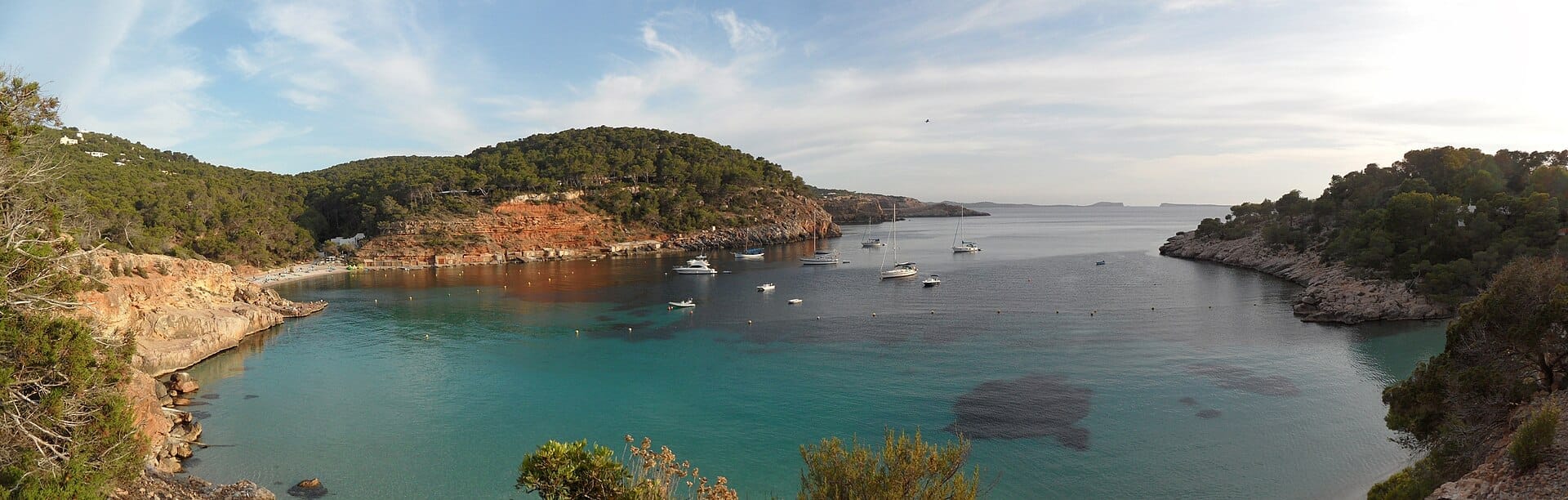
Cala Salada and Cala Saladeta are two adjacent coves carved into the pine-covered limestone cliffs of Ibiza's northwest coast, inside the Es Amunts protected natural area. Cala Salada is the larger of the pair: roughly 80 metres long and 25 metres wide, with fine gravel-and-sand mix, a handful of seasonal beach bars, adapted facilities, and a wooden fishermen's hut perched on the rocks to the left that has become one of the island's most photographed landmarks. Cala Saladeta sits a short walk further along the coastal path: about 50 metres long and 20 metres wide, with no services and no road access, only the sea in front of you and dense scrubland behind.
Both coves share the same water: shallow, intensely clear, and layered in shifting greens and blues over a sandy floor. The visibility here regularly exceeds several metres, fed by the Posidonia oceanica seagrass meadows that fringe the bay and help keep the Mediterranean along this coast unusually clean. That ecological context matters: this is one reason the water looks the way it does, and it is also why the Es Amunts area carries strict environmental protections.
ℹ️ Good to know
Es Amunts is a designated natural protected area covering the northwest of Ibiza. Anchoring is restricted in the cove to protect Posidonia seagrass meadows. Take your rubbish with you from Cala Saladeta — there are no bins.
How the Experience Changes Through the Day
Arrive before 10:00 and Cala Salada is a different place entirely. The morning light comes from the east, which means the cove sits in soft, diffused shadow early on, with the water appearing deep jade rather than the blazing turquoise of midday. The rocks are cool underfoot. The only sounds are water against the stone jetty and the occasional creak of a small fishing boat. At this hour you might share the beach with five or six people at most.
By 11:30 the sun clears the cliffs and hits the water directly. The colour shift is dramatic: the shallows turn pale turquoise, the sand below is fully lit, and the cove starts filling quickly. July and August afternoons bring real crowds to Cala Salada — sunbeds line up in rows, the bar operates at full pace, and finding a flat rock to lay a towel requires patience. The noise level rises markedly. This is when Cala Saladeta earns its value: the coastal path from Cala Salada takes around 10 to 15 minutes on foot over pine-shaded rock, and the second cove absorbs far fewer people simply because of the walk.
Late afternoon, roughly from 17:00 onward, the crowd thins and the light turns golden against the pine trees and limestone. This is the best window for photography. The sunset itself is not directly visible from inside the cove due to the cliff angles, but the sky above the ridge catches colour and the water reflects it back. If watching the actual sun drop into the sea is the goal, the nearby cliffs above the coves offer better sightlines — though the official sunset viewpoints are further south toward San Antonio.
Tickets & tours
Hand-picked options from our booking partner. Prices are indicative; availability and final rates are confirmed when you complete your booking.
Sunset boat tour with tapas, open bar and water sports in Ibiza
From 70 €Instant confirmationFree cancellationEscape Tour self-guided, interactive city challenge in Ibiza
From 30 €Instant confirmationPrivate Sunset Cruise on a Maritime Classic in Ibiza
From 750 €Instant confirmationFree cancellationIbiza to Formentera boat trip with open bar and water sports
From 69 €Instant confirmationFree cancellation
Cala Salada vs Cala Saladeta: Which One to Choose
The two coves appeal to different priorities and there is no need to choose — most visitors do both, since the coastal path connecting them is short and reasonably easy on flat-soled footwear. The key distinction is infrastructure. Cala Salada has a seasonal beach bar, adapted WC with shower, a walkway for wheelchair access, and a lifeguard post. Cala Saladeta has none of these things. You bring your own water, your own sunscreen, and you carry out your own rubbish.
For swimming, Cala Saladeta edges ahead on water clarity and tranquillity, particularly mid-morning on weekdays. For families with young children or anyone with mobility considerations, Cala Salada is the practical base: the entry into the water is gentle, the beach is supervised, and facilities are within easy reach. For snorkelling, both coves reward exploration of the rocky flanks where Mediterranean species shelter among the weed-covered boulders.
⚠️ What to skip
Cala Saladeta is only reachable via the coastal path from Cala Salada. There is no road or vehicle access. People with reduced mobility should be aware the path involves uneven rock surfaces.
Getting There Without a Car
The road to Cala Salada is narrow and parking directly at the cove is extremely limited. In summer, driving all the way to the beach and expecting a parking space is largely wishful thinking. The municipality of Sant Antoni de Portmany operates a Connected Beaches scheme: a free car park on the outskirts of Sant Antoni town where you leave your vehicle, then board a shuttle bus (line P7) to the cove. This is the most reliable summer option for drivers. Verify current timetables and fares with the operator before travelling, as summer schedules change annually.
A more enjoyable alternative, particularly in the morning: the regular summer ferry service from Sant Antoni port. The boat takes roughly 15 to 20 minutes, drops you directly at Cala Salada, and spares you any parking stress entirely. Check departure times at the port or with your accommodation before you go. For more on navigating the island without a car, the guide to getting around Ibiza covers island-wide transport options in detail.
What to Bring and What to Wear
Both coves have a mix of sand, fine gravel, and flat rock. Reef or water shoes are worth bringing if you are sensitive to uneven surfaces, particularly at Cala Saladeta where entry into the water is partly over rounded stones. Flip-flops alone are sufficient for Cala Salada's main beach area.
Shade is limited on both beaches once the sun is high. The pine trees behind the upper section of Cala Salada provide some natural cover in the late morning, but the main beach is fully exposed. A beach umbrella (available for hire at Cala Salada in season) is worth considering for a full day visit in July or August. Sun protection factor should be high: the water reflects UV and the limestone rocks radiate heat.
For Cala Saladeta, bring everything you need including water and snacks. There is no bar, no shade structure, and no nearby shop. The coastal path also has exposed sections, so sunscreen on the walk over is not optional.
Snorkelling, Swimming, and the Water Itself
The water quality at Cala Salada and Cala Saladeta consistently ranks among the clearest on Ibiza's west coast. The underlying reason is ecological: the Posidonia oceanica seagrass beds that extend offshore act as a natural filtration system and nursery for fish, keeping the water oxygenated and free of fine sediment. This is the same seagrass ecosystem that contributes to Ibiza's UNESCO World Heritage status, designated in 1999 for both cultural and natural values.
Snorkelling along the rocky edges of either cove turns up sea urchins, wrasse, bream, and the occasional octopus tucked into shaded crevices. The rock walls drop steeply on both sides of each cove, offering more interesting underwater topography than most sandy-floored Ibizan beaches. Mask and fins improve the experience considerably; snorkel hire is not reliably available at either cove, so bring your own if you plan to explore underwater.
Open-water swimmers sometimes use Cala Salada as a starting point for coastal swims along the cliff line toward the north. This section of coast is part of the wider Es Amunts hiking and coastal trail network. If coastal walking is a priority, the Ibiza hiking guide covers the full range of trail options across the island.
What to Expect: Who This Is and Isn't For
Cala Salada has a deserved reputation as one of Ibiza's most beautiful coves, and in the right conditions — early morning, outside July and August peak weeks, or on a weekday — that reputation holds. The water is genuinely exceptional. The setting, with its pine-scented cliffs and traditional fishermen's structures, is more characterful than most purpose-built resort beaches.
But it is not undiscovered, and it is not large. In peak summer it fills to capacity, sunbeds pack the sand tightly, and the access road becomes a source of genuine frustration for anyone who drives there without using the shuttle system. If your mental image is a deserted cove, you may need to manage expectations. The beach is small enough that even 150 people feels like a crowd. For travellers who prioritise space and solitude above all else, the broader guide to Ibiza's less-visited spots may point to alternatives in the north of the island that see significantly less traffic.
Visitors with limited mobility can access Cala Salada comfortably via the adapted walkway and adapted WC. Cala Saladeta is not accessible for wheelchair users or those who cannot manage an uneven rocky path. For families, Cala Salada works well: gentle water entry, lifeguard supervision in season, and the bar means drinks and basic food are available without carrying everything from the car.
Anyone visiting Ibiza for the first time and trying to build a sensible itinerary around beach quality, ease of access, and natural setting will find Cala Salada worth the short detour from San Antonio. It fits naturally into a west-coast day that might also include Cala Comte further south, or a stop at the Sunset Strip in San Antonio in the evening.
Insider Tips
- The ferry from Sant Antoni port is consistently the most stress-free way to arrive in summer. You skip parking entirely, the boat takes about 15–20 minutes, and the approach from the sea gives you the full visual impact of the cove before you even step off.
- Arrive at Cala Saladeta by 09:30 on any day in July or August and you will often have the whole cove to yourself for at least an hour. It empties again after 18:00 as the sun drops behind the cliffs and the temperature cools.
- The wooden fishermen's caseta (hut) on the left-hand rocks of Cala Salada photographs best in the hour before midday when the light hits the wood directly. By afternoon the structure is backlit and contrast is harsh.
- The coastal path between the two coves has a fork partway along — take the lower route closer to the water for better sea views and easier footing, not the upper track which climbs unnecessarily.
- Neither cove has reliable mobile signal for payments. Bring cash for the beach bar at Cala Salada and for any bus or ferry tickets you have not pre-paid.
Who Is Cala Salada & Cala Saladeta For?
- Snorkellers and swimmers who prioritise water clarity over beach size
- Couples looking for a scenic, relatively quiet morning beach within easy reach of San Antonio
- Families with young children wanting supervised, gently shelving water with onsite facilities at Cala Salada
- Photographers, particularly in the golden hour before midday or after 17:00
- Nature-focused travellers interested in Ibiza's Es Amunts protected coastline and Posidonia ecosystem
Nearby Attractions
Other things to see while in San Antonio (Sant Antoni de Portmany):
- Cala Bassa
Cala Bassa is a 250-metre arc of fine sand on Ibiza's western coast, sheltered by pine-covered cliffs and known for exceptionally clear, calm water. Accessible by car, bus, or seasonal ferry from San Antonio, it draws a mixed crowd from families to beach-club regulars, and offers one of the more complete beach experiences on the island.
- Cala Comte (Cala Conta)
Cala Comte, officially known as Platges de Comte, is a cluster of three small sandy coves on Ibiza's west coast, facing a chain of rocky islets with some of the clearest water on the island. Free to enter and accessible by car, bus, or seasonal ferry from San Antonio, it draws both families and sunset-chasers, though it gets seriously crowded in peak summer.
- Eden Ibiza
Eden Ibiza has anchored the San Antonio nightlife scene since 1999. With a vast main floor, two DJ booths, multiple bars, and a completely redesigned interior, it draws serious clubbers chasing big-name bookings across the summer season.
- Es Paradis
Open since 1975, Es Paradis is one of Ibiza's most architecturally distinctive nightclubs. Located in central San Antonio, it draws crowds with its 120-ton glass pyramid roof, three dance floors, and the legendary weekly Water Party that floods the dancefloor.