Bata Shoe Museum: Toronto's Surprisingly Absorbing Ode to Footwear
The Bata Shoe Museum on Bloor Street West houses nearly 15,000 shoes and artifacts spanning 4,500 years of human history. Housed in a striking building designed by Raymond Moriyama, it is one of Toronto's most distinctive and underrated cultural institutions — compact, thoughtful, and genuinely engaging for visitors who come with curiosity.
Quick Facts
- Location
- 327 Bloor Street West, Toronto, ON M5S 1W7 (SW corner of Bloor St W and St. George St)
- Getting There
- St. George subway station (TTC Lines 1 and 2) — approximately a 1-minute walk
- Time Needed
- 1.5 to 2.5 hours for a thorough visit; 45–60 minutes for a focused walk-through
- Cost
- Adults $14 CAD, Seniors (65+) $12, Students (18+ with ID) $8, Youth (6–17) $5, Children (under 5) free. Free admission for everyone every Sunday.
- Best for
- History lovers, design enthusiasts, curious travellers, families with older children, rainy-day visits
- Official website
- batashoemuseum.ca
What the Bata Shoe Museum Actually Is
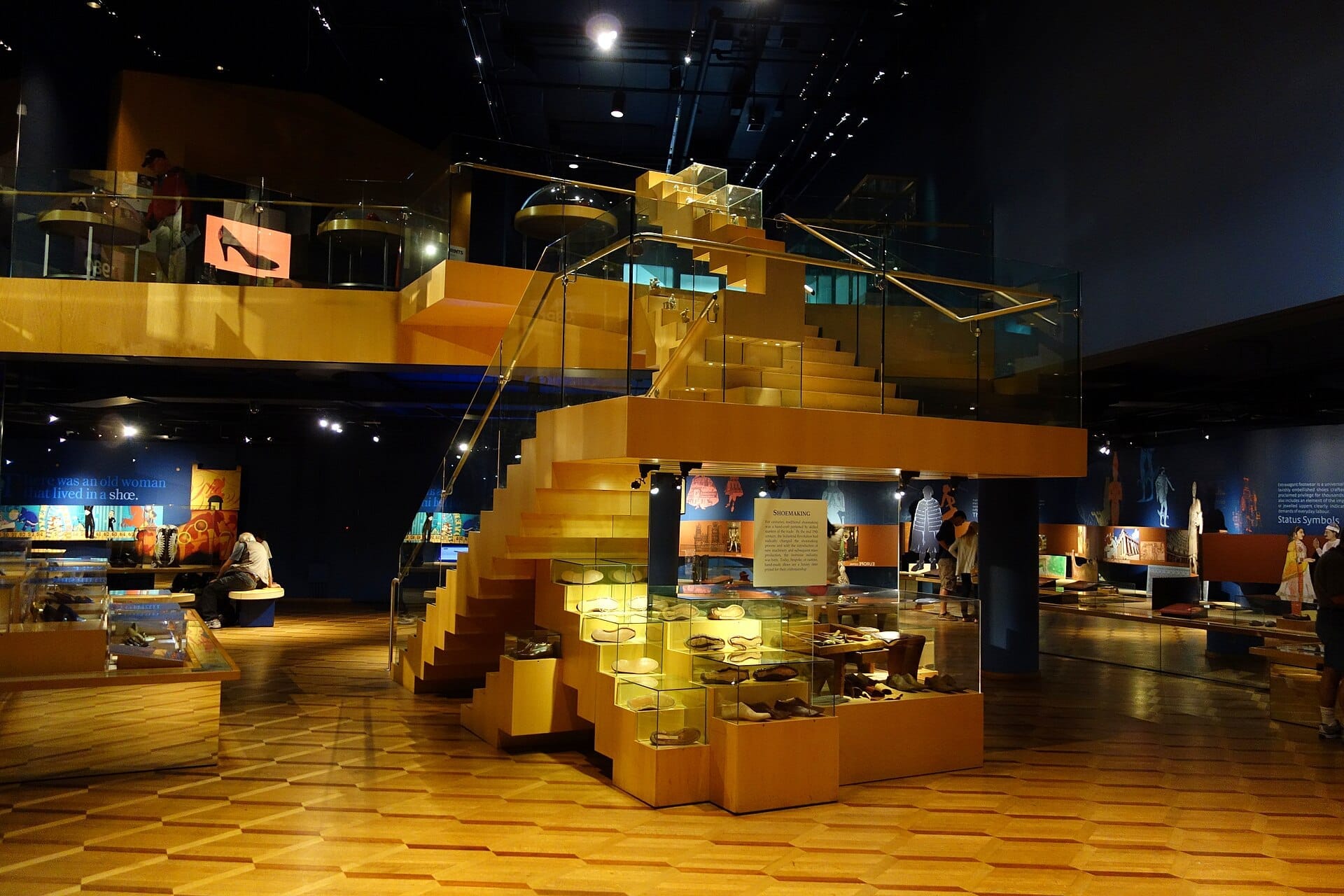
The Bata Shoe Museum is a purpose-built institution dedicated entirely to the history, craft, and cultural meaning of footwear. That may sound narrow, but the collection is genuinely expansive: nearly 15,000 shoes and related artifacts, spanning over 4,500 years of human history across four galleries. You will find lotus shoes from imperial China, beaded moccasins from the Great Plains, platform chopines from Renaissance Venice, and the stage boots of rock and pop icons. The breadth of the collection consistently catches first-time visitors off guard.
The museum opened on May 6, 1995, and was founded by Sonja Bata, a member of the Bata shoe-manufacturing family, to properly care for a private collection that had grown well beyond the capacity of any personal archive. What began as a private passion became one of the most focused and scholarly footwear collections in the world.
💡 Local tip
Visit on a Sunday and admission is free for everyone — no promo code or registration required, regardless of age or residency. It is the most cost-effective day to bring a group or family.
The Building: Raymond Moriyama's Layered Design
Before you step inside, take a moment on the sidewalk to look at the building itself. Designed by Toronto architect Raymond Moriyama of Moriyama and Teshima Architects, the structure is an award-winning exercise in architectural metaphor. The exterior form is widely described as resembling a stacked shoebox, with angled planes and a distinctive slanted roof that creates an asymmetrical silhouette against the surrounding Annex streetscape. The cladding — warm-toned precast concrete with limestone aggregate — reads differently at different hours: muted and subtle in overcast light, almost golden in late afternoon sun.
Moriyama, who is perhaps better known in Toronto for designing the Ontario Science Centre and Scarborough Civic Centre, treated the museum as an opportunity to embed meaning into the structure itself. The building's form signals that something considered and deliberate happens inside — which sets an appropriate tone for a collection that takes its subject seriously. If you are tracing a route through Toronto's architectural landscape, this block of Bloor Street West rewards attention.
The Bata Shoe Museum sits within the broader Yorkville and Annex corridor, a short walk from the Royal Ontario Museum and within easy reach of the Gardiner Museum. Visitors planning a museum-focused day can combine two or three institutions along this stretch of Bloor without needing transit.
Tickets & tours
Live prices and dates from our booking partner. If you book, we may earn a commission at no extra cost to you.
Inside the Galleries: What You Will See
The museum organizes its collection across four galleries. The permanent exhibition 'All About Shoes' forms the backbone of any visit, tracing footwear from prehistoric times through the 20th century. Cases are arranged thematically and culturally, not just chronologically, so you move between contexts — from functional Arctic kamiks stitched from seal and caribou hide to the elevated pattens worn in medieval European streets to keep hems out of the mud. The interpretive text is concise and specific; the curatorial voice avoids vague claims and tends to ground each object in a concrete social or material context.
A second permanent gallery focuses on Sonja Bata's personal collecting history and the Bata organization's global reach. It is more institutional in tone but provides useful context for understanding how a collection of this scale and geographic range came together. The remaining gallery space is reserved for rotating temporary exhibitions, which have historically explored topics ranging from celebrity footwear to the archaeology of ancient sandals. Check the museum's website before your visit to see what is currently installed — the temporary shows vary considerably in subject and scale.
The physical space is compact and well-lit. Display cases are at a comfortable height for adults, though some lower cases may require crouching to read labels fully. The galleries are generally quiet, even on weekday afternoons — this is not a museum that generates a roar of activity. That calm is part of what makes it work: you can spend a full minute with a single object without feeling pressured by crowds behind you.
ℹ️ Good to know
Photography for personal use is generally permitted in the galleries. Flash photography and tripods may be restricted. If you plan to photograph specific objects for editorial or commercial use, contact the museum in advance.
When to Go and How the Experience Changes
Weekday mornings, particularly between 10:00 am and noon, are the quietest windows. School group visits are more common on weekday late mornings through early afternoon, particularly in spring and fall, so if you prefer to move at your own pace and linger at individual cases, arriving at opening on a Tuesday or Wednesday tends to give you the most uninterrupted experience.
Sunday afternoons draw a mix of visitors taking advantage of free admission, which means the galleries see noticeably more foot traffic from roughly 1:00 pm onward. The museum is compact enough that this does create some bottlenecks at popular cases. If you are visiting on a Sunday, arriving close to the 12:00 pm opening time makes a real difference.
Weather has no direct effect on the experience inside, which makes the Bata Shoe Museum one of Toronto's more reliable rainy-day options. The St. George subway station is a one-minute walk, so you will barely be exposed to whatever the sky is doing when arriving by transit.
The museum's Bloor Street West location puts it within a short walk of Yorkville, where you can extend the afternoon with a meal or coffee before or after your visit. The concentration of cafes and restaurants between Bay and Avenue Road means there is no shortage of options for any budget.
Practical Walkthrough: Getting There and Getting Around
The most straightforward way to arrive is via the TTC subway. St. George station sits at the intersection of Bloor Street West and St. George Street and is served by both Line 1 (Yonge-University) and Line 2 (Bloor-Danforth). The museum entrance is visible from the southwest exit — turn left out of the station and it is immediately in front of you. Transit fares are standard TTC rates; verify current pricing at ttc.ca before travel, as fares are updated periodically.
If you are arriving by car, street parking on Bloor Street West is limited and subject to time restrictions. The Green P parking lot on St. George Street, just south of Bloor, is the most practical nearby option. On foot from Yorkville, the walk from Cumberland Street takes roughly eight minutes heading west along Bloor.
Accessibility: the museum's main entrance is at street level and the building includes an elevator. For detailed accessibility information specific to mobility aids, hearing loops, or other requirements, contact the museum directly through batashoemuseum.ca before your visit.
⚠️ What to skip
The museum is closed on December 25 and January 1, and may have modified hours or additional closures around late December; check current details on the official site. Regular hours apply on other statutory holidays. Confirm hours on the official website before visiting, particularly around long weekends.
Photography, the Gift Shop, and Honest Limitations
The museum shop near the entrance is stocked with footwear-themed books, accessories, and design objects that lean toward quality over volume. It is a compact selection and worth browsing, particularly for illustrated reference books related to the collection's themes. Unlike many museum shops that stock generic souvenirs, this one reflects the institution's specific curatorial interests.
On the subject of limitations: the Bata Shoe Museum is a niche institution, and that is not a criticism. If you have no particular interest in material culture, fashion history, or cultural anthropology, this museum is unlikely to convert you. The galleries are small, the pacing is slow, and the subject demands a degree of active engagement from the visitor. Those who walk in expecting a spectacle will leave underwhelmed. Those who slow down and read the interpretive text will often find themselves genuinely absorbed.
For visitors building a fuller Toronto itinerary, the best museums in Toronto guide covers how the Bata Shoe Museum fits alongside larger institutions like the ROM and the AGO, and helps with prioritizing based on interests and available time.
Insider Tips
- The free Sunday admission policy applies to all visitors without exception — no membership or proof of residency required. If your schedule allows any flexibility, Sunday morning at opening is both free and uncrowded.
- The temporary exhibition gallery changes multiple times per year. If you have visited before and found the permanent galleries familiar, check the website for the current show before dismissing a return visit — some temporary exhibitions have been substantially more ambitious than the permanent collection in terms of scope.
- The building's exterior north-facing facade, facing Bloor Street West, photographs best in the hour before sunset when low-angle light catches the textured concrete. If you are interested in architectural photography, plan accordingly.
- The museum is located directly across from the St. George subway station interchange — this stop connects Lines 1 and 2, making it easy to route between Bloor Street institutions and the waterfront or downtown without backtracking.
- Children between ages 5 and 17 pay only $5 CAD on non-Sunday visits, and the celebrity footwear cases and more visually dramatic historical pieces — particularly the towering chopines and heavily beaded examples — tend to hold younger visitors' attention better than the more textually dense historical sections.
Who Is Bata Shoe Museum For?
- History and material culture enthusiasts who engage with object-based storytelling
- Design and fashion researchers or students looking for primary source material in a curated setting
- Families with children aged 8 and older, particularly on free Sundays
- Rainy or cold-day visitors seeking a compact, walkable indoor cultural experience near Bloor Street
- Architecture followers interested in Raymond Moriyama's Toronto work
Nearby Attractions
Other things to see while in Yorkville:
- Bloor-Yorkville Mink Mile
The Mink Mile is Toronto's most prestigious shopping corridor, stretching along Bloor Street West between Yonge Street and Avenue Road in the Yorkville neighbourhood. Home to flagship luxury boutiques, high-end restaurants, and polished streetscapes, it offers a window into Toronto's wealthiest consumer culture — free to walk, endlessly interesting to observe.
- Gardiner Museum
The Gardiner Museum at 111 Queen's Park is Canada's dedicated national ceramics museum, housing around 4,000 objects spanning Ancient Americas pottery, Chinese blue and white porcelain, European earthenware, and contemporary Canadian ceramics. Compact, focused, and genuinely undervisited, it rewards curiosity about craft and material culture in a way that few larger institutions can.
- Royal Ontario Museum
The Royal Ontario Museum holds roughly 18 million objects across natural history, world cultures, and art, all housed in a building that is itself worth studying. From the dinosaur galleries to Daniel Libeskind's angular Crystal addition, the ROM rewards a full half-day of attention.
Planning a trip? Discover personalized activities with the Nomado app.