South Perth Foreshore: Four Kilometres of Riverfront, Zero Entry Fee
South Perth Foreshore stretches more than four kilometres along the Swan River's south bank, offering some of Perth's most recognisable skyline views across open parkland, cycling paths, and riverside reserves. Free to access and reachable by ferry from the CBD, it rewards visitors at any time of day.
Quick Facts
- Location
- South Perth, Western Australia — extends from Narrows Bridge to Ellam Street, incorporating Sir James Mitchell Park, South Perth Esplanade Reserve, Mill Point Reserve and Clydesdale Reserve
- Getting There
- Transperth ferry from Elizabeth Quay Jetty to Mends Street Jetty (South Perth). Bus routes also serve South Perth from the CBD. Check the Transperth journey planner for current timetables.
- Time Needed
- 1–3 hours for a relaxed walk; half a day if cycling the full length or combining with Perth Zoo
- Cost
- Free to enter. Parking available nearby; some foreshore car parks offer one hour free with an active parking session. Ferry fare applies if using Transperth.
- Best for
- Skyline photography, family picnics, cycling, dog walking, and watching sunset light on the CBD
What Is South Perth Foreshore?
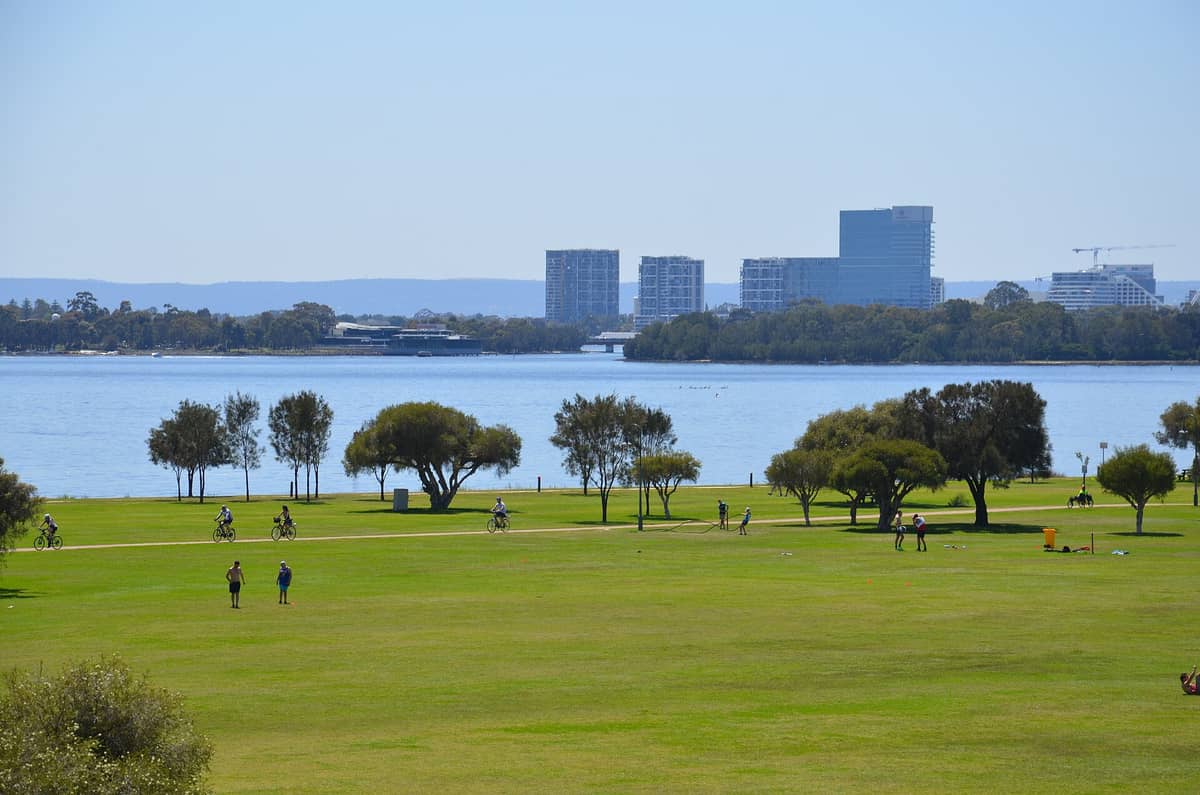
South Perth Foreshore is a continuous ribbon of public open space on the southern bank of the Swan River, sitting directly across the water from Perth's central business district. At approximately 62 hectares and more than four kilometres of north-facing riverfront, it is one of the largest and most accessible stretches of riverbank parkland in the city. Rather than a single fenced attraction with a gate and a ticket booth, it is a network of connected reserves: Sir James Mitchell Park, South Perth Esplanade Reserve, Mill Point Reserve and Clydesdale Reserve together form the foreshore corridor between the Narrows Bridge and Ellam Street.
That north-facing orientation matters more than it might seem. For most of the day, the foreshore receives direct sunlight while looking straight across the river toward the CBD skyline, which means the city's glass towers are lit from behind the viewer rather than into the camera. It is a detail that makes the foreshore a genuinely productive spot for photography, not just a pleasant walking route.
💡 Local tip
The Transperth ferry from Elizabeth Quay Jetty to Mends Street Jetty is the most atmospheric way to arrive. The crossing takes about eight minutes but delivers you directly onto the foreshore with the CBD behind you and the parkland stretching out ahead. Check current Transperth timetables before you travel, as service frequency varies by time of day.
How the Foreshore Changes Through the Day
Early mornings on the foreshore belong to a specific local crowd: joggers working the flat riverside path, dog walkers letting dogs into the grass, and cyclists who use the dedicated shared path as a training loop. The air at this hour sits cool and slightly damp, carrying the particular mineral smell of the Swan River at low tide. The CBD across the water catches the first eastern light, and the glass facade of the buildings turns a pale gold that disappears quickly once the sun climbs higher.
Midday in summer is when the foreshore demands respect. Perth's mean maximum temperature reaches around 31 to 32 degrees Celsius in January and February, and the open riverside has little tree canopy in places. Families with young children tend to gravitate toward the shaded playground areas and the sections of Sir James Mitchell Park with established tree cover. If you are walking the full length in summer, bring water, wear sun protection, and plan to be finished before early afternoon.
Late afternoon shifts the tone considerably. The light softens across the river, picnic groups set up on the grass, and the foreshore fills with people who have finished work and cycled or ferried over from the CBD. This is the hour the foreshore performs best: the skyline is warm, the path is busy without being crowded, and the ferry service runs to a timetable, so check departure times before heading back.
Evenings in spring and autumn are especially worth seeking out. Perth's Mediterranean climate keeps autumn evenings warm well into May, and the foreshore after sunset has a different character to the daytime version: quieter, with the CBD lights reflected across the water and the path lit softly along its length. It is not a nightlife destination, but it is a place worth staying past sundown if the weather permits.
Tickets & tours
Live prices and dates from our booking partner. If you book, we may earn a commission at no extra cost to you.
Perth and Fremantle Guided Tour and Swan River Cruise
From 110 €Instant confirmationFree cancellationPerth and Fremantle Tour in German with Hotel Pickup
From 84 €Instant confirmationFree cancellationDay Trip Around Perth with Swan River Cruise and Rottnest Island Visit
From 172 €Instant confirmationFree cancellationPerth, Fremantle, Rottnest Island, and Swan River Guided Tour
From 166 €Instant confirmationFree cancellation
The Skyline View: What You Actually See
The view from South Perth Foreshore is probably the most reproduced image in Perth tourism photography, and for good reason: the river is wide enough here that the CBD skyline reads as a coherent composition rather than a fragmented cluster of buildings. From the central sections of the esplanade, you can see the full sweep of the city's high-rise core, with Kings Park's tree line visible on the ridge behind it, and Optus Stadium's distinctive roof to the east.
For photography, the hour after sunrise and the 30 minutes before sunset produce the most useful light, with the sun behind you and hitting the buildings directly. Overcast mornings can also work well — flat light softens the contrast on the water. The foreshore is long enough that you can reposition laterally to find a framing that excludes other visitors or changes the relationship between the water and the skyline. If you want to explore Perth's viewing spots more systematically, thePerth views guide covers the range of angles on the city from different vantage points.
Walking and Cycling the Foreshore
The foreshore's shared pedestrian and cycling path runs along the riverside for the full length of the corridor. It is wide enough to accommodate both users comfortably for most of its length, though the sections near Mends Street Jetty and the playground areas get congested on weekend afternoons when pedestrian traffic is at its peak. Cyclists approaching from the busier sections should reduce speed; the path is popular with families and younger children who move unpredictably.
Perth Zoo is accessible from the foreshore at the western end of the corridor, making a combined foreshore walk and zoo visit a practical itinerary for families. Sir James Mitchell Park also sits adjacent to the zoo precinct, giving this end of the foreshore its densest tree cover and some of the better shade for picnicking. If you are planning a full day in the area, thePerth Zoo opens early and is walkable from the foreshore path without needing to cross any major roads.
The path connects into the broader Transperth Cycle Network, so cyclists arriving by bike from the CBD via the Narrows Bridge or from the south can join the foreshore route without significant route-finding. The surface is sealed throughout and reasonably smooth, making it accessible for prams and wheelchairs as well as cyclists and runners.
Getting There and Getting Around
The Transperth ferry from Elizabeth Quay Jetty to Mends Street Jetty is the most direct route from the CBD and takes about eight minutes on the water. It operates on regular timetables — check the Transperth journey planner for current departure times before you travel. Elizabeth Quay itself is worth a few minutes of your time; theElizabeth Quay precinct on the city side has cafes and open space that work well as a staging point before or after the ferry crossing.
Bus services from the CBD also reach South Perth, with stops on Mends Street and adjacent streets giving access to the northern end of the foreshore within a short walk. Driving is possible, with parking available in the area; some foreshore car parks offer one hour of free parking with an active parking session, though this varies by site and should be verified against current City of South Perth signage on arrival.
The foreshore is relatively straightforward to incorporate into a wider Perth itinerary. It pairs naturally with a walk throughKings Park and Botanic Garden, which sits on the ridge directly across the river, or with a visit to the CBD's cultural precinct. A morning at Kings Park followed by an afternoon on the foreshore is a practical and low-cost day that covers two of Perth's most photographed locations without requiring a car.
Facilities, Accessibility and Practical Details
The foreshore is public open space with no general admission charge and no formal opening hours. Facilities are distributed along the corridor rather than concentrated at a single entry point, so what is available depends on which section you are in. Playgrounds, grassed picnic areas, and public toilets are present within the precinct; check the City of South Perth's website or contact them for the most current information on specific facility locations.
Accessibility provision includes a Changing Places facility with an adult change table and ceiling hoist; access requires an MLAK key. The pedestrian and cycling path is sealed and largely flat, making it manageable for wheelchair users and pram users across most of its length. The ferry landing at Mends Street Jetty has accessible boarding provisions, though conditions can vary with river levels; check with Transperth if this is a specific concern.
⚠️ What to skip
There is no single central hub with all facilities. If you need public toilets, a café, or a specific playground, identify their locations on the City of South Perth's parks and reserves map before you arrive rather than assuming they will be immediately at hand.
Perth's summer heat (mean maximums of 31–32°C in January and February, based on Bureau of Meteorology long-term averages) makes the open sections of the foreshore uncomfortable for extended outdoor time in the middle of the day during December to February. If you are visiting in summer, thebest time to visit Perth guide outlines seasonal conditions across the city and can help you plan timing that suits your heat tolerance.
Who Will Get the Most From This Foreshore
The foreshore works especially well for people who want an outdoor experience with a strong sense of place without paying for it. It is a genuinely attractive piece of urban parkland that happens to face one of Australia's more photogenic city skylines. Photographers, cyclists, families with children, and anyone who simply wants to sit near water and watch the river will find it worthwhile.
Visitors whose primary interest is in indoor cultural experiences or shopping will find the foreshore pleasant but probably not sufficient on its own as an afternoon's destination. In that case, the foreshore works better as a half-hour stop between other activities rather than a centrepiece. Perth'sfree things to do in Perth guide includes the foreshore alongside other no-cost options if you are building an itinerary around value.
The foreshore is not an attraction in the sense of offering a curated experience or an event programme. It is a public park that is well maintained, well located, and consistently popular with Perth residents for a reason. If you expect infrastructure, ticketed experiences, or organised activities, the foreshore will feel like an empty stretch of grass with a good view. If you bring your own agenda — a picnic, a camera, a bicycle, or just the intention to walk by the river — it delivers reliably.
Insider Tips
- The ferry crossing from Elizabeth Quay takes only a few minutes, but the view of the CBD from the water is worth the trip on its own. Sit on the upper level if it is available for an unobstructed sightline back toward the city.
- The western end of the foreshore near Sir James Mitchell Park has significantly more mature tree canopy than the central esplanade sections. If shade is a priority — especially in summer — start your walk from this end rather than Mends Street.
- Weekday mornings before 9am are the quietest period on the path. Dog walkers and serious cyclists have generally cleared out by 8:30am, leaving the riverside largely to yourself for an hour before the commuter and leisure crowd arrives.
- If you are shooting the skyline at sunset, position yourself in the central section of the esplanade rather than near the jetty. The jetty and its associated infrastructure appears in the frame from certain angles and is harder to exclude than you might expect.
- The foreshore is flat and largely featureless in terms of wind shelter. On winter days with a strong southerly coming off the river, the exposed sections feel considerably colder than the temperature suggests. A light layer is worth carrying between June and August.
Who Is South Perth Foreshore For?
- Photographers wanting Perth's signature CBD skyline shot with optimal natural light
- Families looking for free, low-effort outdoor time with playground access near the city
- Cyclists wanting a flat, sealed riverside route with straightforward connections to the wider path network
- Visitors arriving by ferry who want to combine a river crossing with a riverside walk
- Anyone building a low-cost Perth day that needs a strong outdoor component
Nearby Attractions
Combine your visit with:
- AQWA – The Aquarium of Western Australia
AQWA – The Aquarium of Western Australia at Hillarys Boat Harbour is the state's largest aquarium, built around a 98-metre underwater tunnel that replicates five distinct West Australian marine zones. It draws families, ocean enthusiasts, and travellers curious about the marine life that makes this coastline one of the most biodiverse in the Southern Hemisphere.
- Bold Park
Bold Park is a 437-hectare A-class nature reserve on Whadjuk Noongar Country, protecting some of the last intact coastal heath near central Perth. Free to enter and open daily, it offers walking trails, a panoramic hilltop lookout, and some of the richest concentrations of native wildflowers in the metropolitan area.
- City Beach
City Beach is a well-maintained stretch of Indian Ocean coastline about 12 kilometres from Perth's city centre. With patrolled swimming, solid amenities, and genuine surf, it draws a wide range of visitors without the commercial noise of some of Perth's busier coastal strips.
- Crown Perth
Crown Perth is Western Australia's largest integrated entertainment complex, sitting on the south bank of the Swan River in Burswood. From a 24-hour casino and three hotels to dozens of restaurants, bars and live event venues, it covers an enormous amount of ground — and rewards some planning before you arrive.
Planning a trip? Discover personalized activities with the Nomado app.