Pinnacles Desert: What to Expect at Nambung National Park
Rising from a pale sandy plain about 250 km north of Perth, the Pinnacles Desert draws visitors to one of Australia's strangest geological formations. Thousands of limestone spires, some reaching 5 metres high, crowd a 190-hectare desert inside Nambung National Park, near the small coastal town of Cervantes.
Quick Facts
- Location
- Nambung National Park, near Cervantes, Western Australia (~250 km north of Perth)
- Getting There
- Car or organised tour; no public transport to the park. Drive via Indian Ocean Drive, then Pinnacles Road (approx. 10 km to the entrance)
- Time Needed
- 2–4 hours including the Discovery Centre, the 4.5 km drive, and the 300 m walking path
- Cost
- Check the current WA Parks fee schedule before visiting.
- Best for
- Geology enthusiasts, photographers, road-trippers, families with older children
- Official website
- exploreparks.dbca.wa.gov.au/park/nambung-national-park
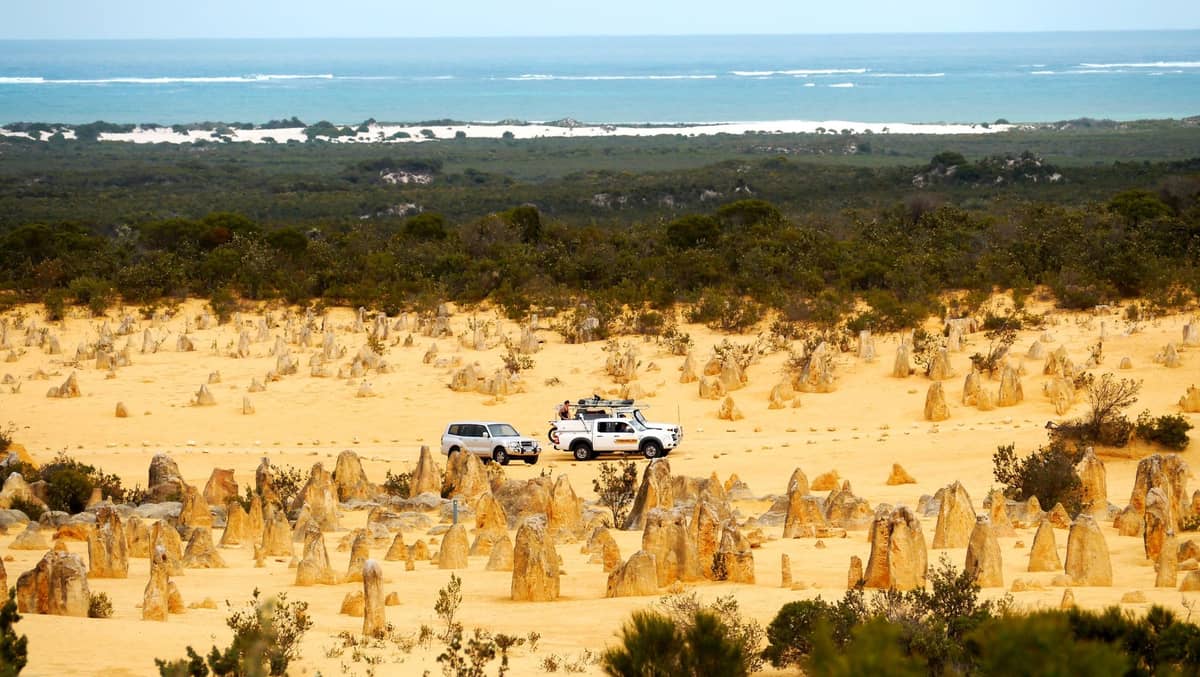
What the Pinnacles Desert Actually Looks Like
Nothing quite prepares you for the first clear view of the Pinnacles Desert. You come over a sandy rise and suddenly the plain below is crowded with thousands of limestone spires, some barely ankle-height, others towering up to 5 metres, all erupting from a pale yellow-white sand that reflects harsh light on a cloudless afternoon. The overall effect is closer to a science-fiction landscape than anything that registers as ordinary Australian bushland.
The formation covers roughly 190 hectares within Nambung National Park, near Cervantes on Western Australia's Coral Coast. The spires are ancient: they formed from coastal limestone, the remnant of a seabed that was pushed up, stabilised by plant roots, eroded by rain and wind, and gradually exposed over millennia. No two columns are the same shape. Some are flat-topped slabs. Others taper to sharp points. Several have been undercut at the base, giving them an unstable, tottering appearance that is entirely natural.
ℹ️ Good to know
The Pinnacles Desert is the accessible name for the attraction inside Nambung National Park. The park gate and facilities are signposted from Pinnacles Road, approximately 10 km off Indian Ocean Drive.
How the Experience Changes by Time of Day
The quality of your visit depends heavily on when you arrive. In the middle of a summer day, the sand radiates heat, shadows are short, and the contrast between spires and ground flattens out visually. Morning arrivals, especially early in the day, get low-angle light that casts long shadows across the rippled sand and makes individual pinnacles stand apart from the crowd. Photographers consistently prefer the first 90 minutes after opening for this reason.
Late afternoon is the second-best window. The western light turns the limestone a deeper gold and the shadows lengthen again in the opposite direction. Between roughly 3 pm and closing time, the crowds also thin noticeably, especially on weekdays, giving the landscape a quieter atmosphere. The Discovery Centre closes at 4:30 pm, so if you arrive late and want interpretive context, plan around that cut-off.
Sunset visits have their advocates. The sand shifts from white to deep amber and the pinnacles hold onto colour for a few minutes after the sun drops. However, the one-way drive can be difficult to navigate safely in fading light, and the exit road is unlit. If you stay until dusk, drive slowly and use low-beam headlights.
💡 Local tip
Arrive before 10 am or after 3 pm to avoid peak coach-tour crowds and to get the most dramatic natural light on the spires.
Tickets & tours
Live prices and dates from our booking partner. If you book, we may earn a commission at no extra cost to you.
Pinnacles and Swan Valley Full-day Guided Tour
From 201 €Instant confirmationFree cancellationPinnacles Full-day Guided Tour
From 184 €Instant confirmationFree cancellationPinnacles Guided Tour in German
From 184 €Instant confirmationFree cancellationPinnacles Guided Tour in French
From 184 €Instant confirmationFree cancellation
The Historical and Geological Context
The Pinnacles have an unlikely human history. In 1700, Dutch sailors approaching the coast reportedly mistook the spire-field for the ruins of an ancient city, an error understandable from a distance at sea, where the taller columns resemble broken columns or walls. The formation has no architectural origin; the spires are entirely natural limestone, shaped over thousands of years by the combined action of coastal sand accumulation, acidic rainfall, plant root systems that created drainage channels, and gradual deflation of the surrounding sand.
Formation of the pinnacles likely began during a period when dense coastal vegetation held and stabilised leached sand, creating a hardened limestone layer. As vegetation cover changed and wind eroded the surface, the harder cemented material was left standing while the surrounding sand blew away, producing the field of columns visible today. The process continues slowly; the landscape looked different a thousand years ago and will look different a thousand years from now.
The park sits within the traditional country of the Noongar people, who have long-standing connections to this part of Western Australia. The Pinnacles Discovery Centre provides some context on both the natural history and the broader landscape.
How to Navigate the Park
Most visitors follow the one-way sealed drive through the main concentration of pinnacles, a loop of approximately 4.5 km. It is slow going by design: you stop, get out, photograph, return to the car, move forward 50 metres, and repeat. Allow at least 45 minutes to an hour for the drive if you plan to step out regularly, and longer if you have a serious interest in photography or geology.
The Desert View Walk Trail is 1.6 kilometres long. Accessible parking bays and accessible toilets are located nearby. For visitors who cannot complete the walking sections comfortably, the one-way drive itself provides views from the vehicle window of most of the significant formations.
The Pinnacles Desert Discovery Centre, open daily from 9:30 am to 4:30 pm except Christmas Day, offers exhibits on the geology, ecology, and natural history of the park. It is worth spending 20 to 30 minutes here before heading into the desert, as the interpretive panels add detail that makes the formations more interesting to look at.
⚠️ What to skip
Do not climb on or attempt to move the pinnacles. The limestone is fragile and surface damage is cumulative. Rangers patrol the area and penalties apply under national park regulations.
Getting There and Practical Planning
The park is reached by road from Perth; check current route and travel-time information before setting out. For road-trip planning, it pairs logically with aPinnacles day trip itinerary from Perth that can also include stops at Lancelin or the sand dunes at Lancelin.
Fuel up before leaving the main highway. Cervantes, the nearest town, has petrol and basic supplies, but prices are higher than in Perth and availability of specific items cannot be guaranteed. Carry at least 1.5 litres of water per person; there is no water available inside the pinnacle drive area itself, and summer temperatures regularly exceed 35°C.
Check the current WA Parks fee schedule before visiting; park entry fees are subject to change. If you hold a WA Parks Pass or plan to visit multiple national parks in Western Australia, a pass may represent better value.
The Pinnacles can be incorporated into a broader drive north along the Coral Coast. For those planning extended time in Western Australia, theday trips from Perth guide covers distances, logistics, and what to combine en route.
Photography, Weather, and What to Wear
The Pinnacles Desert is one of the most photogenic geological sites in Australia, but mid-day images tend to be flat and disappointing. The optimal conditions are low sun at a raking angle, a few clouds to soften shadows, and enough breeze to create light ripples in the sand surface. A polarising filter reduces glare from the white sand significantly. Wide-angle lenses work well for establishing the scale of the spire field; a medium telephoto lets you isolate individual formations against the sky.
Wear closed shoes rather than sandals: the sand conceals sharp edges of limestone rubble underfoot, and the surface temperature of the sand in summer can blister exposed feet. Sun protection is essential year-round; there is almost no shade inside the desert, and the reflected light from pale sand intensifies UV exposure. A hat, sunscreen, and sunglasses are practical necessities, not optional.
Spring (September to November) is a particularly rewarding season. Temperatures are comfortable, wildflowers are in bloom across the surrounding coastal heath, and the light is often clear without the haze that builds in summer. For seasonal context, thebest time to visit Perth guide has detail on monthly conditions across the region.
Who Might Want to Reconsider
The Pinnacles Desert is not for everyone. If you have limited mobility and cannot comfortably ride in a car on a slow loop, the experience from the 300-metre path is meaningful but brief. Visitors expecting the immersive hike-through-wilderness experience of a large national park will find the scale smaller than anticipated; the main visit is structured around a short drive and a short walk rather than extended backcountry exploration.
Travellers making a rushed day trip from Perth, spending 30 minutes in the park before turning back, often report underwhelmed reactions. The site rewards slow attention: reading the formations, noticing the differences between spire shapes, watching how shadows shift as you move around a single column. Treated as a quick tick-off, it can feel like a lot of driving for a modest payoff. Treated as the centrepiece of a half-day or full-day coastal drive, it tends to leave a stronger impression.
Insider Tips
- If you visit in winter (June to August), pack a layer. Mornings near the coast can be genuinely cold, and the park is exposed with no windbreaks. The upside is that winter lighting is softer and more consistent throughout the day, making photography easier without rushing for a specific window.
- The yellow wildflowers that carpet sections of the sandy plain around the pinnacles are most abundant from August to October. Arriving during this period adds considerable visual interest to the surrounding heathland on the drive in.
- Some of the most dramatic formations are along the outer edge of the loop, not concentrated at the beginning near the car park. Many visitors who feel rushed turn around before reaching the best density of tall spires. Stay on the loop to its completion.
- Cervantes is worth a short stop before or after the park. The town's jetty and small beach are quiet and the local rock lobster is a regional product worth trying at the town's cafe if you time your visit around lunch.
- If you want to visit at sunset without night-driving concerns, stay in Cervantes overnight. Accommodation is limited, so book ahead, particularly for weekends and school holiday periods.
Who Is Pinnacles Desert For?
- Road-trippers combining the Pinnacles with a drive along the Indian Ocean Drive or Coral Coast
- Photographers who can time an early morning or late afternoon arrival for optimal light
- Geology and natural history enthusiasts with an interest in how the formations developed
- Families with children old enough to manage a slow car-loop and short walk (younger children may find the experience too passive)
- Travellers spending at least 3 to 5 days in Perth who have a full day free for a longer excursion
Nearby Attractions
Combine your visit with:
- AQWA – The Aquarium of Western Australia
AQWA – The Aquarium of Western Australia at Hillarys Boat Harbour is the state's largest aquarium, built around a 98-metre underwater tunnel that replicates five distinct West Australian marine zones. It draws families, ocean enthusiasts, and travellers curious about the marine life that makes this coastline one of the most biodiverse in the Southern Hemisphere.
- Bold Park
Bold Park is a 437-hectare A-class nature reserve on Whadjuk Noongar Country, protecting some of the last intact coastal heath near central Perth. Free to enter and open daily, it offers walking trails, a panoramic hilltop lookout, and some of the richest concentrations of native wildflowers in the metropolitan area.
- City Beach
City Beach is a well-maintained stretch of Indian Ocean coastline about 12 kilometres from Perth's city centre. With patrolled swimming, solid amenities, and genuine surf, it draws a wide range of visitors without the commercial noise of some of Perth's busier coastal strips.
- Crown Perth
Crown Perth is Western Australia's largest integrated entertainment complex, sitting on the south bank of the Swan River in Burswood. From a 24-hour casino and three hotels to dozens of restaurants, bars and live event venues, it covers an enormous amount of ground — and rewards some planning before you arrive.
Planning a trip? Discover personalized activities with the Nomado app.