Patong Beach: Phuket's Most Famous (and Most Intense) Shoreline
Patong Beach stretches nearly 3 km along Phuket's west coast and delivers the full spectrum of Thai beach tourism: calm morning swims, afternoon water sports, and a nightlife district that runs until dawn. It suits high-energy travelers, but it's not for everyone.
Quick Facts
- Location
- West coast of Phuket, 15-20 km from Phuket Town
- Getting There
- Songthaew from Phuket Town or Grab taxi; ~45 min from Phuket International Airport (HKT)
- Time Needed
- Half-day to full day; evenings extend naturally into nightlife
- Cost
- Free beach entry; sun loungers typically 100-200 THB; water sports vary
- Best for
- Beach days with energy, water sports, nightlife, and convenience
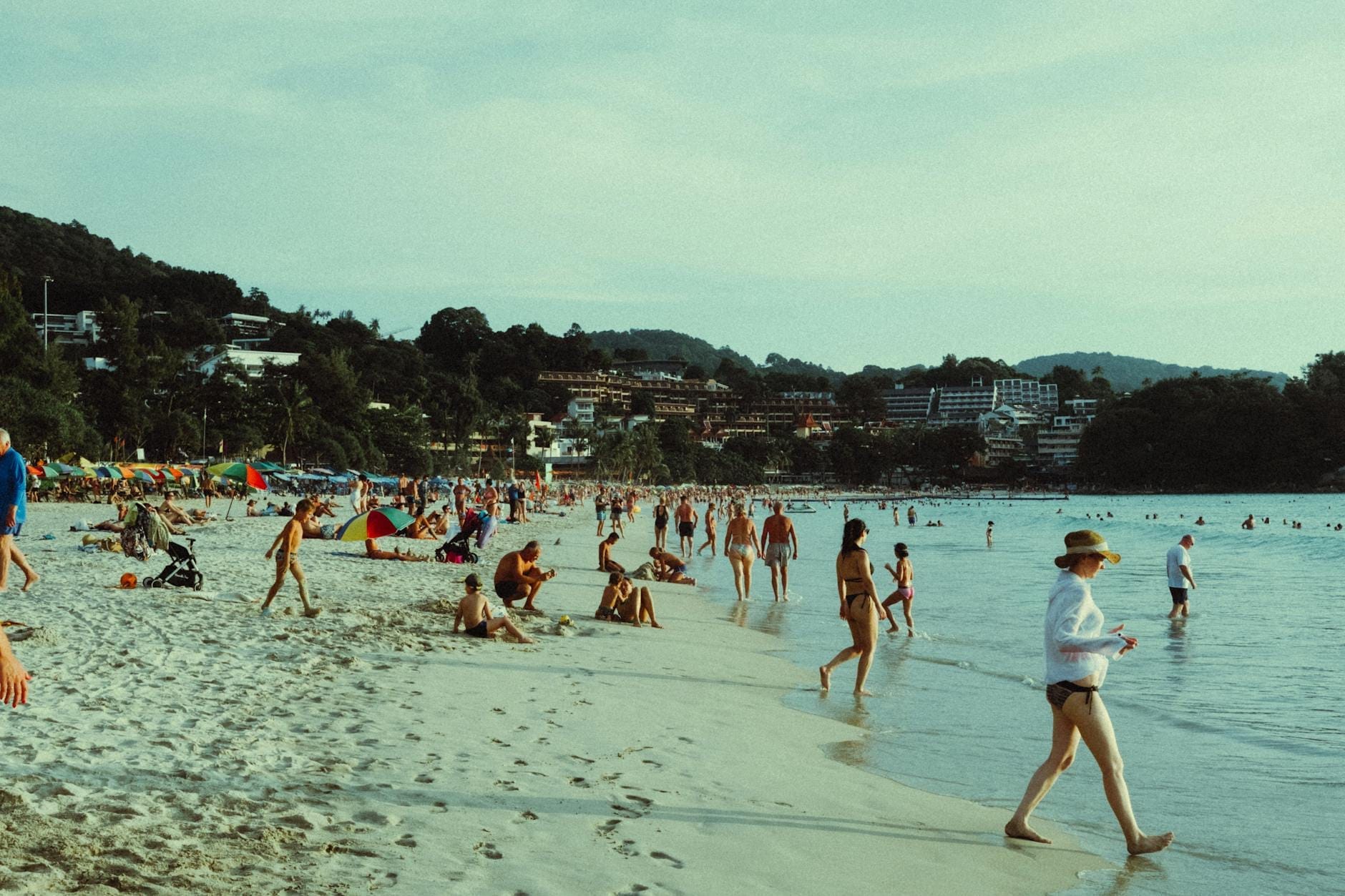
What Patong Beach Actually Is
Patong Beach (Thai: หาดป่าตอง, Hat Patong) is the most commercially developed beach on Phuket Island, running roughly 3 kilometers along a west-facing bay backed by the town of Patong. The sand is wide and golden, the water is clear enough for swimming through most of the dry season, and the infrastructure for tourists is relentlessly comprehensive: rows of sun loungers, jet ski operators, beach massage stalls, seafood restaurants, and a road running its full length that feeds into one of Thailand's most famous nightlife streets.
This is not a peaceful escape. The beach is simultaneously its appeal and its limitation. People who want convenience, activity, and easy access to food, shopping, and nightlife will find Patong unmatched in Phuket. People who want quiet, natural beauty, or solitude should look elsewhere immediately.
ℹ️ Good to know
Beach entry is free and the beach is technically open 24 hours. However, sun lounger operators set up from around 8 AM and claim most of the prime stretch by mid-morning. Arrive before 9 AM to find a spot without paying for a chair.
The Beach Through the Day: Hours Make All the Difference
Early mornings, roughly 6 to 8 AM, offer a version of Patong that most visitors never see. The beach is nearly empty, the air is cool, and the Andaman Sea sits flat and glassy before the sea breeze picks up. Local joggers and hotel guests take their morning walks along the shoreline at this hour. The light from the east catches the water at a low angle that makes the bay look genuinely beautiful, which is easy to forget by midday.
By 10 AM the transformation is well underway. Vendors set up umbrellas, jet skis idle offshore, and tour groups from resort hotels begin spreading across the sand. The central stretch of the beach, directly in front of Beach Road (Thanon Thawiwong), is the most crowded section. If you are visiting in peak season between November and March, expect the mid-beach area to be packed by late morning.
Late afternoon, from around 4 PM onward, brings a second wave of activity. The harsh overhead sun softens, the light turns amber, and the northern end of the bay near Kalim becomes a genuinely scenic spot for watching the sunset over the Andaman. The northern Kalim end is also where surfers gather between May to October when swells are consistent enough to ride.
Tickets & tours
Hand-picked options from our booking partner. Prices are indicative; availability and final rates are confirmed when you complete your booking.
Muay Thai Boxing Tickets at Patong Boxing Stadium
From 56 €Instant confirmationFree cancellationPhuket ATV and zipline experience above Patong Beach
From 34 €Instant confirmationFree cancellationPhuket Island and Big Buddha Private Tour
From 125 €Instant confirmationFree cancellationGuided elephant nature walk tour with transfer
From 50 €Instant confirmationFree cancellation
Water and Beach Conditions
During the dry season (November through April), the sea at Patong is calm and swimmable with generally good visibility. The water is warm year-round, typically in the high 20s Celsius. Red flags are posted by lifeguards when conditions are unsafe, and these should be taken seriously. Lifeguards are stationed on the beach during daylight hours.
During the southwest monsoon (May through October), conditions at Patong can deteriorate quickly. Waves increase, rip currents appear, and the beach becomes genuinely dangerous on rough days. Many of the water sports operators shut down or reduce hours. If you are visiting outside the dry season, check conditions each morning before entering the water.
⚠️ What to skip
Jet ski scams are a documented problem at Patong. A common tactic is to claim pre-existing damage on the machine after your rental and demand compensation. Photograph every scratch on the jet ski before getting on it, and insist on a written agreement. Some travelers avoid jet skis here entirely.
Beyond jet skis, the beach supports parasailing, paddleboarding, banana boat rides, and snorkeling trips departing directly from the shore. Prices are negotiable and highest at midday when demand peaks.
Historical Context: From Fishing Village to Resort Town
Patong was a modest fishing village until the late 1970s, when it became the first area on Phuket to develop mass beach tourism infrastructure catering to Western visitors. Its sheltered bay, wide sand, and proximity to Phuket Town made it the obvious focal point for resort development. Growth was rapid and largely unplanned, which explains the somewhat chaotic mix of architecture and land use visible today.
On December 26, 2004, Patong was struck by the Indian Ocean tsunami. The waterfront suffered significant damage, and the event is still part of the local consciousness. Recovery was faster than many predicted, driven by the scale of investment in the area. Tsunami evacuation route signs remain posted throughout Patong and should be noted when you first arrive.
The speed of Patong's rebuilding and expansion after 2004 underscores just how economically central this beach is to Phuket's tourism industry. Today, it remains the busiest and most commercially intense beach on the island. For context on the broader landscape of beaches across Phuket, the Phuket beaches guide offers useful comparisons between Patong and quieter alternatives.
Patong's Nightlife: Bangla Road and Beyond
The beach itself is only part of the Patong experience. Running perpendicular from Beach Road into the center of town is Bangla Road, the primary nightlife corridor in all of Phuket. After dark, this street fills with bars, clubs, open-air venues, and a constant flow of pedestrians. The noise is substantial, the lights are intense, and the atmosphere is completely unlike anything else on the island.
For visitors specifically interested in the evening scene, a separate guide to Bangla Road covers what to expect, when to go, and what to avoid. The strip is not for everyone, but understanding it is useful even if you plan to skip it, since the noise carries well into the surrounding hotel streets late at night.
Away from Bangla Road, the broader Patong dining scene is extensive. Beach Road itself has seafood restaurants where the catch is displayed on ice out front. The blocks behind Beach Road have everything from Thai street food to Italian pizza to Japanese ramen. Quality varies considerably and is not always proportional to price.
Getting There and Getting Around
Patong is 15 kilometers west of Phuket Town and approximately 35 kilometers from Phuket International Airport (HKT). From the airport, a taxi takes 45 to 60 minutes depending on traffic, and costs roughly 500 to 800 THB. Grab works in Phuket and is generally cheaper than flagging a metered or fixed-rate taxi, though availability can be inconsistent at peak hours.
From Phuket Town, songthaews (shared pickup trucks with bench seating) run to Patong through the day and cost a fraction of a private taxi. They depart from the market area near Ranong Road. The journey takes about 40 minutes and drops passengers near the northern end of Beach Road. This is the most affordable option and works well if you are not carrying heavy luggage.
Renting a scooter is popular and gives flexibility to reach nearby beaches without relying on fixed transport. Helmet use is legally required and genuinely important given the traffic on the road over the hill between Phuket Town and Patong. For a broader overview of navigating the island, the getting around Phuket guide covers all transport options clearly.
Photography, Accessibility, and Practical Notes
The best photography conditions are early morning before 8 AM and in the hour before sunset. Midday light is flat and harsh, and the beach is crowded enough that clean wide shots are difficult. The northern end of the bay near Kalim offers the best elevated angles, and sunset from that point includes the full sweep of the bay.
Beach Road is paved and flat, making it accessible for wheelchairs and strollers along the promenade. Accessing the sand itself is uneven in places, and the central beach has no formal accessible entry points. Restrooms and showers are available at several points along the beach, though cleanliness varies.
💡 Local tip
If you are staying in Patong for multiple nights, book a hotel at least one block back from Beach Road to reduce noise from the evening traffic and Bangla Road. Rooms directly on Beach Road can be loud until 2 or 3 AM even during quieter periods.
Insider Tips
- The far northern end of Patong beach, where the bay curves toward Kalim, is significantly quieter than the central stretch and has a relaxed local-bar scene that is more low-key than Bangla Road.
- Between May and October, Kalim sees consistent surf breaks. Boards can be rented nearby, and the crowd is small enough that beginners can practice without pressure.
- Grab a coffee and walk the beach between 6:30 and 7:30 AM before the sun lounger vendors arrive. The difference in atmosphere compared to midday is so extreme it feels like a different place.
- If you need to negotiate a price for beach services, offer around 60-70% of the opening price. Vendors expect this and it is normal practice, but be polite throughout.
- Avoid renting jet skis unless you are confident in how to handle disputes. If you proceed, photograph all existing damage before boarding and get the vendor to sign off on it.
Who Is Patong Beach For?
- First-time Phuket visitors who want maximum convenience and beach infrastructure
- Groups and couples who plan to combine beach time with nightlife in the same evening
- Water sports enthusiasts looking for jet skis, parasailing, and boat trips in one place
- Travelers who want every type of restaurant and service within walking distance of the shore
- Short-stay visitors who need easy airport access and a well-connected base
Nearby Attractions
Other things to see while in Patong:
- Andamanda Phuket
Andamanda Phuket is the island's largest water park, spread across 10 hectares in Kathu with Thailand's longest lazy river, a 10-rai wave pool generating waves up to 3 meters, and a replica white-sand beach. Opened in 2022, it targets families and thrill-seekers looking for a full-day alternative to the beach. Here is everything you need to decide if it belongs in your itinerary.
- Bangla Road
Bangla Road is the beating heart of Patong's nightlife, a 400-meter pedestrian strip lined with open-air bars, nightclubs, and neon signs that doesn't fully wake up until 10 PM. It's loud, crowded, and completely committed to excess. Whether that's a reason to go or to avoid it entirely depends entirely on what you're after.
- Freedom Beach
Freedom Beach is a 300-meter arc of white sand tucked behind jungle-covered headlands just 2 km southwest of Patong. Reachable only by longtail boat or a steep forest trail, it offers calm water, no motorized watersports, and a fraction of the crowds found on Phuket's main beaches. The trade-off: a 200 THB entry fee, limited facilities, and weather that can shut access completely during monsoon season.
- Simon Cabaret
Running since 1991, Simon Cabaret is Phuket's longest-established kathoey cabaret show, staging three performances nightly in a 600-seat theater on Sirirat Road in Patong. Expect elaborate costumes, Las Vegas-style choreography, and a crowd that ranges from solo backpackers to large family tour groups.