Osaka Aquarium Kaiyukan: What to Expect, How to Get There, and Whether It's Worth It
Osaka Aquarium Kaiyukan sits at the edge of Tempozan Harbor and draws visitors with its massive Pacific Rim tank, whale sharks, and layered underwater walk. Here's everything you need to decide if it deserves a spot on your itinerary.
Quick Facts
- Location
- 1-1-10 Kaigandori, Minato-ku, Osaka 552-0022 (Tempozan Harbor Village)
- Getting There
- Osakako Station, Osaka Metro Chuo Line — approx. 5 min walk from Exit 1
- Time Needed
- 2–3 hours for a thorough visit; 90 minutes if moving efficiently
- Cost
- Adults (16+) ¥2,700 / Youth (7–15) ¥1,400 / Children (4–6) ¥700 / Under 3 free. Prices subject to dynamic pricing — verify before visiting.
- Best for
- Families with children, marine life enthusiasts, rainy-day visitors, first-time Osaka travelers
- Official website
- www.kaiyukan.com/language/eng/index.html
What Is Osaka Aquarium Kaiyukan?
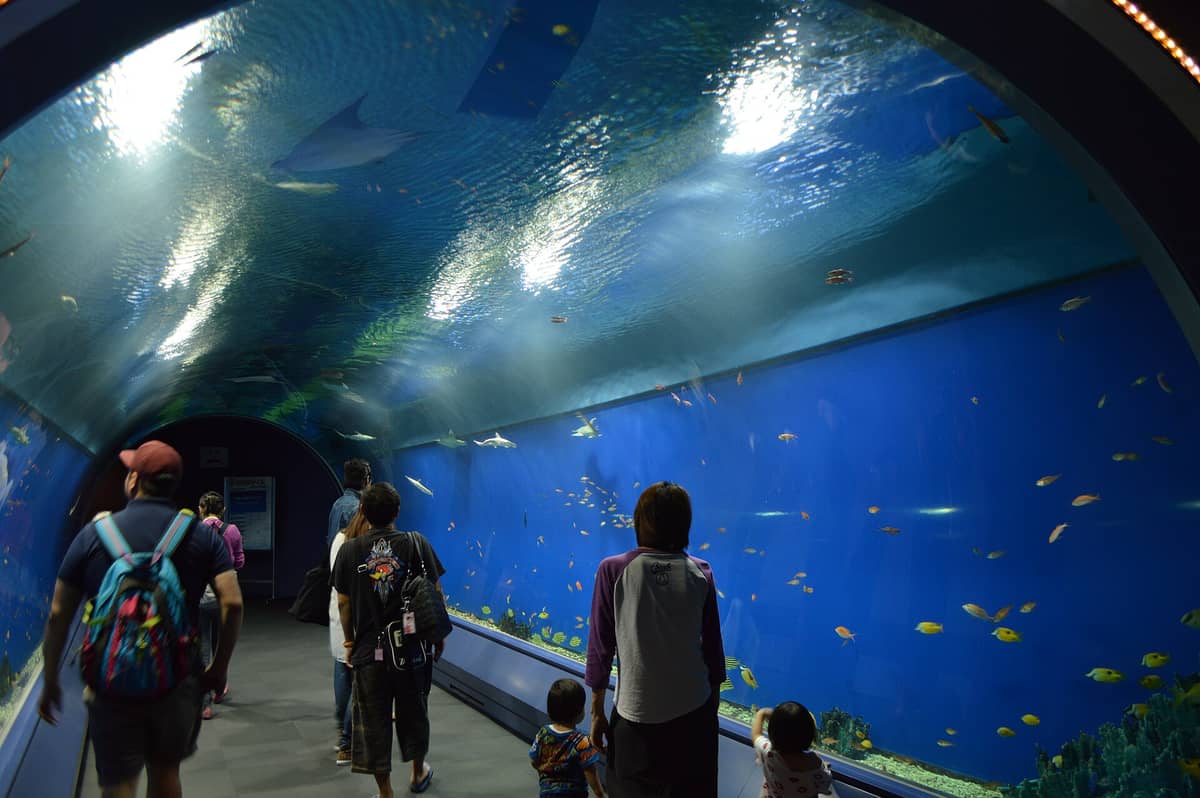
Osaka Aquarium Kaiyukan, known in Japanese as 海遊館, is a large public aquarium built around one of the most ambitious design concepts in aquatic exhibition: a single central tank representing the Pacific Ocean, rising eight stories through the building's core. Visitors descend a spiral walkway around it, watching whale sharks and manta rays glide past at eye level, then again from below, then from angles that shift the sense of scale with every floor.
The aquarium sits within Tempozan Harbor Village on the edge of Osaka Bay, about 30–35 minutes from the city center by metro. The building itself is notable: the exterior's angular blue and white geometry references water and maritime themes without being kitsch, and it reads clearly against the harbor backdrop. The surrounding waterfront plaza gives it room to breathe, which is unusual for central Osaka.
The aquarium is commonly cited as one of the largest in the world, with exhibits organized around the Pacific Rim concept — zones themed to Japan's forests, the Arctic, the Antarctic, and the open ocean, among others. This structure means the experience is more coherent than most aquariums, where tanks can feel arbitrarily arranged. If you're building a broader day around the bay area, it pairs naturally with the Universal Studios Japan corridor or with a walk along the Tempozan waterfront.
💡 Local tip
Arrive around opening time (typically 10:00) on weekdays to see the central Pacific Ocean tank at its quietest. Weekend crowds build quickly after 11:00 and the spiral walkway becomes congested by midday.
Inside the Aquarium: The Experience Floor by Floor
Entry takes you to the top of the building, and you work downward through the zones in a continuous spiral. This design is intentional: it mirrors the sensation of descending into water. The first zones, representing Japan's forests and the Aleutian Islands, feel relatively dim and cool, with the sounds of water trickling and the occasional bark of otters carrying clearly through the space.
The central Pacific Ocean tank dominates every level. It measures approximately 9 meters deep with a capacity of several thousand cubic meters, and the clarity of the water is striking — on a bright morning, light filters through the surface and scatters across the floor of the tank in shifting patterns. The whale sharks, the aquarium's most celebrated residents, move with unhurried slowness that makes the space feel genuinely oceanic rather than theatrical.
The lower levels include the Antarctic zone, which holds Gentoo and King penguins in a chilled enclosure separated from visitors by glass. The temperature drop is perceptible. Children tend to press their faces directly against the glass here; adults tend to stop and stay longer than they planned. The Antarctic zone is one of the more thoughtfully lit areas — soft blue-grey light that approximates a polar sky without dramatic spotlighting.
The aquarium does not recommend strollers inside the venue, which is worth knowing if you're visiting with very young children. The ramps are gradual and manageable, and wheelchairs are available for free rental at the information counter. Most of the facility is slope-accessible throughout.
Tickets & tours
Hand-picked options from our booking partner. Prices are indicative; availability and final rates are confirmed when you complete your booking.
Osaka local food tour in Dotonbori and Shinsekai
From 51 €Instant confirmationFree cancellationGuided day tour from Osaka to Nara Park, Arashiyama and Fushimi Inari
From 59 €Instant confirmationFree cancellationHimeji, Nara and Kobe full-day tour from Osaka
From 76 €Instant confirmationFree cancellationDay trip to Hiroshima and Miyajima by bullet train from Osaka
From 287 €Instant confirmationFree cancellation
Best Time to Visit and How Crowds Behave
Kaiyukan is an indoor attraction, which makes it a popular refuge on rainy days and during Osaka's hot, humid summer months (July and August). That logic is self-defeating: the days when weather makes outdoor sightseeing uncomfortable are exactly when the aquarium fills fastest. Rain days and peak summer weekends can push wait times at the entrance to 30–45 minutes, and the spiral walkway crowds to the point where slow-moving groups create bottlenecks at the main tank viewing windows.
Weekday mornings in spring (March to May) and autumn (October to November) offer the best combination of comfortable visiting conditions and manageable crowds. Autumn is particularly good: natural light through the harbor-facing windows is warm in the late morning, humidity is lower than summer, and school groups tend to visit earlier in the day, clearing out before noon.
⚠️ What to skip
Kaiyukan sometimes has maintenance closure days in January. Check the official calendar at kaiyukan.com before building your itinerary around a visit in that month.
Evening visits, which are possible on days when the aquarium is scheduled to stay open until around 20:00 (last admission typically 19:00), offer a different atmosphere. The exterior is lit against the harbor, families with young children tend to thin out after 17:00, and the Pacific Ocean tank takes on a deeper, more dramatic quality under artificial lighting. Extended hours apply during summer holidays, Golden Week, and around New Year — verify the specific calendar on the official site.
Getting There from Central Osaka
The straightforward route is the Osaka Metro Chuo Line to Osakako Station, which is a 5-minute walk from the aquarium's entrance via Exit 1. From central Osaka's Honmachi Station, the journey takes roughly 10 minutes. From Namba, factor in a transfer, which adds time but keeps the trip under 25 minutes total. Tickets on the Chuo Line are standard Osaka Metro fares — the IC card (ICOCA or Suica) works seamlessly.
If you're planning multiple major attractions in a single day, the Osaka Amazing Pass does not include Kaiyukan admission (it offers a discount only) but does cover metro fares, which can still make it useful depending on your schedule. Run the numbers before buying, since the aquarium's adult ticket alone is ¥2,700.
There is no convenient bicycle parking at the harbor village designed for touring cyclists, and the aquarium area is not particularly walkable from central Osaka — it's a genuine transit trip, not a detour. Allow travel time accordingly when building your day.
Photography Inside Kaiyukan
Phones and compact cameras handle the Pacific Ocean tank well in the early morning when crowds haven't yet fogged the viewing windows with breath and body heat. The tank's backlighting is consistent throughout the day, but morning visits produce cleaner glass. Flash photography is prohibited near the marine life, which is standard practice — the enforcement is gentle but consistent.
The jellyfish gallery, a smaller side room off the main spiral, is a reliable spot for atmospheric photography. Tanks are backlit with shifting colors, the room is relatively quiet, and the translucent animals photograph well without needing special equipment. It's also one of the more peaceful pockets in the building if crowds on the main walkway are getting to you.
💡 Local tip
For whale shark photography, position yourself at the mid-level viewing window rather than the bottom-floor panoramic. The sharks tend to cruise the middle depths more frequently, and the mid-level gives a cleaner angle without as many reflections from overhead lighting.
Is Kaiyukan Worth the Price?
At ¥2,700 for adults (age 16 and up), Kaiyukan is not a casual drop-in. For families, the cost climbs quickly. The experience is genuinely impressive in scale, particularly the central tank, and the Pacific Rim concept gives the visit a coherent narrative arc rather than a series of random exhibits. Most visitors who commit 2 to 3 hours leave satisfied.
That said, if your primary interest is the city's food, architecture, or cultural history, the aquarium may feel like an expensive detour to the bay area. The Osaka Bay waterfront is worth visiting, but Kaiyukan works best as a deliberate choice for marine life interest or as the centerpiece of a family day rather than as a default stop on a general sightseeing itinerary.
Visitors who find the aquarium too crowded or expensive but still want to spend time in the bay area might consider combining a shorter visit to the Tempozan waterfront with a look at the harbor, then heading toward other Osaka attractions. For a broader picture of how Kaiyukan fits into a multi-day plan, see the complete Osaka attraction overview or the guide to Osaka with kids which covers family-friendly pacing in detail.
ℹ️ Good to know
Visitors who find aquariums overstimulating or prefer outdoor natural settings may find the ¥2,700 adult entry hard to justify. The experience is primarily enclosed, artificially lit, and can be loud on busy days.
Insider Tips
- Buy tickets online in advance through the official site or a verified booking platform. This doesn't always guarantee skipping the queue entirely, but it removes the box office bottleneck on busy days.
- The aquarium gift shop near the exit sells whale shark merchandise that children reliably fixate on. Set expectations (or a budget) before you reach it, since it's unavoidable on the way out.
- The Tempozan Ferris Wheel adjacent to the aquarium offers bay views and a useful break between the aquarium and lunch. It's a separate ticket but worth knowing about if you have children who need outdoor time after two hours inside.
- Weekday lunch hours (12:00–13:30) are when the on-site café gets congested. Either eat before entering or plan to exit the aquarium and explore the harbor village's other food options, which are less crowded.
- The Antarctic zone is one of the coldest parts of the building. If you're visiting in winter or plan to spend significant time there, a light layer is useful even on warm days outside.
Who Is Osaka Aquarium Kaiyukan For?
- Families with children aged 4 and above, for whom the whale sharks and penguin zone are genuinely captivating
- Visitors on rainy days who need a half-day indoor option that doesn't feel like a compromise
- Marine life enthusiasts and anyone with a specific interest in Pacific Ocean ecology
- Travelers who want a visually dramatic, architecturally interesting attraction that differs from Osaka's temple and food circuit
- Groups with mixed ages, since the ramped spiral layout is accessible and the exhibits hold attention across a wide age range
Nearby Attractions
Other things to see while in Osaka Bay Area:
- Universal Studios Japan (USJ)
Universal Studios Japan (USJ) is Osaka's most-visited theme park, drawing millions of visitors each year to its film-themed worlds, seasonal events, and blockbuster rides. From the Wizarding World of Harry Potter to Nintendo World, here is everything you need to know before you go.