Killiney Hill Park: Panoramic Views, Ancient Stones, and a Free Afternoon Well Spent
Killiney Hill Park rises 153 metres above Dublin Bay on the bay's southern side, offering some of the most dramatic viewpoints in the greater Dublin area. With woodland trails, a Victorian obelisk, and a curious stone pyramid, it rewards walkers who make the climb from Killiney DART station. Admission is free, the terrain is genuine, and the views on a clear day are genuinely hard to beat.
Quick Facts
- Location
- Killiney Hill Road, Dublin 18 (Dalkey–Killiney area, Dún Laoghaire–Rathdown)
- Getting There
- Killiney DART station, approx. 16-minute walk to the park entrance
- Time Needed
- 1.5 to 2.5 hours for a full loop including the summit
- Cost
- Free — no admission charge
- Best for
- Walkers, view-seekers, families, DART day-trippers from Dublin city centre
- Official website
- www.dlrcoco.ie/en/parks-outdoors/parks/killiney-hill-park
What Killiney Hill Park Actually Is
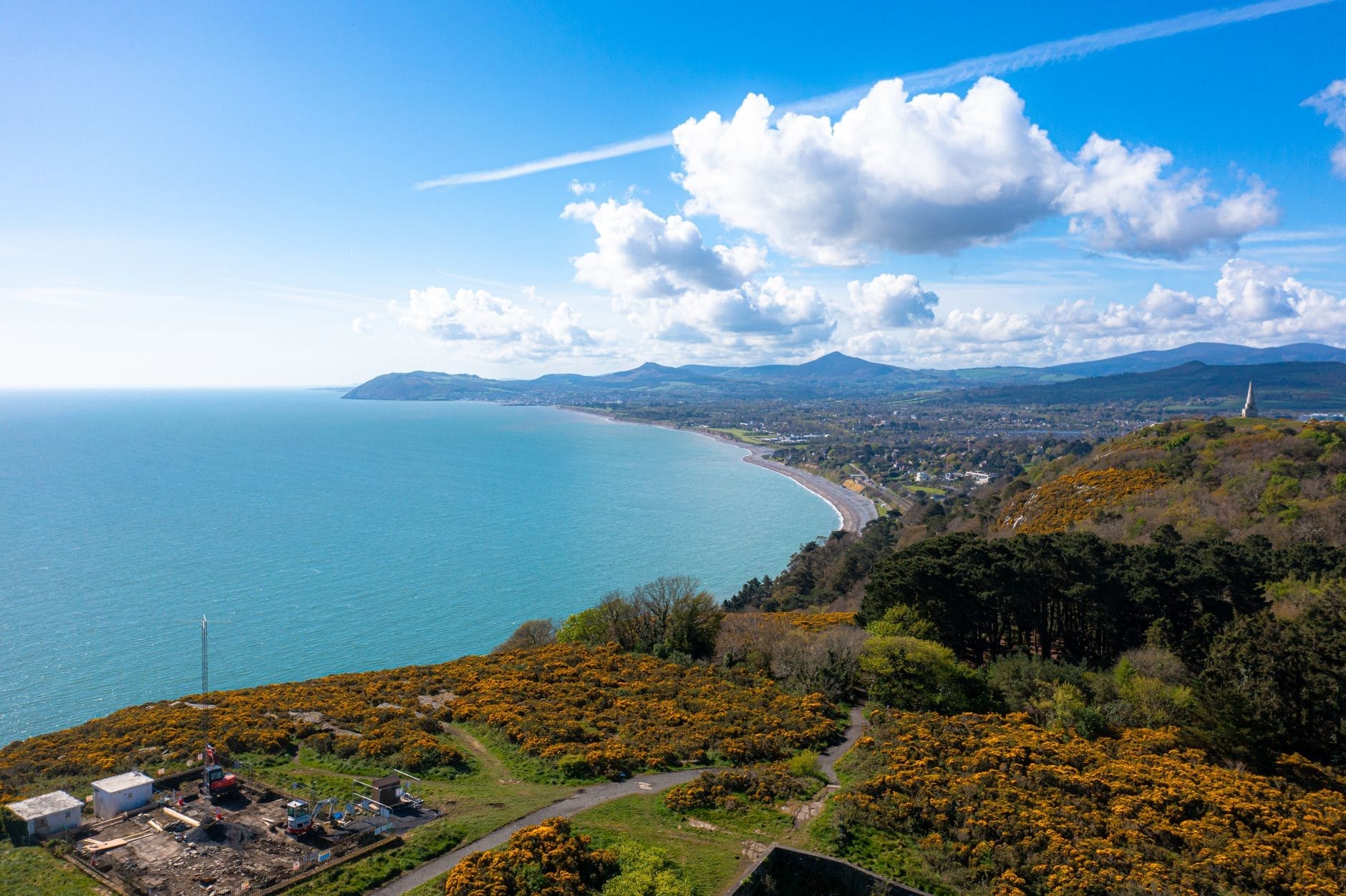
Killiney Hill Park is a publicly accessible hillside park managed by Dún Laoghaire–Rathdown County Council, sitting on the southern arc of Dublin Bay roughly 12 km south of the city centre. The park encompasses both Killiney Hill and Dalkey Hill, connected by trails that wind through gorse, bracken, and patches of oak and pine woodland. The summit of Killiney Hill reaches 153 metres, marked by a Victorian stone obelisk, and from here the ground drops away sharply toward Killiney Bay and the Irish Sea.
The park was opened to the public in 1887 as Victoria Park to mark Queen Victoria's Golden Jubilee. That royal origin explains some of the ornamental stone features dotting the hillside, including a small pyramid known as the Wishing Stone, constructed in 1852 by local landowner Robert Warren. These structures are not grand monuments: they are modest, weather-worn, and easy to miss on a quick visit, but they give the park an odd, layered quality that makes a second visit as interesting as the first.
💡 Local tip
The most straightforward route to the summit starts from the Killiney Hill Road entrance and follows the main gravel path uphill. Allow 20 to 30 minutes at a steady pace to reach the obelisk from the car park.
The View from the Top: What You'll Actually See
The panorama from the obelisk at the top is the main reason people come here. On a clear day, the view spans Killiney Bay directly below (sometimes compared to the Bay of Naples, a local claim that is enthusiastic but not entirely without basis on a sunny July morning), the Great and Little Sugar Loaf mountains to the south, and Bray Head further along the coast. To the north, the eye travels across Dublin Bay toward Howth Head and, on very clear days, the Mourne Mountains across the water in County Down.
The obelisk itself sits at approximately 170 metres above sea level, slightly higher than the stated 153-metre height of the hill due to its position on a rocky outcrop. Stand at its base and look northeast and you can trace the arc of Dún Laoghaire Harbour, with the long granite piers visible on calm days. The Wicklow Mountains form the southern backdrop, giving the view a satisfying depth that flat urban vantage points cannot match.
Weather matters here more than at most Dublin attractions. On overcast days, which are common in any season, the views compress quickly into a grey-green middle distance. The bay still looks handsome, but the distant peaks disappear. If you want the full, long-range panorama, check the forecast and choose a morning with high pressure and westerly winds, which tend to produce the clearest conditions on this east-facing coast.
Tickets & tours
Hand-picked options from our booking partner. Prices are indicative; availability and final rates are confirmed when you complete your booking.
Giant's Causeway, Dark Hedges, and Belfast Tour from Dublin
From 85 €Instant confirmationFree cancellationDublin self-guided audio tour
From 10 €Instant confirmationBird of Prey, Cliffs of Moher and Aillwee Cave from Dublin
From 201 €Instant confirmationFree cancellationGame of Thrones Studio tour with return transfer from Dublin
From 63 €Instant confirmationFree cancellation
How the Park Changes Through the Day
Early morning, particularly on weekdays, Killiney Hill Park is quiet enough to feel private. Dog walkers account for most of the traffic between 7am and 9am, moving quickly along the lower paths. The light at this hour is horizontal and soft, falling across the bracken in a way that makes the hill look larger than it is. The Irish Sea below takes on a pewter sheen, and on still mornings you can hear the DART train rounding the coastal curve near Killiney station far below.
By mid-morning on weekends, families with young children begin arriving at the playground near the lower entrance, and the main path to the summit becomes moderately busy. The tea room near the park provides a practical stopping point before or after the climb, though visitors should check current opening hours locally as these can vary by season. Midday in summer brings the largest crowds: groups of teenagers, tourists who have taken the DART south from the city, and day-trippers from the surrounding suburbs.
Late afternoon is arguably the most photogenic window. The low sun catches the surface of Killiney Bay, the shadows lengthen across the hillside, and the summit crowd thins out considerably. In summer, the long Irish evenings mean usable light until well past 9pm. In winter, the park empties fast after 3pm as the temperature drops and the light goes.
The Walk: Terrain, Trails, and What to Expect
The trails within Killiney Hill Park range from wide gravel paths near the lower car park to rougher, rockier sections as you approach the summit. The main ascent is uneven underfoot, with exposed roots and loose stones in sections, particularly after rain. Footwear with grip is genuinely useful, not just a precaution: trainers work fine in dry conditions, but flat-soled shoes become awkward on the steeper rocky stretches.
The park is not a long walk by any measure. A loop taking in both Killiney Hill and Dalkey Hill, with time at the summit viewpoint and a detour to find the Wishing Stone pyramid, can be completed comfortably in under two hours. Those travelling with small children should expect to add time, particularly on the descent where the rocky terrain requires more care. There is no formal trail map at the entrance, but the paths are well-worn and the hilltop is always visible above you as a navigational anchor.
⚠️ What to skip
The terrain is hilly and uneven throughout the park. Visitors using wheelchairs or pushchairs will find access limited largely to the lower paths near the entrance. The summit route is not accessible for those with significant mobility impairments.
Killiney Hill Park connects naturally with the wider Dalkey and Killiney area, and combining a visit with a walk through Dalkey village and lunch at one of its pubs makes for a full and satisfying half-day. Dalkey itself has a distinct character: a small coastal town with a castle, good cafes, and a main street that does not feel like a tourist production.
Historical Context: Victoria Park to Killiney Hill Park
The land that is now Killiney Hill Park was largely in private hands through the 18th and early 19th centuries, with the Warren family among the prominent landowners. Robert Warren commissioned the stone pyramid on the hillside in 1852, an eccentric ornamental feature that predates the park's public opening by 35 years. When the park was formally opened in 1887 and named Victoria Park in honour of the Queen's Golden Jubilee, it became an important publicly accessible green space in the southern Dublin coastal area.
The obelisk at the summit is the park's most visible landmark and serves as a navigational marker for walkers approaching from multiple directions. Its origins are tied to the 19th-century tradition of erecting commemorative stone monuments on prominent hilltops, a practice common across Ireland and Britain in this period. The structure is solid, unadorned granite, and its simplicity suits the exposed hilltop setting better than any more elaborate design would.
For visitors interested in the broader heritage of this coastal stretch, Dalkey Castle sits in the village below and offers guided tours covering the medieval history of the area, including the period when Dalkey functioned as a significant port town south of Dublin.
Getting There: DART and Practical Access
The DART (Dublin Area Rapid Transit) coastal rail service is the most convenient way to reach Killiney Hill Park without a car. Killiney station is on the southbound DART line, and from the station the walk to the park entrance takes approximately 16 minutes on foot, following Killiney Hill Road uphill. The DART runs frequently from Connolly, Tara Street, and Pearse stations in the city centre, and the journey takes around 30 to 35 minutes. Verify current timetables and fares with Irish Rail before travelling.
There is also a small car park at the Killiney Hill Road entrance for those arriving by car. Parking is free but limited, and it fills quickly on sunny weekend mornings. Arriving by 9am guarantees a space; arriving at noon on a fine Saturday does not. Dalkey village, a 10-minute walk from another park entrance via Torca Road, is an alternative starting point if the main car park is full.
If you are planning a longer day in this part of coastal Dublin, it is worth reading a day trips guide from Dublin to understand how to combine Killiney Hill with other attractions along the DART line, from Sandycove in the north to Bray in the south.
Photography and Practical Tips for the Summit
The obelisk at the summit makes a useful foreground element for wide-angle compositions looking south toward the Sugar Loaf and Bray Head. For the full bay panorama, position yourself slightly below and to the east of the obelisk, where the ground falls away and the horizon opens. Smartphone cameras handle the scale of the view reasonably well; the challenge is haze rather than light, so morning and post-rain conditions consistently produce sharper results than afternoon summer haze.
Wind at the summit is a constant consideration. The hilltop offers no shelter, and even on mild days a steady breeze comes in off the Irish Sea. Bring a layer regardless of the temperature in Dublin city centre: the difference between the DART platform and the summit is noticeable.
ℹ️ Good to know
The Wishing Stone pyramid is easy to miss. It sits on the southern slope of the hill, slightly off the main path between the car park and the obelisk. Look for a low stone pyramid roughly 2 metres tall among the gorse. There is no signage directing visitors to it.
Insider Tips
- The lower Dalkey Hill side of the park sees far fewer visitors than the Killiney Hill summit trail. If you prefer solitude over views, cross over to Dalkey Hill after reaching the obelisk and take the quieter descent toward Dalkey village.
- After wet weather, the rocky sections near the summit become genuinely slippery. The gorse beside the path also drips onto the trail for several hours after rain, so waterproof footwear is worth it even when it has stopped raining.
- For the clearest long-distance views to the Mourne Mountains in Northern Ireland, come in late autumn or winter after a cold front has passed through. Summer haze consistently obscures the furthest distances even on technically sunny days.
- The Wishing Stone pyramid is unmarked and unsigned. It sits on the southern slope below the main path between the car park and the obelisk. It is a genuinely unusual structure and worth five minutes of searching.
- If you are travelling on the DART, consider getting off at Dalkey station rather than Killiney station and approaching the park from the northern Dalkey Hill entrance. The route through Dalkey village is longer but more interesting, and you pass through the village before the climb rather than after it.
Who Is Killiney Hill Park & Viewpoint For?
- DART day-trippers from Dublin city centre who want a proper outdoor walk within easy reach
- Families with older children who can manage uneven terrain and want a reward at the top
- Photographers looking for the best coastal panorama in greater Dublin outside of Howth
- Walkers combining the hill with a coastal walk and lunch in Dalkey village
- Visitors who want a free, genuine outdoor experience away from the main tourist circuit
Nearby Attractions
Other things to see while in Dalkey & Killiney:
- Dalkey Castle & Heritage Centre
Dalkey Castle & Heritage Centre brings together a 14th-century fortified townhouse, a 10th-century church, and an early medieval graveyard, all within a short walk of the DART station. Guided tours run daily except Tuesday, and the surrounding village is worth at least an afternoon of your time.