Jalan Alor: Kuala Lumpur's Great Outdoor Food Street
Jalan Alor transforms every evening into one of Kuala Lumpur's most energetic dining destinations. Stretching through the heart of Bukit Bintang, this open-air food street draws locals and visitors alike to its rows of plastic chairs, sizzling woks, and seafood tanks lit by bare bulbs. It is loud, fragrant, and unapologetically real.
Quick Facts
- Location
- Jalan Alor, Bukit Bintang, Kuala Lumpur
- Getting There
- Bukit Bintang MRT/Monorail Station, approximately 5 minutes on foot
- Time Needed
- 1.5 to 3 hours
- Cost
- Free entry. Expect to spend RM 20–60 per person on food and drinks
- Best for
- Street food lovers, night owls, groups, and travelers who want to eat like a local
What Jalan Alor Actually Is
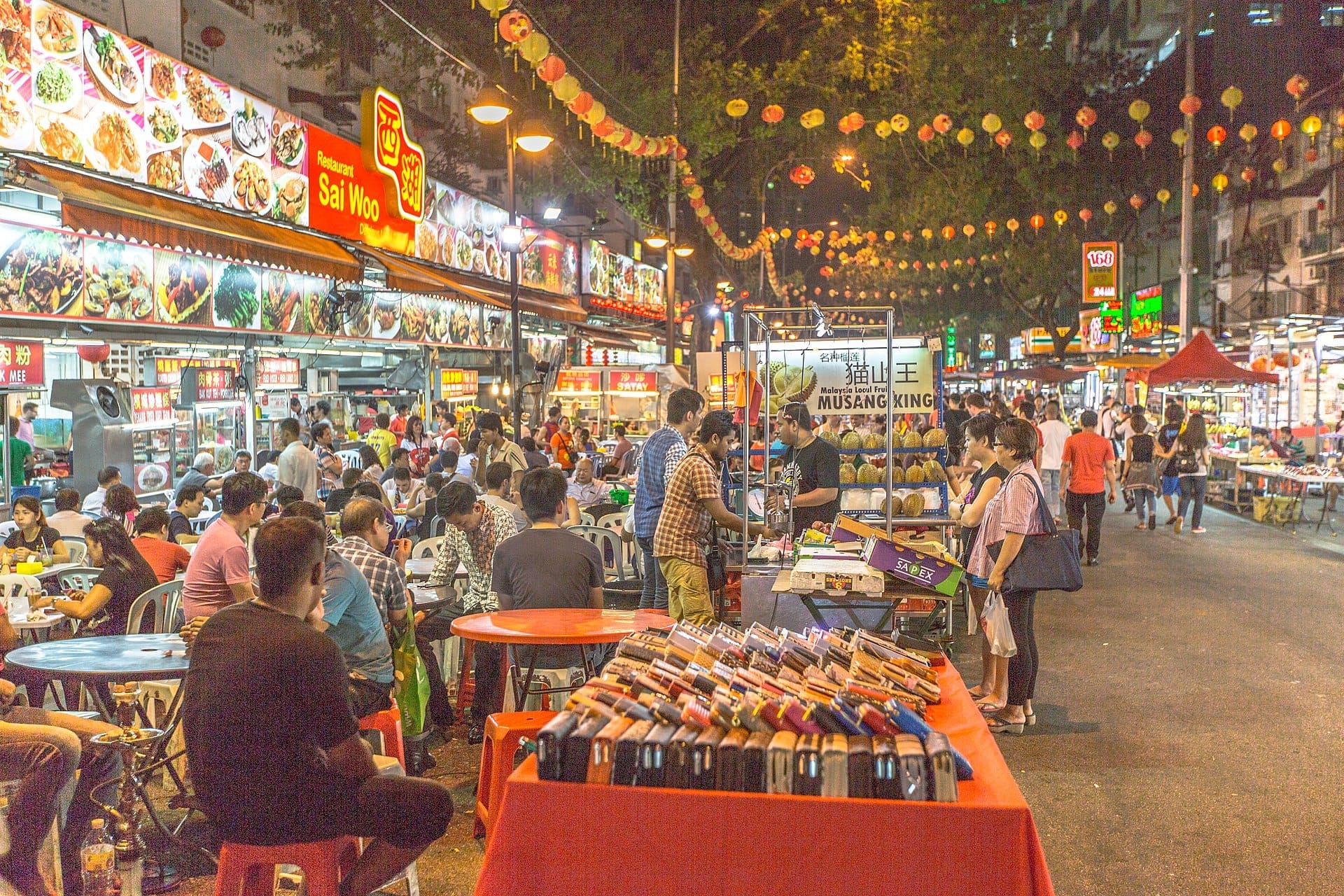
Jalan Alor is a single city block in Bukit Bintang that reinvents itself every evening. During the day it is a quiet residential and commercial lane with little reason to visit. By around 5pm, stallholders drag out their equipment, gas flames light up, and the street fills with the smell of charcoal-grilled chicken wings, wok hei from fried rice, and the brine of fresh shellfish. Within an hour it is almost unrecognizable: a corridor of competing restaurants and hawker stalls, every table filled, touts calling from doorways, and the sky above reduced to a strip of neon and smoke.
This is not a curated food market. It is a working street with decades of history and genuine competition between vendors. The quality is uneven by design: some stalls have been here for forty years and have earned their queues, others are newer and trade on proximity to the crowd. Knowing which is which matters, and you can usually tell by looking at the tables. An empty table on Jalan Alor is not an invitation to sit down early. It is a sign the food needs more scrutiny.
💡 Local tip
Arrive between 7pm and 8pm for the best balance of energy and availability. By 9pm most popular stalls are packed and wait times grow. After 10pm the crowds thin slightly but some stalls begin running out of key ingredients.
The Food: What to Order and Where to Focus
The menu across Jalan Alor is roughly consistent from stall to stall but quality varies sharply. The items that have become synonymous with the street are char-grilled chicken wings marinated in a sweet soy glaze, often listed simply as 'BBQ wings'. They are cooked over charcoal in batches, sold by the piece, and eaten with your hands at folding tables on the pavement. These are worth seeking out from vendors with active grills rather than ones keeping pre-cooked batches warm.
Beyond the wings, the range covers most of the Malaysian Chinese hawker canon. Hokkien mee (thick egg noodles in a dark prawn broth), char kway teow (flat rice noodles stir-fried at high heat with egg, bean sprouts, and cockles), and various seafood preparations dominate. Tanks of live shellfish, crabs, and prawns sit outside many restaurants on the north side of the street, where you point at your choice and the price is calculated by weight before cooking. Butter-fried mantis prawn and salted egg crab appear regularly on specials boards.
For drinks, sugar cane juice pressed to order, fresh coconut water, and various iced Malaysian teas are available at low prices. Some stalls sell beer openly; it is accepted and common here given the area's character. If you are looking for something purely local to drink, the iced barley water or chrysanthemum tea served in plastic cups alongside a meal is exactly what regulars choose on a warm night.
⚠️ What to skip
Jalan Alor is not halal. The street is dominated by Chinese Malaysian cuisine with significant pork and alcohol presence. Visitors requiring halal food should look elsewhere in Bukit Bintang.
Tickets & tours
Hand-picked options from our booking partner. Prices are indicative; availability and final rates are confirmed when you complete your booking.
Petronas Twin Towers and Kuala Lumpur Tower observation deck tickets
From 34 €Private Taman Negara day trip from Kuala Lumpur with lunch
From 85 €Instant confirmationFree cancellationKuala Lumpur city and Batu Caves tour
From 41 €Instant confirmationFree cancellationKuala Lumpur city exploration private half-day tour
From 42 €Instant confirmationFree cancellation
How the Street Changes Through the Evening
The transformation from day to night is the most important thing to understand about Jalan Alor. Before 5pm there is almost nothing worth coming for. Between 5pm and 6:30pm, the setup phase is genuinely interesting if you are nearby: crates of produce arriving on motorcycles, ice being laid over seafood, menus chalked up, plastic furniture unfolded from vans. It is a brief window where you can walk the length of the street without being called to tables and get a clear sense of who is preparing what.
Peak hours run from roughly 7pm to 10pm. This is when the experience is at its most complete, and also its most chaotic. Tables spill onto the full width of the road, which is closed to through traffic by this point. Touts from competing stalls are persistent but not aggressive; a firm no or sustained eye contact with the stall you have chosen is sufficient. The noise level is high: generators, woks, music from different stalls overlapping, and the general volume of several hundred people eating outside.
After 10:30pm the crowd shifts in character. Families leave earlier; what remains is a mix of younger locals, tourists returning from nearby bars on Changkat Bukit Bintang, and hospitality workers on late breaks. Some stalls pack up by midnight, others continue until 3am or 4am. The late-night edition of Jalan Alor is quieter, cheaper-feeling, and slightly more local in tone.
Getting There and Getting Around
Jalan Alor sits a short walk from both Bukit Bintang MRT Station and the Bukit Bintang Monorail Station. From either station, follow the signs toward Bukit Bintang's main shopping corridor on Jalan Bukit Bintang, then turn north onto Jalan Alor. The walk takes five to eight minutes and passes several large malls, which are useful landmarks if you lose your bearings.
Grab is the most practical option if you prefer not to walk. Traffic around Bukit Bintang on weekend evenings is heavy and parking is difficult, so most visitors arrive by rail or rideshare. The street itself is pedestrianized during operating hours, so once you arrive, navigation is entirely on foot. Jalan Alor is one straight block, roughly 300 meters long, so there is no risk of getting lost. You can see the full length of it in a single glance from either end. For a broader look at getting around the city, the guide to getting around Kuala Lumpur covers all transit options clearly.
Practical Notes on Eating Here
Seating works differently here than in a restaurant. Most vendors on Jalan Alor operate semi-independently from the tables in front of their stalls, but in practice the boundaries blur. Sit at a table, a server from the nearest stall will appear and hand you a menu. You are not obligated to order exclusively from that stall, but it keeps things smoother if you do, and the selection at any given stall is broad enough that most groups will find what they need.
Payment is almost always cash. A small number of larger restaurant-style operations accept cards, but for the majority of hawker vendors and smaller stalls, bring ringgit. An ATM is available in the 7-Eleven near the junction with Jalan Bukit Bintang, a two-minute walk away.
Dress lightly. The combination of cooking heat, close proximity to other diners, and KL's baseline humidity makes the street warm even on cooler evenings. Comfortable sandals or shoes work better than anything you would mind getting wet or splattered, since the pavement is frequently washed down between sessions.
ℹ️ Good to know
Accessibility is limited. The street's pavement is uneven, tables and chairs are often packed tightly, and there are no designated accessible routes during peak hours. Wheelchair users or those with mobility limitations should visit earlier in the evening when space is more available.
Where Jalan Alor Fits in Bukit Bintang
Jalan Alor is one part of a larger evening in Bukit Bintang rather than a standalone destination. Most visitors combine it with the shopping malls along Jalan Bukit Bintang before dinner, or continue afterward to the bars and restaurants on Changkat Bukit Bintang, which runs parallel a few blocks away. The two streets serve completely different functions: Jalan Alor is for eating, Changkat is for drinking, and the ten-minute walk between them is a natural progression for an evening out.
For those spending time in the surrounding malls before dinner, Pavilion Kuala Lumpur is directly on the way and worth a look for its food hall on the lower ground floor if you want to compare KL's air-conditioned food court scene with the outdoor version on Jalan Alor. The contrast is sharp and telling: both are valid, but they attract different kinds of evenings.
Travelers who find Jalan Alor too crowded or too tourist-oriented should know that its reputation is partly responsible for its own decline in localism. Many regular KL residents who want a similar experience without the noise and competition for tables head instead to the hawker centers in Chow Kit or smaller coffee shops in Kampung Baru. Jalan Alor remains genuinely good, but it is no longer the secret it once was, and anyone expecting to eat alongside a mostly local crowd will find that the reality skews heavily toward international tourists, particularly on weekends.
Photography and the Visual Experience
Jalan Alor photographs well from around 7pm to 8pm, when the light from stall lamps and the remnants of dusk combine without requiring a flash. The seafood tanks along the north side of the street, lit from inside and stacked with moving shellfish, are an effective subject at any time of night. The chicken wing grills, when active, produce dramatic smoke and flame that works well with a phone camera on portrait mode if you can position yourself slightly to the side.
The street is crowded enough that candid photography of strangers is common and mostly accepted, but pointing cameras directly at individual vendors or kitchen staff without acknowledgment can create friction. A nod or a smile before photographing anyone up close is both courteous and practical.
Insider Tips
- Walk the full length of the street before sitting down. Spend five minutes comparing which stalls have active woks, full seafood tanks, and occupied tables with locals. The quality difference between adjacent stalls can be significant.
- The stalls at the far western end of the street (away from the Jalan Bukit Bintang junction) tend to have slightly lower prices and fewer aggressive touts. The junction end is where foot traffic is highest and markups are most common.
- If you order seafood by weight, confirm the price per 100 grams before the stall takes your selection to the kitchen. Misunderstandings about pricing are the most common complaint on the street, and a simple clarification beforehand avoids them entirely.
- Tuesday and Wednesday evenings are noticeably quieter than weekends. The food quality does not suffer, but you get more space, less noise, and a faster table. Weekend visits feel like an event; weekday visits feel like a meal.
- For an afternoon visit before the stalls open, the coffee shop at the Bukit Bintang end of the street serves local breakfast and lunch items at low prices with almost no tourist presence. It is one of the few moments when Jalan Alor feels like a neighborhood lane rather than an attraction.
Who Is Jalan Alor For?
- Groups of four or more who want variety without coordinating a restaurant reservation
- First-time visitors to KL looking for an accessible introduction to Malaysian Chinese street food
- Night owls and late diners who want a full meal after 9pm when most restaurants have wound down
- Travelers combining a Bukit Bintang shopping day with a low-effort, high-reward dinner
- Food photographers who want a dense, photogenic environment with minimal staging required
Nearby Attractions
Other things to see while in Bukit Bintang:
- Berjaya Times Square
Berjaya Times Square is one of Southeast Asia's largest shopping complexes, anchored in the heart of Bukit Bintang. Beyond the retail floors, it houses an indoor theme park, a cinema multiplex, and a dedicated anime and hobby trading zone that draws collectors from across the region.
- Changkat Bukit Bintang
Changkat Bukit Bintang is the spine of Kuala Lumpur's after-dark social scene, a compact strip of colonial-era shophouses converted into bars, restaurants, and rooftop terraces. By day it's calm and photogenic; by night it draws locals, expats, and travelers in equal measure for cocktails, live music, and late-night food.
- Fahrenheit 88
Fahrenheit 88 sits at the heart of Bukit Bintang, KL's most commercial strip, and caters squarely to younger shoppers hunting local fashion labels, beauty brands, and affordable street wear. It's smaller and less polished than its neighbors, but that's precisely its appeal.
- Lot 10
Lot 10 is a focused, upscale shopping centre on Jalan Bukit Bintang that punches above its size. Home to the long-established Isetan department store, a curated mix of Japanese and international fashion labels, and the much-praised Hutong hawker food court in the basement, it rewards visitors who prefer quality curation over sprawling retail chaos.