Cova de Can Marçà: Inside Ibiza's Most Dramatic Cave
Carved into the sea cliffs above Port de Sant Miquel, Cova de Can Marçà is a 100,000-year-old cave system with a history as a smugglers' hideout. Guided tours wind through 350 metres of stalactites, underground lakes, and theatrical lighting over 35 to 40 minutes. It is one of the few cave attractions on Ibiza's northern coast that genuinely rewards the detour.
Quick Facts
- Location
- Port de Sant Miquel, Sant Joan de Labritja, North Ibiza — about 20 km from Ibiza Town
- Getting There
- Car recommended; drive to Port de Sant Miquel then follow cliff steps to cave entrance. No direct bus route to the cave.
- Time Needed
- 45–60 minutes including the guided tour (tour itself: 35–40 min)
- Cost
- Approx. €15 adults / €9 children (guided tour included). Verify current rates at official website.
- Best for
- Families, geology enthusiasts, travellers seeking shade on hot days, non-beach day alternatives
- Official website
- http://www.covadecanmarsa.com
What Is Cova de Can Marçà?
Cova de Can Marçà is a natural limestone cave system set inside the cliffs between Port de Sant Miquel beach and Benirràs beach on the northern coast of Ibiza. The cave is estimated to be around 100,000 years old, spans approximately 8,500 square metres in total, and sits roughly 14 metres above sea level inside the rock face. The visitor route covers about 350 metres of the cave's interior, guided at all times by a member of staff.
Before it became a tourist attraction in the early 1980s, the cave served a more clandestine purpose: local smugglers used its deep chambers and cliff-face concealment to store contraband, taking advantage of its near-invisible entrance from the sea. That layered history, geological and human, gives the place more texture than a standard show cave.
ℹ️ Good to know
Opening hours vary by season. Winter (November–April): 10:30–17:30, tours every 45 minutes. Summer (May–October): 10:30–19:30, tours every 30 minutes. The cave is open all year round. Always check the official website before visiting, as schedules can change.
The Experience: What You Actually See Inside
Access begins with a descent down rocky steps cut into the cliff face. The path is signed from the Port de Sant Miquel car park but it is uneven and moderately steep. Before you even enter the cave, there are open views down to the cove below, the water a deep blue-green against pale limestone. On a hot July afternoon, the temperature drop as you step inside the cave entrance is immediate and noticeable, going from 35°C outside to a cool, humid interior that stays relatively constant year-round.
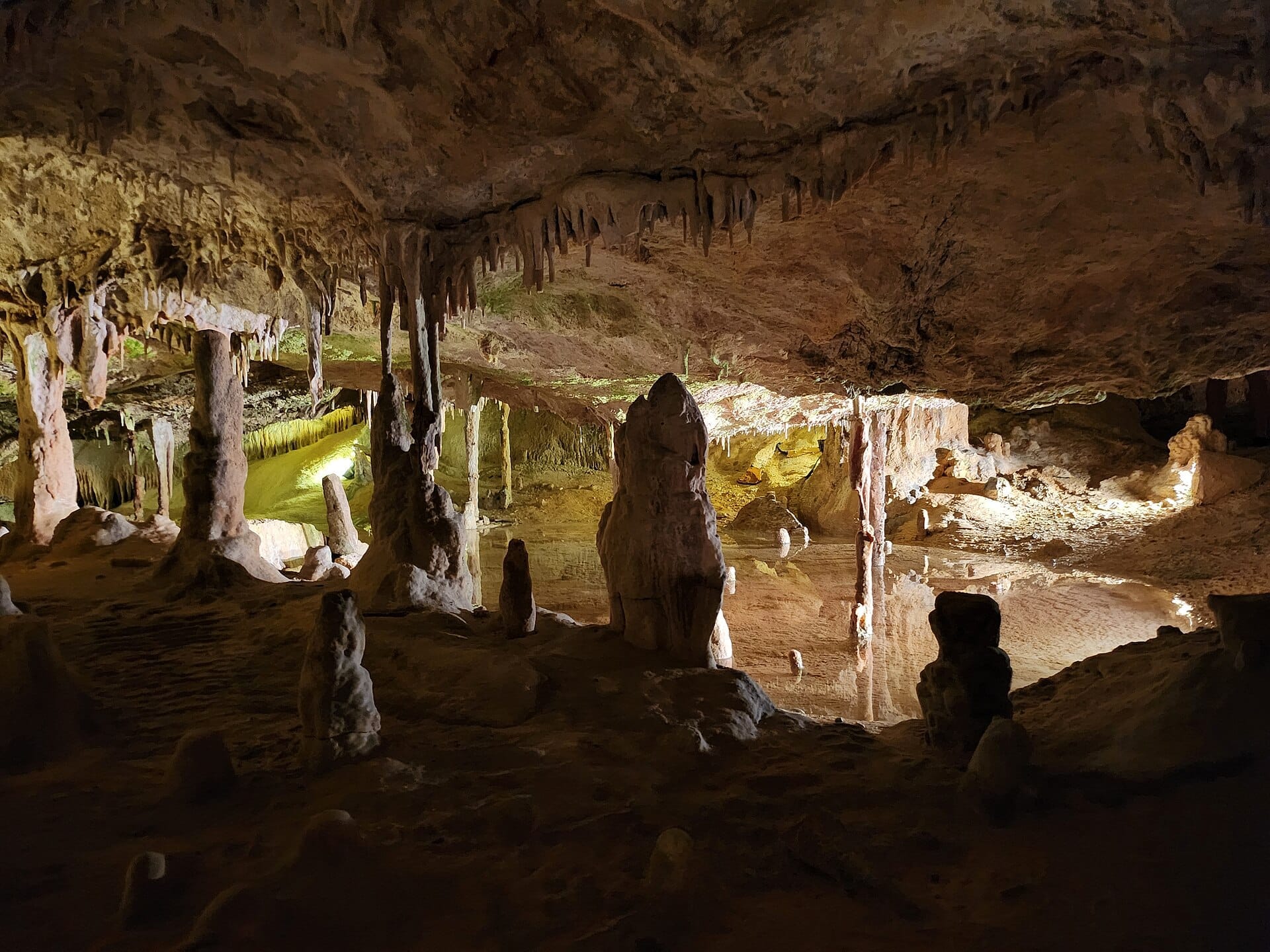
The guided tour moves through a series of chambers, each with stalactites and stalagmites in various states of formation. The largest formations are millions of years in the making, and guides are careful to point out which structures are still actively growing. Coloured lighting has been installed throughout, which is theatrical rather than scientific, but it does help visitors read the scale and depth of formations that would otherwise be lost in the dark.
One section of the route passes above a small underground lake fed by seawater. The reflections from the cave walls on the still surface create one of the more genuinely striking moments of the tour. The final section includes a light-and-sound show built around the cave's smuggling history, which runs for a few minutes. It is brief and adds context without overstaying its welcome.
Tickets & tours
Hand-picked options from our booking partner. Prices are indicative; availability and final rates are confirmed when you complete your booking.
Sunset boat tour with tapas, open bar and water sports in Ibiza
From 70 €Instant confirmationFree cancellationEscape Tour self-guided, interactive city challenge in Ibiza
From 30 €Instant confirmationPrivate Sunset Cruise on a Maritime Classic in Ibiza
From 750 €Instant confirmationFree cancellationIbiza to Formentera boat trip with open bar and water sports
From 69 €Instant confirmationFree cancellation
Historical Context: Smugglers, Limestone, and 100,000 Years
The cave's geological story begins with the slow dissolution of limestone by mildly acidic rainwater over tens of thousands of years, a process called karstification. As the water table shifted and sea levels changed across ice ages, the chambers were gradually left dry, allowing calcite deposits to build into the stalactites and stalagmites visible today. The largest and most developed formations represent growth over hundreds of thousands of years, building at a rate of roughly one centimetre per century under ideal conditions.
The human history is more recent and considerably more colourful. The cave's position inside an almost sheer cliff, accessible from the sea but invisible from land, made it ideal for the small-scale smuggling operations that ran along the Ibiza coast for centuries. Goods stored here reportedly included tobacco and other taxable commodities. When the cave was developed for tourism in the early 1980s, some of the original storage infrastructure was still in place.
For context on the broader northern landscape these caves sit within, the north Ibiza area is notably different from the resort-heavy south, quieter, more agricultural, and substantially less visited in general. The cave fits that character: it is a site that rewards curiosity over spectacle.
Practical Walkthrough: Getting There and Timing Your Visit
The cave is located at Port de Sant Miquel, approximately 20 kilometres from Ibiza Town, 23 kilometres from Santa Eulària, and 25 kilometres from Sant Antoni. There is no reliable public bus connection directly to the cave. A rental car or taxi is the realistic option for most visitors, and the drive through the pine-covered interior of northern Ibiza is itself pleasant. Parking is available near the cliff steps.
Tours depart at regular intervals, every 30 minutes in summer and every 45 minutes in winter. Arriving shortly before a tour departs is straightforward. Groups are kept to a manageable size, and waiting times are rarely long outside of the peak August weeks. In the height of summer, arriving in the early morning slot around 10:30 tends to mean smaller groups and cooler external temperatures during the cliff descent.
💡 Local tip
Wear closed shoes with grip. The rocky steps down the cliff and the cave floor can be slippery, particularly in humid conditions. A light layer is useful inside the cave even in summer, as the internal temperature is notably cooler than the exterior.
Photography inside the cave is generally permitted, though the low-light conditions and coloured theatrical lighting make realistic shots difficult without a camera capable of higher ISO performance. Phone cameras on automatic settings will often produce oversaturated or blurry results in the deeper chambers. The external cliff and cove views before you enter are the more reliably photogenic element.
Accessibility and Limitations
The cave is not suitable for visitors with limited mobility. The descent from the car park involves rocky, uneven steps with no lift alternative, and the cave interior itself has irregular ground throughout. The site's management is transparent about this: it is classified as difficult to access for people not in good physical condition or those with reduced mobility. This is worth knowing before you make the drive.
It is also worth calibrating expectations around scale. Cova de Can Marçà is a genuine and well-maintained cave with real geological interest, but it is not among the largest show caves in the Mediterranean. The tour covers 350 metres over 35 to 40 minutes. Visitors expecting something on the scale of the Drach Caves in Mallorca will find it more modest. What it does offer is a coherent, well-guided experience in a location with serious drama outside, that cliff approach, the cove below, the sea views, that more than compensates for the relatively short interior route.
⚠️ What to skip
If you have significant mobility difficulties or are travelling with a wheelchair user, the cave cannot be accessed. The cliff steps are steep and there is no adapted alternative route.
Combining the Cave With the Surrounding Area
Port de Sant Miquel beach is directly below the cave access point and is a calm, sheltered bay worth an hour before or after your cave visit. North Ibiza has several other worthwhile stops nearby. Benirràs beach is only a short drive away and is known for its distinctive rocky landscape and Cap Bernat sunsets (the official Sunday drum circle has been discontinued). Together, a cave visit, a lunch stop in the village, and an afternoon at Benirràs makes for a full and varied day in the north without touching a club or a resort beach.
If you are planning several days in this part of the island, the San Juan Sunday market is a short drive inland and represents the older, slower-paced side of Ibiza that the north preserves better than anywhere else. For a broader sense of what the island's interior and northern coast offer, the guide to Ibiza's lesser-known spots covers several sites in this area worth planning around.
Who Should Skip This Attraction
If you have limited time in Ibiza and your priorities are beaches, nightlife, or the historic architecture of Ibiza Town, the cave is not an essential stop. The journey to Port de Sant Miquel takes time, and visitors who feel underwhelmed by cave geology or theatrical lighting shows are unlikely to find 45 minutes here well spent. It is a niche attraction, genuinely excellent within its niche, rather than a universally compelling draw.
Similarly, very young children who find enclosed, dark spaces frightening may not enjoy the tour. For families with older children who respond well to natural history or adventure, it is considerably better suited. Travellers building a first itinerary around Ibiza's highlights should consult the Ibiza first-timer guide before deciding whether the cave fits their priorities.
Insider Tips
- Arrive 10 minutes before the tour departure time you are aiming for. There is no booking queue system that reserves your place, and popular summer slots can fill quickly with walk-up visitors.
- The cliff path down to the cave entrance faces west and catches full afternoon sun in summer. Morning visits are cooler for the approach and exit.
- The light-and-sound show at the end of the interior route is brief, roughly 2 to 3 minutes. Do not leave early expecting it to run long, you will miss the final chamber formations just beyond it.
- Combine your visit with Port de Sant Miquel beach directly below. The cave entrance is visible from the beach, which gives you a useful sense of scale for what you just walked through.
- If you are visiting in winter, the cave interior looks essentially identical to summer, but the drive through north Ibiza is notably quieter and more atmospheric. The cave is one of the few island attractions that works equally well outside the tourist season.
Who Is Cova de Can Marçà For?
- Families with children aged 6 and above who are comfortable in dark, enclosed spaces
- Geology and natural history enthusiasts looking beyond beaches and nightlife
- Travellers visiting in the heat of summer who want a genuinely cool, shaded experience
- Visitors spending several days in north Ibiza building a day around Port de Sant Miquel and Benirràs
- Photographers interested in cave formations and cliff-face coastal scenery
Nearby Attractions
Other things to see while in North Ibiza (Es Amunts & San Juan):
- Benirràs Beach
Cala Benirrás is a compact, pine-backed cove in the municipality of Sant Joan de Labritja, roughly a 10-minute drive from San Miguel. Free to enter, it combines clear turquoise water with an offshore rock formation and a long-running sunset drumming reputation — though the official Sunday ritual has been banned/discontinued, and any informal sessions are occasional and not guaranteed.
- Hippy Market Las Dalias
Running since 1985, the Mercadillo Hippy Las Dalias in Sant Carles de Peralta is one of the most iconic hippy markets in Ibiza, with over 250 stalls selling handmade jewellery, textiles, ceramics, and street food. The summer night market adds a completely different dimension after dark.
- Portinatx Beaches
Portinatx, at the far northern tip of Ibiza, offers three distinct beaches in a single resort: the large and well-equipped S'Arenal Gros, the quieter S'Arenal Petit, and the tiny harbour cove of Playa Porto. Together they make the most complete beach destination in north Ibiza, with genuinely calm water, good facilities, and far fewer crowds than the island's famous southern shores.
- San Juan Sunday Market
Every Sunday, the central square of Sant Joan de Labritja in northern Ibiza transforms into the Mercadillo de San Juan, a craft and hippy market that draws locals and visitors alike. With free entry, handmade goods, and live music drifting across a whitewashed village plaza, this is one of the few markets on the island that genuinely feels like it belongs to the place.