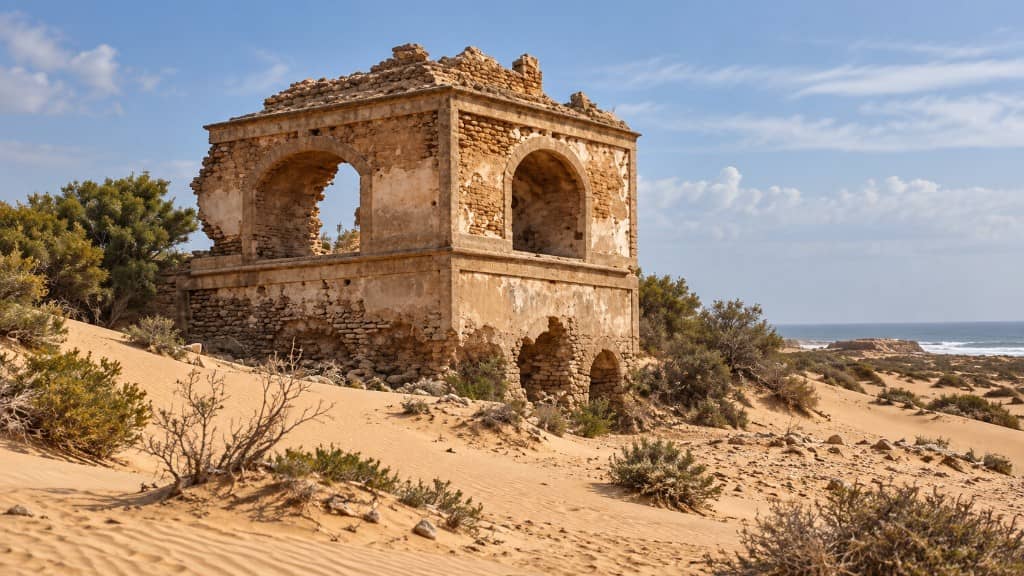
Diabat is a small Berber village and dune landscape sitting about 5 kilometres south of Essaouira's medina, where the Oued Ksob river meets the Atlantic. It offers a slower, more open counterpoint to the city's walled streets, with crumbling palace ruins half-swallowed by sand, horses cantering along the shoreline, and a long beach that stretches all the way to Cap Sim.
Diabat feels like Essaouira's quieter, sandier alter ego. Where the medina is all compressed lanes and carved plaster, Diabat opens up into low Atlantic dunes, ruined 18th-century architecture, and a beach wide enough to lose yourself in. It sits just 4–5 kilometres south of the city walls, close enough for a half-day excursion, different enough to feel like another world entirely.
Orientation: Where Diabat Fits in the Essaouira Picture
Diabat sits at approximately 31.47°N, 9.79°W, on the Atlantic coast of Morocco, about 5 kilometres south of Essaouira's medina. Its position at the mouth of the Oued Ksob river creates a natural boundary between the city's long main beach and the wilder dune terrain that rolls southward toward Cap Sim and, eventually, Sidi Kaouki. The village itself is compact: a cluster of houses gathered around a mosque, flanked by low sand dunes on the seaward side and scrubby Atlantic coastal vegetation inland.
To orient yourself from Essaouira: start at Place Moulay Hassan and walk south through the beach zone. The medina's ramparts eventually give way to open sand, and after crossing the Oued Ksob estuary, you are effectively in Diabat's territory. The transition is gradual rather than sharp: there is no gate, no signpost announcing arrival. The dunes simply grow taller, the beach grows quieter, and the first ruined walls appear in the middle distance.
The village core sits slightly inland from the beach, sheltered behind low dunes, which explains why it can feel almost invisible until you arrive directly. Nearby ranches and small businesses line the single main track through the village. The dune landscape extends several kilometres south from here, providing the wide-open terrain that makes Diabat the practical base for Essaouira's horse riding, camel trekking, quad and buggy operators.
ℹ️ Good to know
Diabat is in Essaouira Province, Marrakech-Safi region, Morocco. It has no formal administrative sub-district designation of its own and is generally treated as a rural locality within the wider Essaouira commune. There is no urban transport grid here: the village runs on foot traffic, taxis, and horses.
Character & Atmosphere: What It Actually Feels Like
Arrive in Diabat in the morning and the dominant sensations are wind and light. The Atlantic trade winds that define Essaouira's climate are even more exposed here, away from the medina's sheltering walls. Sand moves in thin streams across the track. The smell is salt and damp earth near the river mouth, shifting to dry, mineral-warm dune sand as you move south. In early hours, the beach is usually empty enough that the only sound is surf and the occasional whinny from one of the village's horse ranches.
By midday, particularly in spring and summer, the dunes become busier. Quad bikes trace loops across the sand, horseback excursions depart and return, and small groups of visitors pick their way through the ruins of the Dar Sultan palace. The atmosphere remains loose and unhurried compared with Essaouira's medina, but it is not entirely off the tourist radar. The Jimi Hendrix association means the village gets a steady trickle of curious visitors year-round, most of them arriving by petit taxi and returning to Essaouira within a couple of hours, even though whether Hendrix ever actually set foot in the village is disputed.
Afternoons bring a particular quality of light that photographers notice: the low Atlantic sun hits the sand dunes from a shallow angle, turning the ruins golden and throwing long shadows across the beach. This is the time to walk south along the shoreline, with the city's faint silhouette visible to the north and nothing but open coast ahead. The wind usually strengthens from mid-afternoon onward, so plan any sandy activities for the morning if you want better conditions.
After dark, Diabat is very quiet. The handful of cafés and the village restaurant close early. There is minimal street lighting. This is not a nightlife destination, and visitors planning to stay for sunset should arrange return transport in advance rather than assuming taxis pass frequently after dark.
What to See & Do
The most compelling reason to come to Diabat is the ruins of the Dar Sultan palace, an 18th-century structure that is slowly being consumed by the encroaching dunes. The walls are still standing in sections, the arched doorways still frame empty sky, and the whole complex has a strange, cinematic quality that comes from the contrast between architectural formality and complete abandonment. There are no fences, no entrance fee, and no staff: you walk through at your own pace. The trade-off is that the structure is genuinely deteriorating, so care around crumbling sections is necessary.
Nearby, the Borj el-Baroud is a ruined 18th–19th-century gunpowder fort that sits partly buried in the dunes close to the beach. It is less architecturally striking than the palace ruins but contributes to the general atmosphere of the area: a stretch of Atlantic coast where historic structures are losing a slow battle with wind and sand. The combination of both sites within a short walk makes for an unusual open-air archaeology experience that costs nothing and takes about an hour at a relaxed pace.
The dunes themselves are the main activity draw. Several operators based in or near the village run horse riding excursions along the beach and through the dune landscape, and this remains the most popular way to experience the area. Camel rides and quad or buggy tours are also available. For context on the broader dune and sand landscape, see the Essaouira sand dunes guide.
Dar Sultan palace ruins: free access, no staff, allow 30–60 minutes
Borj el-Baroud fort ruins: short walk from the palace, free access
Horse riding excursions: departing from ranches in the village, prices negotiated directly with operators
Camel rides: available through the same operators near the village core
Quad and buggy tours: operators depart from Essaouira and the village area
Beach walking: the shoreline south toward Cap Sim is open and largely empty
The Jimi Hendrix connection is worth addressing honestly. The story that Hendrix visited Diabat in 1969 and was inspired to write 'Castles Made of Sand' here is deeply embedded in local tourism marketing. Its historical accuracy is disputed, and the song predates the visit. That said, the café in the village that trades on the association is part of the local texture, and the legend itself says something real about the atmosphere of the place: it does look like castles made of sand.
⚠️ What to skip
The Dar Sultan ruins and Borj el-Baroud are unstable historic structures with no safety infrastructure. Do not climb on walls or enter sections with visible structural damage. The sand around the ruins can be deceptively soft and uneven underfoot.
Eating & Drinking
Diabat is not a food destination. Options are limited to a small number of café-restaurants in the village, primarily serving simple Moroccan staples: tagine, kefta, tea, and coffee. Prices are low, the quality is functional rather than exceptional, and the atmosphere is relaxed. The café that references Jimi Hendrix is the most well-known of these, and it serves as an informal gathering point for visitors arriving in the village.
For serious eating, the expectation should be that you return to Essaouira. The city has a developed food scene covering everything from grilled fish at the port to more formal restaurants in the medina. A full guide to options is available in the where to eat in Essaouira guide. The fish grills near the port are a short walk from Place Moulay Hassan and offer some of the best-value eating in the city.
If you are spending a full day in Diabat, bring water and snacks from Essaouira. Wind and sun combined with walking on sand is more dehydrating than it feels, and the village has no reliable shop or supermarket. Moroccan taxis to Essaouira take around 8–10 minutes, so mid-day returns for lunch are entirely practical.
Getting There & Around
The most straightforward way to reach Diabat from Essaouira is by petit taxi. The fare is typically around 30 MAD per trip, and the journey takes about 8–10 minutes by road. Taxis depart from the main taxi stands near the medina. Note that return taxis are less readily available in Diabat itself, so either arrange for your taxi to wait, ask your driver for a contact number, or factor in the possibility of a walk back.
Walking along the beach is the other popular option, and it takes roughly 30 to 60 minutes from the southern end of Essaouira's main beach, depending on the tide and where exactly you are heading in the village. This route follows the shoreline south, crosses the Oued Ksob estuary (which can require wading at certain tides), and arrives at the dune area before the village. It is a genuinely good walk on a clear, lower-wind day. The full beach experience is covered in more detail in the Essaouira beach guide.
Many visitors come to Diabat as part of an organized excursion from Essaouira. Horse riding and quad operators typically manage transport logistics as part of their packages. If you are renting a vehicle independently, the drive south from the medina is straightforward. See the guide to renting a car in Essaouira for practical vehicle hire advice.
💡 Local tip
If you plan to walk back along the beach to Essaouira, check tide conditions before setting out. The Oued Ksob estuary crossing is easier at low tide. Walking into a strong westerly afternoon wind can also add significantly to return journey times.
Essaouira has no metro or urban rail. All transport within the city and to outlying areas like Diabat operates via petit taxis, grand taxis, or private vehicles. A full overview of getting around is in the getting around Essaouira guide.
Where to Stay
Diabat is not a conventional accommodation hub. The village has a handful of small guesthouses and at least one ryad-style property, appealing primarily to visitors who want genuine quiet and separation from the city. Waking up here means ocean wind, birdsong near the estuary, and no medina foot traffic. For a certain type of traveler, that is exactly the point.
The practical trade-off is real: you are 4–5 kilometres from Essaouira's restaurants, souks, port, and medina attractions, with limited taxi availability in the evenings. Travelers who want proximity to the medina's historic core, the port fish market, or the city's food scene should base themselves in Essaouira proper. The where to stay in Essaouira guide covers the full range of accommodation zones across the city and surroundings.
Diabat suits independent travelers who are visiting specifically for the horse riding, the dune landscape, or who want a quieter rural coastal base. It is also a logical choice for anyone organizing multi-day activities on the beach between Essaouira and Sidi Kaouki. Couples looking for a remote Atlantic retreat will find it more characterful than most beach hotels, though facilities are basic by comparison.
Diabat as a Day Trip from Essaouira
For most visitors, Diabat works best as a half-day excursion rather than a base. A typical visit covers the palace and fort ruins, a walk across the dunes, and either a horse ride or a long beach walk south. Combined with a morning at the Essaouira fish market and an afternoon in the medina, it makes for a complete day that covers both the urban and the open-landscape sides of the city.
If you are planning a broader itinerary around Essaouira, Diabat pairs naturally with a visit to Sidi Kaouki beach further south, or with a tour through the argan tree groves of the interior. The day trips from Essaouira guide maps out how to combine these options into longer excursions.
Travelers doing Essaouira as a stop on a longer Morocco trip, perhaps from Marrakech, can include Diabat easily within a two-day itinerary. The 2 days in Essaouira guide shows how the pieces fit together.
ℹ️ Good to know
Essaouira's famous Atlantic winds affect Diabat even more than the city itself. Wind speeds are typically strongest from May to August and in the afternoon hours. If you are planning photography at the ruins or a beach walk, morning visits in spring or autumn offer the best combination of light and manageable wind.
TL;DR
Diabat is a small Berber coastal village 5 km south of Essaouira, best visited as a half-day excursion rather than a primary base.
The main draws are the Dar Sultan palace ruins, Borj el-Baroud fort, Atlantic sand dunes, and horse or camel riding along the beach.
Access is easy by petit taxi (around 30 MAD, about 8–10 minutes) or by walking south along the beach in 30–60 minutes, with the Oued Ksob crossing variable by tide.
Food and nightlife options are minimal: bring water, eat before you come or return to Essaouira for meals.
Best suited to travelers who want open space, ruin photography, outdoor activities, and quiet: not suitable for those seeking convenience, restaurants, or city energy.
Two days is the sweet spot for Essaouira. Long enough to walk every corner of the medina, eat grilled fish at the port, and watch the kites dot the Atlantic horizon. This itinerary gives you a realistic, hour-by-hour plan with prices, logistics, and the kind of detail that separates a good trip from a great one.
Essaouira's Atlantic climate makes it a year-round destination, but timing still matters. This guide breaks down every season by weather, crowds, wind, and cost so you can choose the visit that suits you best.
Essaouira is compact enough to explore in a day or two, but the surrounding coastline and countryside reward those who venture further. These are the best day trips you can make from the city, whether you have a rental car, a grand taxi, or just a bus ticket.
Essaouira sits at the edge of the Arganeraie Biosphere Reserve, making it one of Morocco's best places to buy authentic argan oil. This guide covers how cooperatives work, what fair prices look like in 2024-2026, how to spot fakes, and how to shop with confidence.
Essaouira's Atlantic beach is one of Morocco's most distinctive stretches of coastline: wide, public, perpetually windswept, and accessible year-round. This guide covers the beach's layout, water sports pricing, seasonal conditions, what to expect as a swimmer versus a surfer, and how to get the most out of the shore without falling for the tourist traps.
Essaouira's cooking classes range from family kitchen sessions in the medina to full-day Berber farm experiences in the countryside. This guide breaks down every format, price tier, and booking method so you can choose the right class for your trip.
Essaouira is one of Morocco's most underrated destinations for couples: a fortified Atlantic city with cool ocean breezes, candlelit medina alleys, and hammams that cost a fraction of what you'd pay in Europe. This guide covers the best seasons, where to stay, what to do, and how to avoid the pitfalls.
The journey from Marrakech to Essaouira takes around 3 hours each way, which makes a day trip tight but genuinely doable. This guide covers every transport option, realistic itineraries, what to prioritize in Essaouira, and the honest tradeoffs of doing it in a single day versus staying overnight.
The Essaouira fish market is one of the most rewarding and affordable eating experiences on Morocco's Atlantic coast. This guide covers everything: when to go, what to pay, how the grill stalls work, and how to avoid the common traps that catch first-time visitors.
The Gnaoua World Music Festival is one of Africa's most celebrated music festivals, drawing tens of thousands of visitors to Essaouira's medina each June. This guide covers tickets, free stages, what to expect on the ground, and how to plan your trip around the festival.
Essaouira is one of the Atlantic's most consistent wind destinations, drawing kiters and windsurfers from across Europe and beyond. This guide breaks down the wind calendar, lesson costs, top schools, and practical gear advice so you can make the most of every session.
Essaouira's UNESCO-listed medina is compact, walkable, and remarkably easy to explore on your own. This guide covers the full route from Bab Sbaa to the Atlantic beach — with stop-by-stop directions, entry costs, timing tips, and practical notes on what's worth your time.
Essaouira is one of Morocco's most affordable Atlantic-coast destinations, but smart budgeting requires knowing the real costs. This guide breaks down transport, accommodation, food, and free activities so you can plan a trip to Essaouira without financial surprises.
Essaouira is one of Morocco's safest cities, but that doesn't mean you should arrive unprepared. This guide covers the real risks, common scams, taxi pricing, and practical precautions so you can explore the medina, port, and beach with confidence.
Essaouira has earned its reputation as Morocco's windy city, but the reality is more nuanced than the nickname suggests. This guide breaks down exactly when the wind blows, how it affects different activities, and how to time your visit for the experience you actually want.
Essaouira punches well above its size as a family destination. This guide covers the best kid-friendly activities, seasonal timing, real costs, and practical logistics for families traveling to Morocco's Atlantic coast.
Essaouira is one of Morocco's most rewarding cities to explore on a tight budget. From cannon-lined sea ramparts to a working fishing port, most of what makes this UNESCO-listed medina special is completely free to experience.
Everything you need to know about reaching Essaouira and navigating the city once you arrive. Covers the Marrakech to Essaouira bus route, airport transfers, city taxis, walking the medina, and day trips by car.
Essaouira is one of Morocco's most distinctive coastal cities, but it is not the right destination for everyone. This guide cuts through the travel-blog hype to tell you exactly what to expect: the atmosphere, the drawbacks, the best seasons, and the practical details you need to decide.
Essaouira is one of Morocco's most rewarding stops, but most travelers underestimate how much time it deserves. This guide covers exactly how to fit Essaouira into a Morocco itinerary: transport logistics, timing, how long to stay, and what to prioritize once you're there.
Renting a car in Essaouira unlocks the Moroccan Atlantic coast in a way no bus or taxi can match. This guide covers where to pick up, how much to pay, what documents to bring, and which roads are worth driving.
Essaouira is one of Morocco's best-value shopping destinations, known for argan oil, thuya woodwork, hand-woven textiles, and spices. This guide covers what to buy, current price benchmarks, where to shop, and how to avoid common scams.
Essaouira delivers year-round Atlantic swells, world-class wind, and a relaxed surf culture that draws everyone from first-timers to experienced riders. This guide covers the best surf spots, when to go, what lessons cost, and the common mistakes that waste a surf trip.
Essaouira is far more than a beach stop on the Moroccan Atlantic coast. This guide covers the city's best experiences — fortified ramparts, a working fishing port, artisan souks, watersports, and day trips — with practical notes on what to skip, what to prioritize, and how to plan your time.
Essaouira's food scene runs from freshly grilled sardines at the harbour to carefully plated tasting menus in the medina. This guide breaks down where to eat in Essaouira by budget, neighbourhood, and meal type, with real prices and a clear take on what to skip.
Essaouira's compact size makes it deceptively easy to pick the wrong base. This guide breaks down every area, from the UNESCO-listed medina to the Atlantic beachfront, with real price ranges, seasonal timing advice, and honest takes on which accommodation type suits which traveler.