Dar Sultan Palace Ruins: Essaouira's Sand-Buried Royal Relic
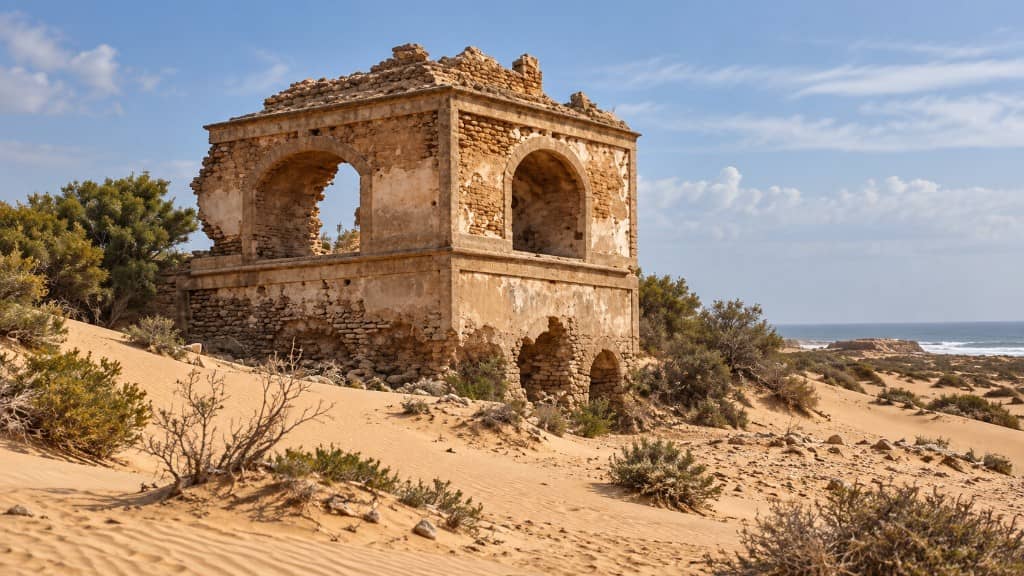
The ruins of Dar Sultan Palace sit partly swallowed by coastal dunes just outside the village of Diabat, roughly 5km south of Essaouira. Built around 1780 for Sultan Mohammed ben Abdallah, the crumbling white walls and wind-sculpted arches are free to visit at any hour, though the walk there is half the point.
Quick Facts
- Location
- Near Diabat village, south of Oued Ksob river, ~5km from Essaouira medina
- Getting There
- 35–60 min beach walk from Essaouira, or taxi from city ~MAD 30–50 (10–15 min); from airport ~MAD 80–120 (20–25 min)
- Time Needed
- 1.5–3 hours including the walk; 30 min at the ruins themselves
- Cost
- Free – no ticket booth, no entry fee
- Best for
- Photography, history lovers, sunset walks, off-the-beaten-path exploration
What You're Actually Coming to See
The Ruins of Dar Sultan Palace are not a manicured heritage site. There are no information panels, no ticket booth, no guardrails. What you find is a large, partially sand-buried stone structure with crumbling arched doorways, roofless chambers open to Atlantic sky, and walls that have been softened into curves by two-and-a-half centuries of salt wind. It is eerie, photogenic, and strangely peaceful – a place that rewards wandering slowly rather than ticking off.
The palace sits on slightly elevated ground above the coastal dunes near the village of Diabat, with views toward the Atlantic to the west and the Oued Ksob river to the north. In the distance, on a clear day, you can see the outline of Essaouira's medina walls. The landscape here is wide and sparse: scrubby vegetation, sand blowing across cracked plaster, and the faint smell of sea and dry earth. It does not feel remote, but it does feel untouched.
💡 Local tip
Wear closed shoes with good grip. The ground around the ruins is a mix of loose sand, broken stone, and uneven earthen floors. Sandals work on the beach walk but become awkward once you're climbing over rubble inside the structure.
History: A Sultan's Retreat at the Edge of the Atlantic
Dar Sultan, also written as Dar Soltane or Dar Es-Sultan, was built around 1780 as a royal residence for Sultan Mohammed ben Abdallah, who reigned over Morocco from 1757 to 1790. This is the same sultan credited with founding modern Essaouira, commissioning the city's famous fortified medina and its sea-facing ramparts through French architect Theodore Cornut. The palace at Diabat was conceived as a retreat from court life, positioned at a deliberate distance from the city walls.
After Mohammed ben Abdallah's reign, the palace continued to function as a royal and administrative residence. Moulay Abderrahmane, who governed and eventually ruled Mogador (the city's former European name) between 1822 and 1858, used it to receive visiting dignitaries. By the late 19th century, the structure had fallen into disuse. Wind-driven sand began to bury the lower sections of the building, a process that has continued steadily. Today, parts of the outer walls and interior arches remain standing, but much of the ground-floor detail has been swallowed.
For visitors wanting to understand the full arc of Essaouira's 18th-century history, the palace connects directly to what you can see in the city itself. The Skala de la Ville and the Skala du Port were built during the same reign. Visiting Dar Sultan adds a quieter, less-visited footnote to the same royal story.
The Walk from Essaouira: Beach, River, Dunes
Most visitors reach the palace on foot from Essaouira, and this journey is worth treating as part of the experience rather than a commute. The route takes you out through Bab Sbaa, one of the medina's southern gates, and down onto the long sandy beach. From there it is a roughly 5km walk south along the shoreline, with the Atlantic breaking to your right and the dunes building on your left.
The Oued Ksob river mouth must be crossed before reaching Diabat. In summer and during dry periods, this is typically a shallow wade or a simple crossing on exposed sand bars. After heavy rain or in winter months, the river can run deeper and wider – not impassably so, but enough to soak your feet and ankles. Check conditions if you are visiting between November and April. Some travelers roll their trousers up; others accept wet feet. A local guide familiar with seasonal variations can be useful.
The beach itself is part of the draw. Essaouira's main beachEssaouira’s main beach, and the walk south takes you progressively away from the kitesurf crowd and into quieter stretches of sand, where you are likely to pass nothing but a few fishing nets and the occasional horse from one of the local stables.
⚠️ What to skip
If you plan to walk both ways via the beach, budget 3–4 hours total. The return walk heading north into the prevailing Atlantic wind can feel significantly harder than the outward leg. Some visitors take a taxi back from Diabat village to avoid this.
How the Ruins Change by Time of Day
Early morning, before 9am, the site is almost always empty. The light is soft and raking across the pale stone walls, and the only sounds are wind moving over the dunes and distant Atlantic surf. This is the best time for photography: the shadows inside the ruined chambers are long and dramatic, and the sand has often been smoothed overnight into clean, untracked surfaces.
Midday, particularly in summer, brings strong overhead light that flattens the structure and intensifies the heat. The ruins offer almost no shade. If you are visiting in July or August, the combination of sun and wind can be exhausting by noon. The site is also most likely to have other visitors at this time, including small tour groups from Essaouira.
Late afternoon into sunset is widely considered the most atmospheric window. The western-facing walls catch the low Atlantic light and turn a warm amber, while the shadows lengthen and the breeze often drops slightly compared to midday. The Oued Ksob crossing in fading light can be trickier to navigate, so plan to leave the ruins at least 45 minutes before dark.
Practical Walkthrough: Navigating the Site
There is no formal entrance to the Dar Sultan ruins. The structure is unfenced, and you simply walk up to and into it from whatever direction you approach. The outer walls enclose a series of roofless chambers and open courtyards at different levels, connected by partially collapsed doorways and eroded staircases. The scale is larger than it appears from a distance: visitors often underestimate how much ground there is to cover.
Move carefully through the interior. Some of the floor surfaces are stable compacted earth; others are loose sand over rubble. Overhanging masonry, while visually spectacular, means you should stay aware of what is above you and avoid leaning against walls that show signs of instability. The site has no maintenance staff or safety fencing.
Diabat village itself, visible below the dunes, is a small traditional settlement worth a brief walk-through after visiting the ruins. There are a few cafe-style spots in the village, though availability can be inconsistent outside peak months. The village is also the starting point for exploring the wider Diabat area, which includes views back toward Essaouira and access to the coastal dune landscape.
Photography: What to Aim For
The structural composition of Dar Sultan rewards patient photography. The most compelling shots tend to come from inside the ruined chambers looking outward through arched openings, framing sky or distant sea. The contrast between decaying carved plaster and raw Atlantic light is the site's visual signature.
Wide-angle lenses work well for capturing the dune landscape and the palace's relationship to its surroundings. A 24-35mm equivalent is useful for the interior corridors. If you shoot in direct midday sun, the contrast between bleached walls and deep shadow is extreme and requires exposure care. Golden hour before sunset gives more manageable, warmer conditions.
The sand dunes immediately around the palace are part of what makes this location visually unusual for Morocco. If you want to explore further into the surrounding dune environment, Essaouira's sand dunesthe dunes.
Honest Assessment: Is This Worth the Trip?
Dar Sultan Palace is not a conventional tourist attraction, and that is precisely its value. There is nothing to read, nothing to buy, and nobody to guide you. What you get is unmediated access to a genuinely old and genuinely atmospheric ruin in an extraordinary coastal setting, for free. That is rare.
The effort of getting here is moderate but real. If you walk from Essaouira, you need to want the walk as part of the experience. If you take a taxi directly to Diabat village, the ruins are a short uphill walk from the road, but you miss the beach approach entirely.
Visitors who want a structured, interpreted heritage experience will find this frustrating. There is no historical signage. You bring your own knowledge or curiosity. For context before you go, the Mohammed ben Abdallah Museum in Essaouira's medina covers the history of the city and its founding sultan in more detail.
Anyone with significant mobility limitations should know clearly: the walk from Essaouira involves soft sand, a river crossing, and uneven terrain across the site itself. There are no adapted facilities of any kind. The ruins are not accessible for wheelchair users or those who cannot manage rough ground unaided.
Insider Tips
- Visit on a weekday morning in shoulder season (October, November, March, April) for the best combination of light, temperature, and near-total solitude. Summer weekends bring small tour groups that break the mood considerably.
- The river crossing at Oued Ksob can catch people off guard. In winter or after rain, wear shoes you don't mind getting wet, or bring sandals in your bag specifically for the crossing, then change on the other side.
- The ruins are sometimes called the 'White House' or 'Maison Blanche' by local guides. If you are asking for directions in Diabat village, either name is understood, though Dar Sultan is more widely recognized.
- There are locals near the site who may offer informal guiding. If you want to know the history in more depth, this can be worthwhile – agree on a price before you start. A short guided visit typically runs 30–60 minutes.
- Pack more water than you think you need. The combination of Atlantic wind and Atlantic sun is deceptive: you lose moisture faster than you feel thirsty, especially on the beach walk south.
Who Is Ruins of Dar Sultan Palace, Diabat For?
- Photographers looking for unusual light, texture, and architectural decay without crowds
- History-minded travelers who want to connect Essaouira's medina story to its wider royal past
- Beach walkers who enjoy a destination at the end of a long shoreline stroll
- Couples looking for a quietly dramatic and uncrowded place that feels genuinely off the tourist circuit
- Travelers with a half-day to spare who want something more contemplative than the medina
Nearby Attractions
Other things to see while in Diabat Village & Dunes:
- Essaouira Sand Dunes
About 15 to 20 km south of Essaouira, the Cap Sim sand dunes offer a rare chance to experience a Saharan-style landscape against an Atlantic backdrop. Free to access, open year-round, and surprisingly uncrowded, this natural site suits travelers looking for something beyond the medina walls.
Planning a trip? Discover personalized activities with the Nomado app.