Sanctuary of Truth Pattaya: The Wooden Temple That Will Never Be Finished
The Sanctuary of Truth is a colossal all-wood temple rising 105 meters, located on coastal land in North Pattaya in North Pattaya. Construction began in 1981 and continues today, which means every visit reveals something slightly different. Guided tours are mandatory, hard hats are required, and the sheer scale of the hand-carved woodwork is unlike anything else in Southeast Asia.
Quick Facts
- Location
- 206/2 Moo 5, Soi Naklua 12, Naklua, North Pattaya
- Getting There
- Grab taxi or private car recommended; ~20 min from central Pattaya. Street taxis available but negotiate fare in advance.
- Time Needed
- 2 to 3 hours including the mandatory guided tour
- Cost
- 500 THB per person (foreigners and locals); includes guided tour in English or Thai
- Best for
- Architecture enthusiasts, cultural travelers, photography, family day trips
- Official website
- sanctuaryoftruthmuseum.com
What Is the Sanctuary of Truth?
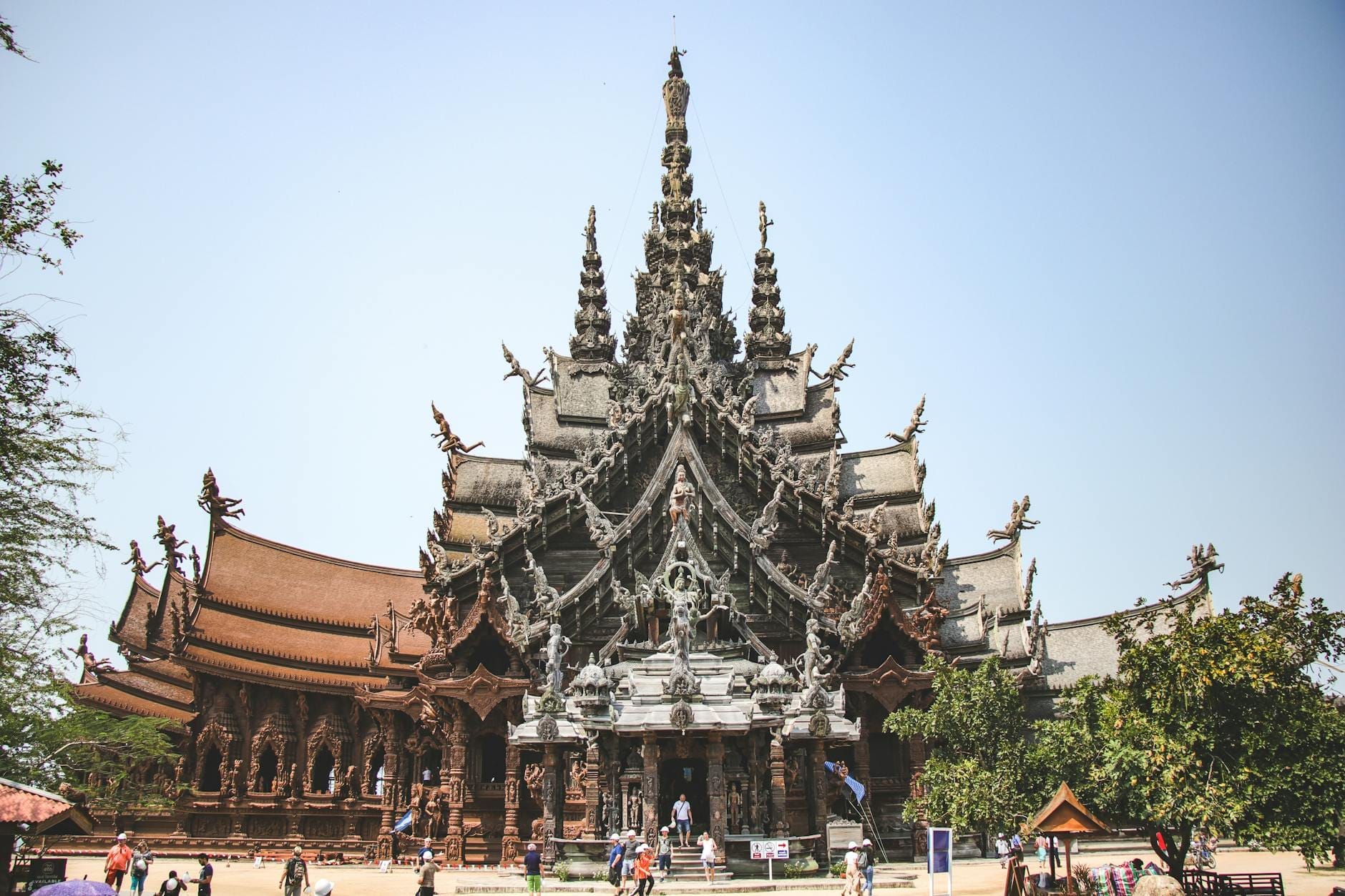
The Sanctuary of Truth, known in Thai as ปราสาทสัจธรรม (Prasat Sat Ja-Tam), is a fully hand-carved wooden temple-castle that has been under active construction since 1981. Thai businessman Lek Viriyaphan commissioned the structure as a philosophical monument to ancient wisdom, blending Hindu and Buddhist iconography with the architectural language of the Ayutthaya Kingdom. There is no concrete or steel inside: every surface, every column, every ceiling panel is carved from tropical hardwoods including Mai Deang, Mai Takien, Mai Panchaat, and teak.
At 105 meters tall, the tallest spire is taller than the dome of St. Paul's Cathedral in London. The building sits on 13 hectares of coastal land at Laem Ratchawet, with its base practically meeting the sea. From the entry gate, the structure looks almost impossible: four ornate towers converging into a single peak, every centimeter covered in carved figures of gods, nagas, apsaras, and mythological animals. It does not look like something still being built. It looks like something from a different century.
ℹ️ Good to know
Construction is ongoing and independent exploration is not permitted. All visitors must join a guided tour and wear a provided hard hat throughout the visit. This is non-negotiable and enforced at the entrance.
The Guided Tour: What Actually Happens
Tours depart regularly throughout the day between 8:00 AM and 6:00 PM, with an additional evening session from 6:30 PM to 8:30 PM. Groups are kept manageable in size. At the entrance you collect your hard hat, receive a brief safety briefing, and are assigned a guide who speaks either English or Thai.
The tour moves through the interior rooms and open galleries of the structure's 2,115 square meters of museum space, then out onto partially scaffolded exterior terraces where you can look up at workers chipping away at new panels overhead. The guide explains the cosmological meaning behind different carvings: the Hindu deities Brahma, Vishnu, and Shiva occupy specific quadrants, while Buddhist imagery dominates other sections, representing the belief that all great spiritual traditions share a common truth.
The scaffolding and construction noise are part of the experience, not a disappointment. Watching craftsmen carve intricate figures by hand, using techniques passed down from traditional Thai artisan schools, is genuinely arresting. Some sections show obvious age and weathering; others look freshly completed. The contrast gives the building an unusual, layered quality you do not get from finished monuments.
💡 Local tip
The morning tours, particularly between 8:00 AM and 10:00 AM, tend to have smaller groups and cooler temperatures. The coastal breeze is noticeably stronger in the morning, which helps when the humidity climbs.
Tickets & tours
Hand-picked options from our booking partner. Prices are indicative; availability and final rates are confirmed when you complete your booking.
Tuktuk Tour in Koh Sichang Island from Pattaya
From 106 €Instant confirmationFree cancellationIntroductory Group Muay Thai Boxing Lesson for Beginners in Pattaya
From 26 €Instant confirmationFree cancellationKoh Samet Island Self-Guided Tour from Pattaya
From 95 €Instant confirmationFree cancellationIntroductory private Muay Thai boxing lesson for beginners in Pattaya
From 79 €Instant confirmationFree cancellation
Architecture and Cultural Significance
The design draws most directly from Khmer and Thai Ayutthaya-era temple architecture, but Viriyaphan deliberately layered in iconography from Hindu, Buddhist, Taoist, and Brahmin traditions. The intention was to represent a unified philosophy of human existence rather than a single religion. Each of the four main towers faces a cardinal direction and is dedicated to a different aspect of this worldview: Heaven, Earth, Time, and the ocean-facing facade.
What makes the Sanctuary architecturally remarkable beyond its scale is the consistency of the craft. The carving is not decorative in a superficial sense: every figure has theological meaning, every pattern corresponds to cosmological symbolism documented in ancient manuscripts. The project employs traditional Thai woodcarvers full-time, and the ambition is that construction will continue indefinitely, making the building a living artwork rather than a completed structure.
For context on how this fits into Pattaya's wider cultural landscape, the city's other major spiritual sites offer very different experiences. The Big Buddha Temple is more accessible and openly navigable, while the Wat Khao Phra Bat gives a quieter, more conventional Thai temple visit. The Sanctuary of Truth sits in a category of its own.
How the Experience Changes by Time of Day
Morning visits offer the most comfortable conditions. The sun is low enough that it illuminates the eastern facades dramatically without flooding the open terraces with glare. The carved wood appears warmer in tone, and the scaffolding casts geometric shadows across the figurework that actually enhance the photography. Tour groups are smaller, and the construction crew is active but not at full capacity, so the ambient noise is lower.
Midday is the most crowded window, roughly 11:00 AM to 2:00 PM, and also the hottest. There is limited shade outside the interior sections of the tour. The coastal position means a consistent sea breeze, but on still days the heat index inside the wooden chambers can be significant. Bring water.
The evening session from 6:30 PM to 8:30 PM offers a completely different atmosphere. The exterior illuminated at night transforms the building: the warm amber lighting on the carved wood is striking, and the smaller crowds make the tour feel almost private. If photography is a priority, the evening session is worth the planning effort, though the interior details are harder to capture without a good camera.
⚠️ What to skip
Pattaya's rainy season runs from May through October. During heavy rain, outdoor sections of the tour may be restricted for safety. The experience is significantly reduced in a downpour. Check the weather forecast before booking.
Getting There and Practical Logistics
The Sanctuary of Truth is located in North Pattaya at Soi Naklua 12, roughly 20 minutes by car from central Pattaya and about 25 to 30 minutes from Jomtien Beach. The address puts it slightly off the main tourist circuit, which is part of why many visitors skip it entirely. That is a mistake.
Using the Grab app is the most straightforward option: the address is searchable and the fare is transparent. Street taxis work too, but agree on the price before you get in. Songthaews, the shared pick-up trucks that run Pattaya's informal transit network, do not reliably pass this far into Naklua territory. For an overview of how transport works across the city, the getting around Pattaya guide covers the options clearly. Parking is available on site if you are renting a scooter or car.
Wheelchair access is available, which is notable given the construction context. However, some exterior sections involve uneven surfaces and low-clearance scaffolding areas. Call ahead if mobility needs are specific.
Dress modestly: shoulders and knees covered is the standard expectation at Thai religious sites, and this applies here too. Comfortable closed shoes are recommended over sandals, particularly given the construction environment and scaffolded walkways.
Photography: What Works and What Doesn't
The Sanctuary of Truth is one of the most photogenic structures in all of Thailand, but it demands some thought. The sheer height of the building makes wide-angle lenses essential for exterior full shots. A 16-24mm equivalent on a full-frame camera, or the ultra-wide mode on a modern smartphone, will capture the full silhouette from the garden approach.
Inside, the carved detail rewards a macro or standard lens. The interlocking figures on columns and ceiling panels have extraordinary depth and complexity: close-up shots of individual carvings can be more compelling than wide interior shots, which tend to lose focus. Natural light enters through open gallery sections; avoid flash on carved wood surfaces as it flattens the relief detail completely.
Tripods are generally not permitted during busy hours and would be impractical anyway in tour-group conditions. The evening session is an exception: with fewer people and slower movement through the space, a small tabletop tripod or a camera with strong image stabilization becomes genuinely useful.
Who Should Skip This Attraction
Travelers with very limited time who want to cover multiple Pattaya highlights in a single day may find the mandatory two-to-three-hour commitment difficult to justify. If your itinerary already includes Nong Nooch Tropical Garden or a day trip to Koh Larn island, the Sanctuary of Truth may be one visit too many. It is also not well-suited for very young children: the hard hat requirement is fiddly with toddlers, the tour is long and verbal, and the scaffolding environment creates genuine hazard anxiety for parents.
People who find religious iconography confusing or off-putting without a strong interest in the historical and philosophical context behind it may feel the tour moves slowly. The guide covers a lot of symbolic explanation, and if that is not interesting to you, 90 minutes of carved wooden figures becomes a long walk.
Insider Tips
- Book the 8:00 AM opening slot on weekdays. Tour groups from organized excursions tend to arrive between 10:00 AM and noon, so early arrivals get a near-private experience with smaller groups and better light on the eastern facades.
- The evening session (6:30 PM – 8:30 PM) is separately ticketed and sees far fewer visitors than daytime slots. The illuminated exterior at dusk is exceptional for photography and the guided commentary is identical, so there is no information trade-off.
- Look up at the ceiling panels inside the main hall. Most visitors focus at eye level on the columns and friezes, but the overhead carving is some of the finest work in the building and almost universally ignored.
- The coastal position means the structure is exposed to salt air and sea wind year-round. Some sections of original carving from the early construction years show beautiful weathering and patina. Ask your guide which panels date from the 1980s: the comparison with newer work is genuinely instructive.
- Remove this tip or verify with attraction directly. Confirm the current show times at the ticket counter when you arrive.
Who Is Sanctuary of Truth For?
- Architecture and design enthusiasts who want to understand Thai and Khmer building traditions
- Cultural travelers looking for something with genuine philosophical depth beyond standard temple visits
- Photographers with an interest in texture, scale, and dramatic religious iconography
- Families with children aged 10 and above who can engage with a guided explanatory tour
- Repeat visitors to Pattaya who have already covered the beach and nightlife circuit
Nearby Attractions
Other things to see while in North Pattaya & Naklua:
- Anek Kusala Sala (Viharn Sien)
Built in 1987 to house a remarkable gift to the Thai royal family, Anek Kusala Sala — also known as Viharn Sien — holds one of Southeast Asia's most concentrated collections of Chinese art outside China itself. terracotta warrior replicas, Taoist mythological scenes, and intricate bronzework fill a three-story hall on grounds that feel genuinely removed from Pattaya's coastal noise.
- Max Muay Thai Stadium
Max Muay Thai Stadium in North Pattaya hosts live Muay Thai bouts every night of the week, drawing serious fight fans and curious first-timers alike. With a capacity of around 2,000, it strikes a balance between spectacle and intimacy that larger Bangkok arenas rarely manage.
- Mini Siam
Mini Siam compresses Thailand's greatest monuments and Europe's iconic landmarks into a single open-air park on Sukhumvit Road. Opened in 1986, the park spans over 46,000 square meters and displays more than 100 replicas at 1:25 scale. It is a calm, walkable experience that rewards curious travelers and families with young children.
- Wat Khao Phra Bat
Perched on Pratumnak Hill in south Pattaya, Wat Khao Phra Bat (วัดเขาพระบาท) offers a rare combination of genuine religious atmosphere, an 18-metre standing Buddha, and panoramic views across Pattaya Bay. Entry is free, crowds are thin, and the experience feels a world apart from the beachfront below.